

Product Details




价 格Negotiable
最小起订0 Piece库存0 Piece
 Business Card
Negotiable

¥190000.00

¥190000.00

Negotiable
 Fully Automatic Viscosity Meter
Negotiable
Fully Automatic Viscosity Meter
Negotiable
 Mixing Valve
Negotiable
Mixing Valve
Negotiable
 Fully Automatic Viscosity Meter
¥190000.00/Piece
Fully Automatic Viscosity Meter
¥190000.00/Piece
 Fully Automatic Viscosity Meter
Negotiable
Fully Automatic Viscosity Meter
Negotiable
 Melt Index Instrument
Negotiable
Melt Index Instrument
Negotiable
 Fully Automatic Viscosity Meter
¥190000.00/Piece
Differential Pressure Moisture Me
Negotiable
Fully Automatic Viscosity Meter
¥190000.00/Piece
Differential Pressure Moisture Me
Negotiable
 Fully Automatic Viscosity Meter
¥190000.00/Piece
Fully Automatic Viscosity Meter
¥190000.00/Piece
 Fully Automatic Viscosity Meter
¥190000.00/Piece
Fully Automatic Viscosity Meter
¥190000.00/Piece
 Fully Automatic Viscosity Meter
¥190000.00/Piece
Fully Automatic Viscosity Meter
¥190000.00/Piece
Operation Guide
To ensure safe use, it is essential to thoroughly comply with this guide, in addition to carefully reading the instructions!
Prevent the silicone oil from rising up into the horizontal pipe C in the U-shaped tube.
1. The valve J on the left must open first before the middle valve G; the necessity for closing the middle valve G is that the left valve J must already be closed. Additionally, pay attention to temperature changes during the initial operation. In case of any abnormal rapid changes, the middle valve should be opened promptly.
Before vacuum release, first open the middle valve G, then gradually open the left valve J.
During testing, the operator should monitor the liquid level change in the U-shaped tube L. If one side of the liquid level rises towards the horizontal tube, the middle valve G should be opened promptly.
II. Prevent Vacuum Pump Oil Overflow
After vacuum extraction, close valve J on the left. Before disconnecting the power to the vacuum pump, the exhaust valve F must first be opened to connect the vacuum pump to the atmosphere.
Between the vacuum pump and the U-tube assembly, a round buffer bottle must be inserted in the vacuum hose to prevent the accidental entry of vacuum pump oil into the U-shaped glass device, which could cause trouble.
III. Prevent Shattering of Glassware
If inserting into a vacuum hose, the glass fitting must be coated with vacuum grease in the middle.
2. Never pull vacuum hoses directly from glass fitting connections; instead, cut the hose and remove it.
3. Handle the test tube with care, apply a sufficient amount of vacuum grease at the opening, and twist it on in one direction for several turns. When lifting the furnace, ensure the center position aligns with the test tube.
Section 4: Preventing Gas Leaks
The plug and valve body are mated for grinding, so it is essential to ensure that their numbers match.
2. Over time, the vacuum grease at the valves hardens, reducing air tightness; it should be reprocessed: clean the valve and reapply vacuum grease, then rotate the valve handle 50-100 turns in one direction (it must be!! and must also be this direction during normal operation!!).
Always handle with care, gently lift and place to prevent breakage.
V. Prevent Sample Temperature Increase During Vacuum Extraction
When adding the sample to the tube and connecting it to the test apparatus (pressure difference tube), and while vacuuming, the bottom of the tube is close to the heating cylinder. To avoid heat radiation convection affecting the test accuracy, please place the circular hollow insulating plate on the heating cylinder before vacuuming and while the heating cylinder has not yet risen.
Section 6: Heat Transfer Oil Replacement
After a period of use, thermal oil tends to evaporate and age, so it is important to clean and replace it in a timely manner to prevent the oil from hardening. This could cause the test tube to fail to float in the thermal oil during the heating chamber's up and down movement (as shown in Figure 4), resulting in lifting and lowering blockages, or even damage to the glass apparatus.
SF-1 Differential Pressure Moisture Measurement Device
User Manual
Methods for determining trace moisture in common plastic pellets include differential pressure, electrolysis, and Karl Fischer methods, among others. The differential pressure method for moisture measurement, with its advantages of speed, accuracy, ease of operation, and low cost, is widely used in intermediate processes of the chemical fiber and plastic industry, particularly in the measurement of trace moisture content before melt spinning of polyester chips, nylon 6, nylon 66 pellets, and others, which has a direct and significant impact on spinning quality after drying. It is also applicable to general trace moisture measurement of nylon 6, nylon 66 pellets, and plastic resins. Currently, there is no complete set of equipment available in China, and customers must custom-order and manufacture them, which is quite麻烦. This device refers to methods from national and international standards (see Appendix) and the usage habits of many domestic manufacturers, assembling a complete set that provides considerable convenience and testing assurance to users.
The differential pressure moisture measurement device is suitable for determining trace amounts of moisture combined with the molecular structure of raw materials, but not for determining the equilibrium moisture between the raw materials and the environment. When the material contains moisture and is heated to melt, it will cause degradation of the material, resulting in a decrease in characteristic viscosity, which directly affects product quality. Generally, before spinning, the moisture content should be less than 0.03%. Therefore, the internal moisture content of the raw material must be measured by the differential pressure method after drying and before spinning. The moisture content of vacuum-packed plastics can also be measured using the differential pressure method.
The device measures a maximum water content of 1.5 mg.
When the sample contains a significant amount of volatile mixed substances other than water, attention should be paid to the reliability of the test results.
The testing method is based on GB12006.2 for the determination of water content in nylon, ISO 960-1988 (E) for the determination of water content in plastics - nylon (PA), and ISO 6188-1980 "Determination of water content in plastic - polyethylene terephthalate granules" (see Appendix).
Operating Principle:
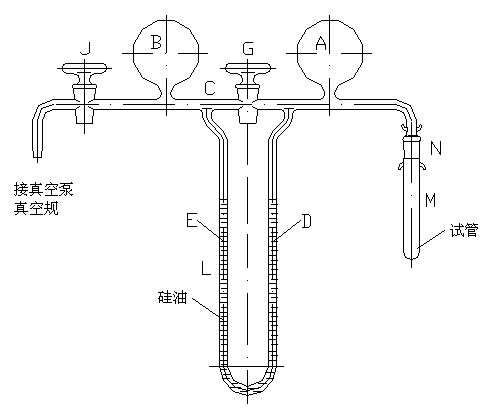
Figure 1
Figure 1 depicts a sealed system consisting of glass pipes, test tubes, and glass bulb A and B. In the U-shaped pipe L, a certain amount of silicone oil is present. With the valve G open, the system is evacuated to a high vacuum. If the system maintains good airtightness, closing valve G should result in equal pressures on both sides of the silicone oil's liquid surfaces D and E, with both surfaces at the same level. Should the right-side pressure increase due to any cause, the pressure at the right surface D will rise, causing the silicone oil level to fluctuate, with the right surface descending and the left surface ascending. If a moisture-containing substance is initially placed in the test tube, and its moisture can only be released under certain conditions (such as heating), then before reaching the moisture release condition, the pressures at surfaces D and E will be equal. Once the moisture release condition is met, the system's right...
Due to the effect of water vapor within the side pipe, the pressure increases, causing the D liquid level to rise and the E liquid level to drop. The pressure difference formed by the D and E liquid levels balances with the pressure of water vapor on the right. The more water vapor, the greater the pressure produced, and the larger the fluctuation in liquid levels. When the moisture content reaches a certain level, causing the water vapor pressure to reach the critical point of saturated steam, a portion of the water vapor recondenses back into water (in the form of mist or droplets), and the pressure no longer increases. The moisture content corresponding to this saturated steam critical point is also the maximum moisture content that the device may measure.
The moisture content determination using the pressure difference method employs the comparative method. Different known moisture contents are tested to identify the corresponding changes in the D and E liquid levels. Thus, when testing a substance with an unknown moisture content, the moisture content can be determined based on the different rises and falls of the D and E liquid levels.
Domestic manufacturers commonly use this method to measure the moisture content of polyester chips and nylon after drying. The general test temperature is:
| Polyester Chips | 220±5℃ |
| Polyamide 6, 66, 69, 610, 612 | 195±5℃ |
| Polyamide 11, 12 | 170±5℃ |
Structure:
Pressure difference moisture measurement device, mainly composed of the following measuring sections, as well as a vacuum pump, heating, and temperature control sections:
Measurement Section
The measurement section is as shown in Figure 2. This is a combination of glass structural components with a vacuum pump and vacuum gauge, requiring excellent airtightness for the entire structure. The vacuum pump ensures that the measurement section is maintained in a high vacuum state prior to testing.
2. Heating Section
Composed of a heater, a furnace chamber with a floating tube centering device, and a lift platform, the heating of the sample can be achieved by lifting the platform to insert the tube into the chamber.
The tube is inserted into the sleeve, which floats in the furnace. Therefore, even when the tube M is connected to the conical port N and becomes misaligned (which is unavoidable due to glass processing reasons), it can still be placed freely in the furnace. Heat conduction between the sleeve and the furnace is achieved through thermal oil (silicone oil) (see Figure 4).After a period of use, thermal oil may evaporate and age; it should be added and cleaned in a timely manner.。
3. Temperature Control Section
The temperature is controlled by a single-chip microcomputer. Set with a touch switch for higher temperature control accuracy.
Technical Specifications
Moisture Content: 5~500 ppm (when the sample weighs 3g)
30-3,000 ppm (when the sample weight is 0.5g)
Corresponding maximum moisture content measurable: 1.5mg
Temperature Range: Room Temperature to 250℃
Display Error ±3℃ (at 170℃, 195℃, 220℃)
Temperature Fluctuation ±2℃
Vacuum Degree ≤ 100 Pa
Power Supply: 220V 50Hz 2A
Rated Power: 0.35 kW
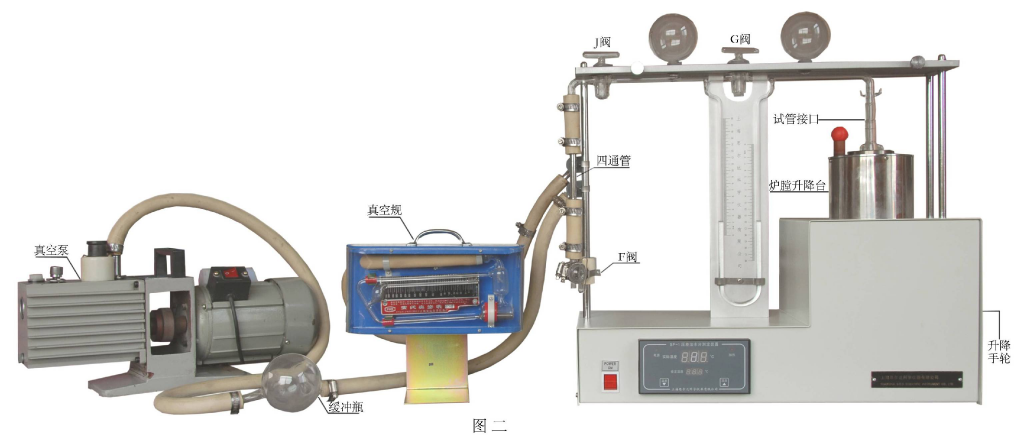
Figure Two
● Installation
Refer to Figure 2.
Connect the two unused joints of the four-way pipe with vacuum hoses and then connect them separately to the vacuum gauge and vacuum pump (via a buffer ball). Apply some vacuum grease at the connection points, insert the hoses, and then tighten them with clamps to prevent air leakage.
2. Remove the glass valve G, insert the plastic tube and extend it to one end of the U-shaped tube. Use a syringe to draw a small amount of methyl silicone oil and slowly inject it into the U-shaped tube until it reaches the 0 line mark (refer to Figures 2 and 3; it's already filled at the factory). Note that the injection should be slower as you get closer to the 0 line. If too much is injected, it will be more麻烦 to remove it. After reaching the desired level, let it sit for a while (about 1 hour) to allow the air in the oil to escape; the level may slightly drop. At that point, top it up as needed. Be careful not to let the silicone oil contaminate the parallel pipe C.
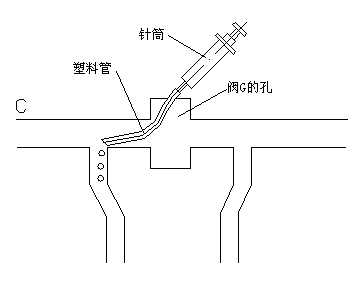
Figure 3
3. Apply vacuum grease to the sealing surfaces of plug G, J, and F. After inserting into the valve bore, continuously rotate in one direction until the plug mating surface is sealed reliably without leakage. The vacuum grease should not block the perforations in the plug.
Remove the pressure plate above the furnace chamber, take out the copper sleeve, and then add thermal oil (also use silicone oil). The oil level should be 5mm below the overflow point after placing it in the sleeve (the oil level will rise after heating).
The device is pre-set upon factory shipment. Should issues arise during transportation, please follow the aforementioned self-resolution procedures.
Seal Integrity Test
Upon completion of the installation, the airtightness test can be conducted.
On the outer side of the conical joint N on the glass assembly, apply a small amount of 7501 vacuum grease (high-temperature resistant). After fitting the conical mouth of the dried tube M, continuously turn it in one direction to ensure the seal is tight.
Open glass valve G, close valves F and J, start the vacuum pump, and then gradually open glass valve J to connect the vacuum pump with the entire glass system.Please ensure that the numbering of the glass valve plug and the valve body is not mixed up, as this will directly affect the vacuum level.
10 minutes later, place the vacuum gauge in the testing position, observe the vacuum level. If it has not reached 100 Pa, try again for a few more minutes.
Once the vacuum level is reached, close valves J and G sequentially. At this point, you may also open valve F, shut off the vacuum pump, and connect the four-way pipe section to the atmosphere.
First, close valve J, then close valve G. Make sure not to make a mistake. Otherwise, the silicone oil will instantly rush into the left section of horizontal pipeline C. Rotate valve
The direction of the seal should be consistent, and the movement should be slow and gentle.
Maintain for 1 hour, and the liquid level difference between the two oil planes on the L-shaped tube should be less than 2mm; otherwise, it is due to air leakage on one side, causing the liquid level on that side to drop. Carefully inspect for poor seals at the connections, check for cracks in the glass equipment, and pay special attention to any valve leaks. If necessary, clean and then reapply vacuum grease before attempting again.
Note: When replacing the silicone oil in the U-shaped tube, the instrument must be evacuated for several hours to de-gas the new oil; the same applies to new equipment or equipment that has been stored for a long time without use before being reused.
Calibrated
The purpose of calibration is to establish the correlation between the moisture and level difference (i.e., the difference in liquid levels in the U-tube) of this device, for reference during actual testing. Calibration is related to the glass equipment and the ambient temperature of the testing environment.
Accurately measure 4, 8, 12, 16, and 20mg (approximately) of sodium molybdate, place them in a test tube, and then set the tube aside in a desiccator for later use.
Turn on the moisture meter's power switch, set the temperature to 220±5°C, and wait for the temperature to stabilize.
Open Valve G.
Insert the test tube into the interface and seal it (apply 7501 vacuum grease, as follows).
Shut off valves F and J, start the vacuum pump, gradually open valve J, and evacuate to less than 100 Pa, as low as possible.
Sequentially close valve J and valve G, open valve F to connect with the atmosphere, and shut off the vacuum pump.
Note! After valve G is closed, closely monitor the pressure changes on both sides of the U-tube. If there is an excessive change in liquid level due to other reasons, quickly open the piston to check if the sample quantity is too much or if there is an issue with the airtightness.
Gently rotate the right handle clockwise to raise the pre-heated heating cylinder, allowing tube M to be inserted into it.
Maintain insulation for 10 minutes or until the liquid level difference indicated by the scale remains constant.
Read the liquid level change value of the U-shaped tube.
G valve should be opened slowly and steadily, followed by the J valve (make sure the order is correct at all costs).
Lower the heating cylinder and replace the pre-prepared sample for testing.
Represent the obtained data on a plan view:
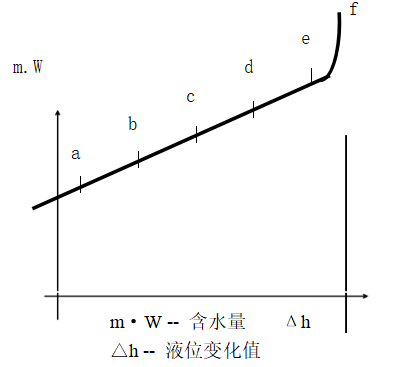
Visibly, the moisture content (m·w) on the left side of point e shows a linear relationship with the change in level (Δh), which can be represented by the coefficient K, i.e., the slope of the line. However, the line on the right curves, indicating that as the total moisture content increases, the change in level decreases, suggesting an oversaturated state of steam. The moisture content corresponding to point e is the maximum moisture content that the device may measure.
Calculate the coefficient K value of the linear segment:
The K-values made with different quantities should be consistent, as there is a linear relationship between water content and level difference. If the total water content increases, the total change in the liquid level decreases, indicating that an oversaturated steam state has been reached at this point.
In the formula: m: mass of the sample (g)
The moisture content (g/g) of each test sample (e.g., sodium molybdate) can be calculated based on the molecular weight.
△h: The change in liquid level inside the U-tube before and after heating (mm).
The moisture content (w) of each test sample is calculated using the following formula:
W(sample) = Molecular weight of water of crystallization / Molecular weight
For example: The molecular weight of sodium molybdate () is 241.92, and the molecular weight of the crystalline water is 36.

Calibration samples can also be made with sodium tungstate(), previously, copper sulfate() was more commonly used; accordingly, their water content is:


Only 4 can be released at the temperature shown in the experiment.
● Measure
The measurement method is similar to the calibration method:
Turn on the power switch of the moisture measurement device, set the temperature, and wait for the temperature to stabilize.
Open valves G and J, close valve F.
Place approximately 2g of the sample, precisely weighed, into a dry test tube (usually pre-loaded and kept in a desiccator), then insert the tube into the connector and seal it.
Shut off valve J.
Start the vacuum pump.
Gently open valve J, evacuate to less than 100 Pa, as small as possible.
Sequentially close valve J, valve G.
Attention! After valve G is closed, closely monitor the pressure changes on both sides of the U-tube. If there is an excessive change in liquid level due to other reasons, quickly open the piston to check if the sample quantity is too much or if there is an issue with the airtightness.
Open valve F to connect with the atmosphere and shut off the vacuum pump.
Increase the temperature-controlled heating cylinder, allowing tube M to be inserted into the cylinder.
Maintain the sample at a constant temperature for 10 minutes until the level difference indicated by the liquid level gauge remains steady.
Read the liquid level change value inside the U-shaped pipe.
Set down the heating cylinder, and if no further testing is required, turn off the heating power supply; slowly and steadily open the G valve, followed by the J valve (make sure to get the order right).
Remove the test tube.
Note: ①When testing the powdered material, slowly open the piston while vacuuming, and a thin layer of glass wool should cover the sample.
Cotton is pre-dried in an oven and then stored in a desiccator after cooling.
For samples with potentially high moisture content, pay attention to the liquid level gauge during the initial stages of the test. If the change in liquid level is significant, promptly open valve G, disconnect the heat source, reduce the sample, and then proceed with the test.
③If the change in level value is too small and difficult to read, you may increase the sample amount appropriately.
④ Each sample should be tested twice; if the results vary significantly, check for air leaks before proceeding.
● Calculation:
In the formula: K: Water Content Difference Coefficient (g/mm), determined by calibration.
Δh: Liquid level difference in U-tube before and after moisture release (mm)
Sample Quality (g)
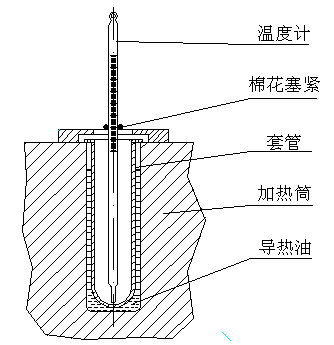
Figure 4
t-view: The reading observed on the thermometer.
T-rings: Environmental temperature, calculated as the midpoint of the exposed mercury column height.
②Actual Temperature Value: Actual Value = Indicated Value + Correction Value + Dew Diameter Correction Value
Shanghai Sirda Scientific Instruments Co., Ltd.

Phone Consultation