









THE PRODUCT DESCRIPTION ►∣Product Description:
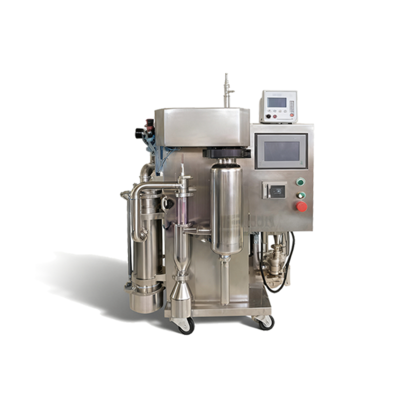
Spray Dryers, primarily used for producing trace particle powders in university and research laboratories, as well as in food, pharmaceutical, and chemical industry R&D labs, offer broad applicability to all types of solutions, including emulsions and suspensions. They are suitable for drying heat-sensitive materials such as biological products, biopesticides, and enzyme preparations. Since the material is only heated when it is atomized into mist-like particles, it undergoes a brief heat exposure, preserving the active components of these materials after drying without degradation.
THE MAIN CHARACTERISTICS
1. 7-inch touch screen operation control, full Chinese interface, PID temperature control for heating, allowing direct setting of import temperature and gas flow rate.
Automatic needle frequency, pump speed, for data collection and process monitoring and control. Features dual control mode: fully automatic and manual. The entire experimental process is dynamically displayed on a color touch screen (with animation).
2. The self-priming peristaltic pump draws the liquid sample from the container through a nozzle into the drying chamber. Simultaneously, compressed nitrogen enters the chamber from the outer casing to atomize the liquid particles. Heated nitrogen enters from the top to encounter the spray-coated particles, initiating the drying process. The dried powder is then separated from the exhaust gas in a cyclone separator and collected in a container. The气流 laden with organic vapor is cooled in a heat exchanger and the solvent condenses and is recovered in a refrigeration unit. The clean nitrogen is then returned to the next cycle.
3. The inert gas enclosed recirculating laboratory spray dryer will contain these toxic gases within the system and collect them in subsequent processes, reducing environmental pollution and benefiting environmental protection. It avoids the issue of toxic gas pollution during raw material production.
4. Explosion-proof closed-loop laboratory spray drying machines enable the material to circulate within a sealed drying system, preventing contact between organic solvent gases and external oxygen-rich air. This ensures safe production and effectively resolves the issues of flammability, explosiveness, and difficulty in drying for organic solvent materials.
5. Materials are dried and transported in an anti-oxidation environment within a closed-loop system, serving to isolate oxygen, thereby ensuring the quality of the drying production of easily oxidizable materials.
6. During the experiment, the spray nozzle sprays evenly without bias, preventing the spray from hitting the bottle wall and affecting the recovery rate. The nozzle can be moved up and down to alter the atomization position, thereby enhancing the spray drying effect. This spray nozzle is highly adaptable to high-viscosity materials, with rare occurrences of clogging.
7) Standard exhaust dust removal device, reducing environmental pollution while effectively increasing yields, especially for materials that are difficult to recover.
Technical Paper Dimensions
Material Handling Capacity: 20-2000 ML/H (varies with the solid content of the material)
2. Real-time PID temperature control technology with ±1℃ heating and temperature control accuracy.
3. Air Inlet Temperature Control: Max 250°C, Air Outlet Temperature: Max 140°C
4. Nozzle diameter: Optional in 0.5mm/0.7mm/0.75mm/1.0mm/1.5mm/2.0mm, and customizable upon request.
5. Entirely made of high-quality SUS304 stainless steel, featuring a two-fluid spray atomization structure. The spray, drying, and collection systems are all constructed with superior SUS304 stainless steel (with observation mirrors).
6. Total Power: 2KW / 220V
7. Spray drying suitable for aqueous and organic solutions