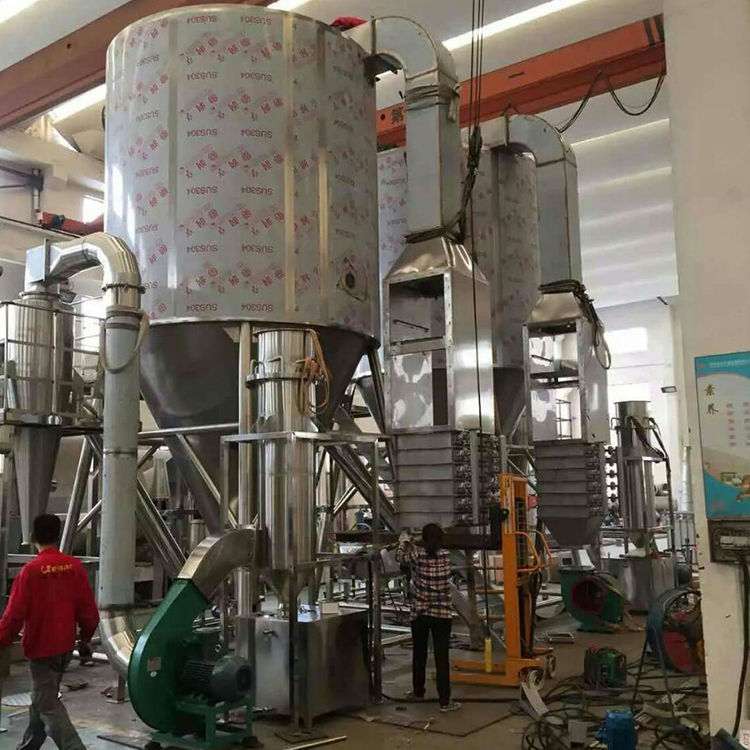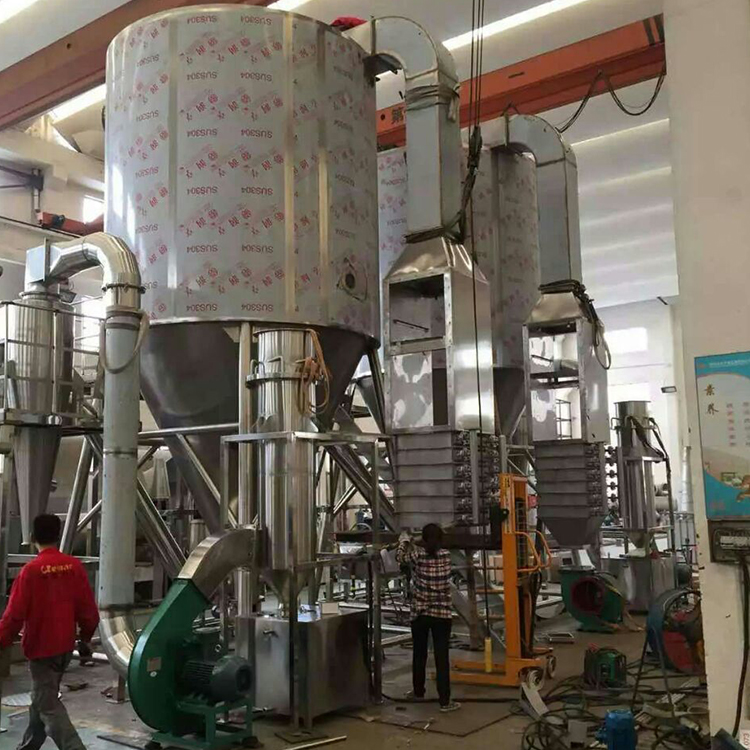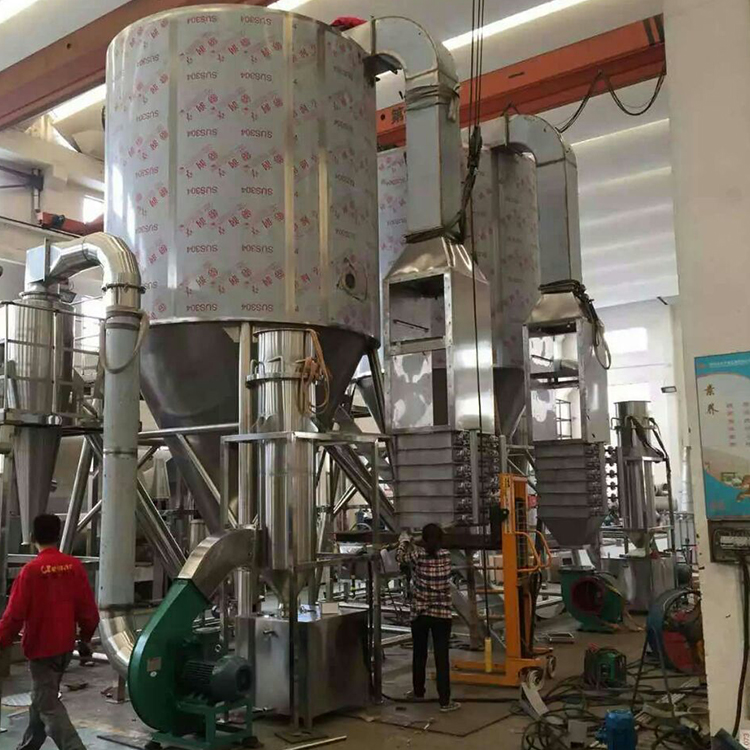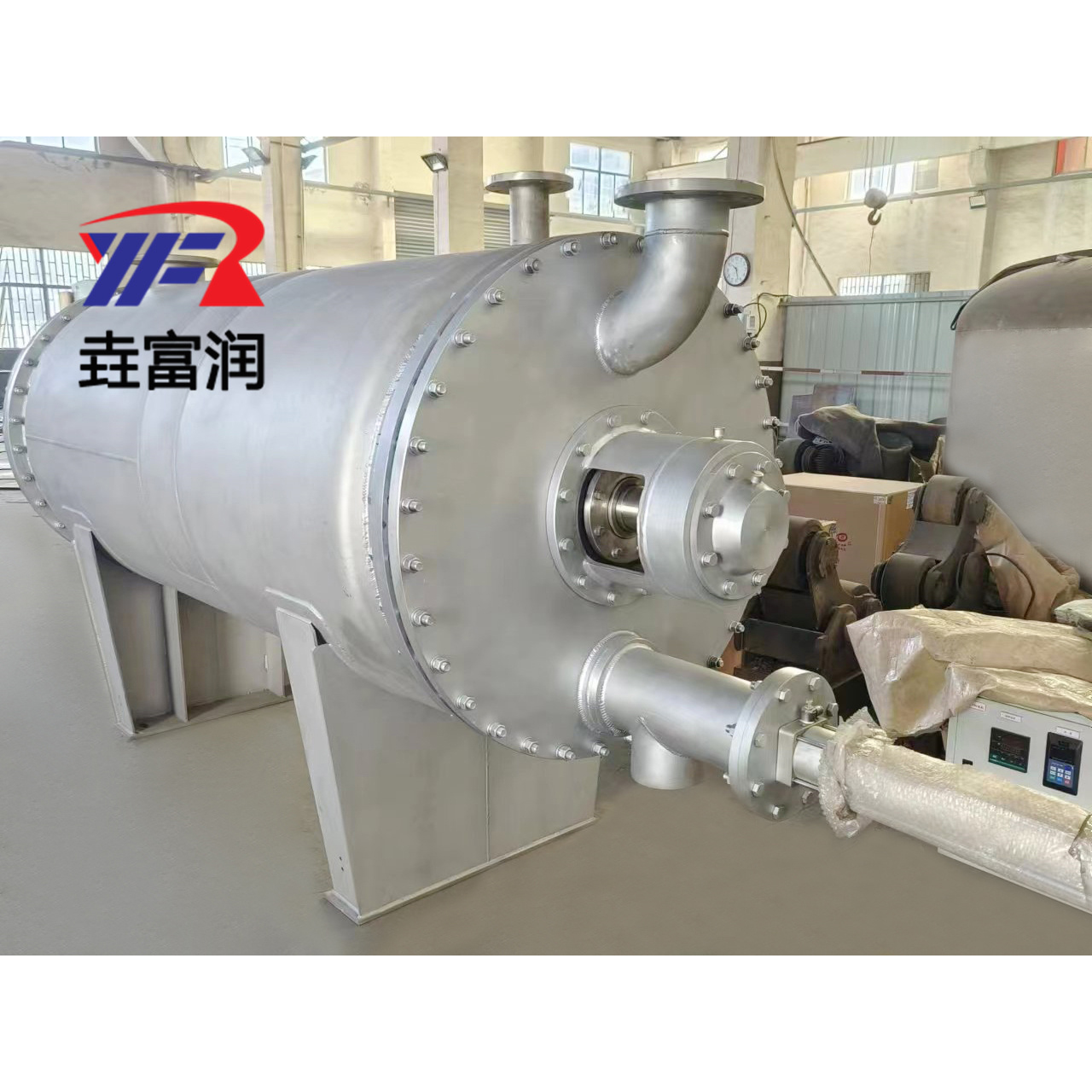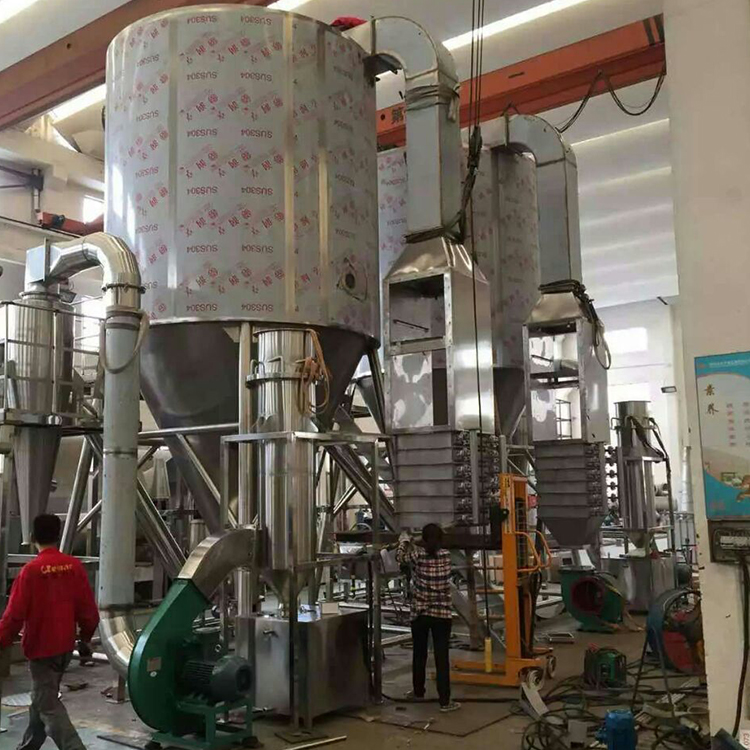

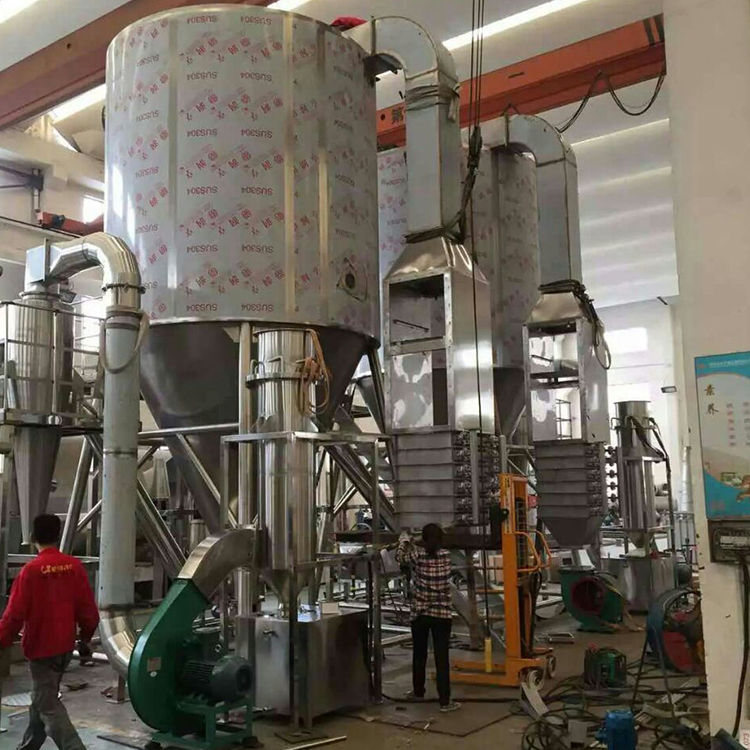
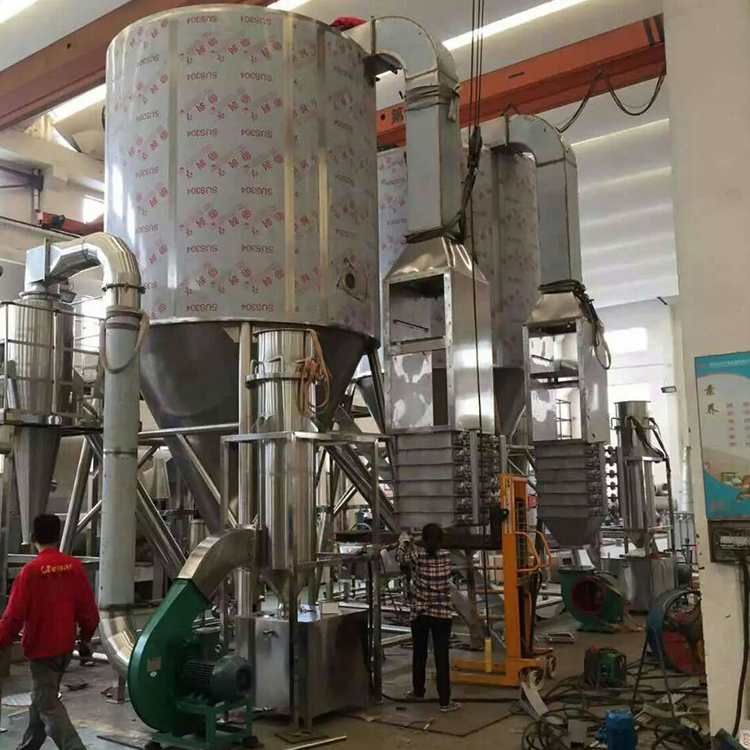








Product Introduction:
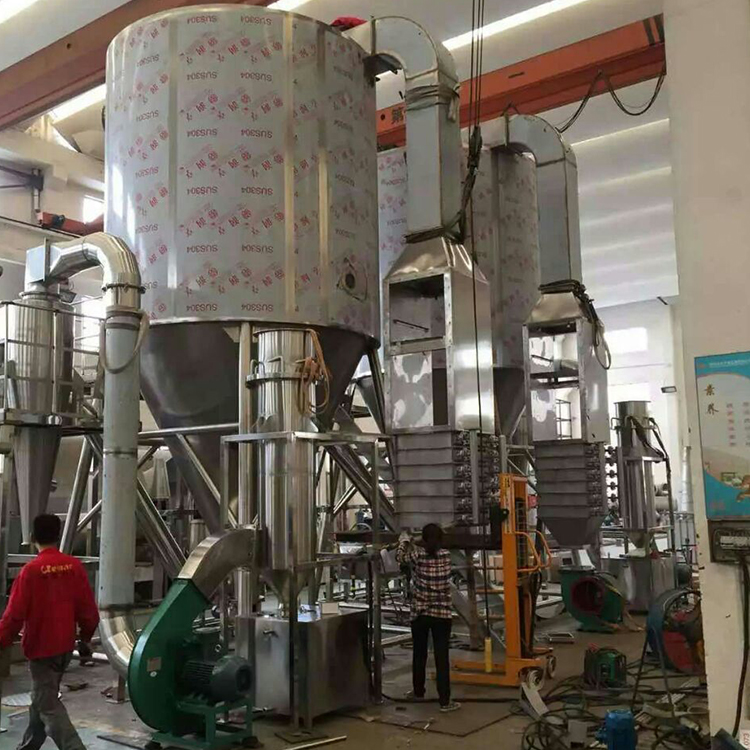
A spray dryer is a drying unit that uses an atomizer to disperse the material into a mist, allowing it to come into full contact with hot air for instant drying, resulting in a powdered finished product. The spray dryer mechanically disperses the material to be dried into very fine mist-like particles.(Increase water evaporation area to accelerate the drying process)Upon contact with hot air, most of the moisture is removed instantaneously, drying the solid material in the material into a powder. The spray drying process is completed in the air, allowing the dried material to maintain a spherical shape similar to the droplets, with good flowability, dispersibility, and solubility.
Spray dryers are commonly used for processing wet content.40%—90%The solution can be dried into a powdered product in a single dryer, significantly reducing production processes and simplifying the manufacturing flow. The particle size, bulk density, and moisture content of the product can be adjusted within a certain range by changing the operating conditions, making operation and control quite convenient.
The spray dryer operates as follows: After passing through a filter and a heating unit, air enters the hot air distributor at the top of the drying chamber. The hot air distributed evenly throughout the chamber spirals, while the liquid material is sent to a centrifugal spray nozzle mounted at the top of the chamber. The liquid is atomized into extremely fine droplets, significantly increasing the surface area of contact between the liquid and hot air, causing rapid evaporation of moisture and forming the dried product in a short time.
If the spray dryer is experiencing a serious issue with sticking to the walls during operation, the possible reasons may include:
1The incoming material volume is too large, leading to insufficient evaporation.
2Insufficient pre-heating of the drying chamber before the spray dryer's spray begins.
3When starting the spray, the material feed flow is too high; the added liquid is unstable.
For the various causes of the aforementioned issues, the following measures can be sequentially adopted:
1Reduce raw material intake moderately; increase the intake and outlet temperatures of the hot air moderately.
2At the beginning of the spray, the flow rate should be low, gradually increasing, adjusting until it reaches an appropriate level.
3Check for pipe blockages, adjust the solid content of materials, ensuring the fluidity of the liquid.
Product Specifications:
Project Parameters | 5 | 25 | 50 | 150 | 200-2000 |
Inlet Temperature (°C) | 140-350 Self-Control | ||||
Export Temperature (°C) | 80-90 | ||||
Water Evaporation Rate | 5 | 25 | 50 | 150 | 200-2000 |
Centrifugal spray head drive type | Compressed Air Transmission | Mechanical Transmission | |||
Speed (RPM) | 25000 | 18000 | 18000 | 15000 | 8000-15000 |
Spray Plate Diameter (mm) | 50 | 120 | 120 | 150 | 180-240 |
Heat Source | Electricity | Steam + Electric | Steam and electricity, fuel oil, gas, hot blast air | ||
Electric Heating Power (kW) | 9 | 36 | 72 | 99 | |
Dimensions (m) | 1.8×0.93×2.2 | 3×2.7×4.26 | 3.5×3.5×4.8 | 5.5×4.7 | Determine based on actual circumstances |
Dry Powder Recovery (%) | ≥95 | ||||
Note:
The amount of water vaporization is related to material characteristics, solid content, and the temperature of the hot air at the inlet and outlet. The data in the table is for reference only. Users can select the heating method based on local energy conditions and choose the dust collection method according to the material characteristics.