







Standards for Hazardous Building Evaluation
If your home has been around for about 30 years, it's important to determine whether it's a dilapidated building. Some houses may not be very old, but due to various reasons, they are no longer suitable for habitation. Such houses can also be considered dilapidated. So, how do we make a determination? Today, our editor will discuss the methods for identifying dilapidated buildings, ensuring we all have a safe and warm home.
1. Basic Standards. The independent column foundation is measured by a single column's basic unit; the strip foundation is by the single face length of a natural room; the full-red foundation is by the area of a natural room.
1. Walls are measured by one story high and one natural room face.
2. Poles are measured in units of one pole per one story high.
3. Beams, joists, rafters, etc., are priced by span and piece.
4. Prefabricated panels are measured by pieces, cast panels by area of a natural room.
5. Trusses are sold in units of one set.
Section II: Foundation, Basic Regulations.
1. If the foundation should slip, or if the bearing level is insufficient due to other reasons, it may cause uneven settlement, leading to significant distortion, displacement, cracking, tilting, and other conditions, with a tendency to worsen.
2. Increased load due to adjacent buildings' foundation or additional stories on its own, along with other human factors, cause settlement, which then leads to significant structural distortion, displacement, cracks, tilting, and an exacerbating trend.
3. Basic aging, corrosion, and breakage, etc., have led to significant distortions, displacements, cracks, and tilts in the house structure, with a tendency for further deterioration.
Other standards for hazardous building assessment
Section 1: Wall Column Specifications.
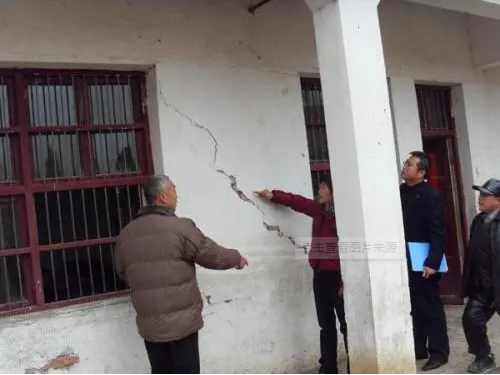
1. Cracks appear in the wall columns or protective layers fall off. The primary reinforcement is exposed, or there are significant horizontal cracks, crushing, and other conditions.
2. Significant interlaced cracks appear at the center of the wall, or accompanied by the falling off of the protective layer.
3. Columns and walls are crooked, with the crookedness exceeding 1/100 of their height.
4. Columns and walls with concrete spalling, carbonation, and bulging; the damaged area exceeds 1/3 of the total area, with the main steel exposed, severe rusting, and reduced cross-section.
Section II: Beam Specifications.
1. Single girder or the central part of a connected girder exhibits transverse cracking, either extending upwards to more than 3/2 of the girder's height, with the protective layer falling off. Accompanying are vertical cracks below.
2. Significant diagonal cracks appear at the ends of simply supported beams and continuous beams, while significant vertical or diagonal cracks are observed at the root of the cantilevers.
3. The frame beam exhibits significant vertical or diagonal cracks at the fixed end, or interlaced cracks appear.
4. There are significant vertical cracks appearing beneath the prefabricated panels.
5. Cracks appear around the edge of the tamping board or interlaced cracks appear beneath.
6. Various beams and plates exhibit deflection exceeding 1/150 of their span, and cracks in the tension zone are wider than 1mm.
7. Various board protective layers have fallen off, with over half of the main steel bars exposed, severe rusting, and reduced cross-section.
8. Pre-stressed prefabricated panels exhibit vertical through cracks; or the concrete at the ends is loose, exposing steel reinforcement, with a length exceeding 100% of the main reinforcement.