











Gasoline Vapor Recovery Overview:
Vapor recovery is the process of collecting vapors emitted during the storage and transportation of oil products, then concentrating and treating them through various techniques into liquid gasoline.
Our current technological approaches include condensation, adsorption, absorption, and membrane adsorption methods. We design combinations of these four individual methods to achieve oil and gas recovery based on specific needs. The most commonly used combinations are "condensation + adsorption + membrane" and "absorption + adsorption + membrane."
Oil and gas processing technology:

Condensation + Adsorption + Membrane
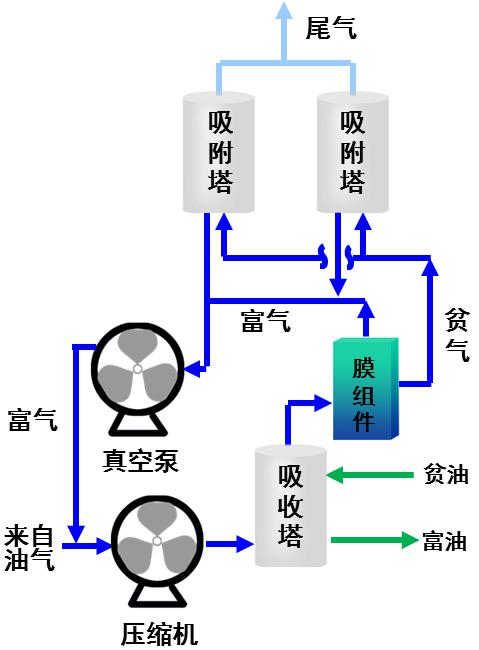
The oil and gas are pressurized by a booster (pressure controlled as needed between 0.1-0.7 MPaG) and preprocessed through a condenser (with condensation temperature typically maintained at 0-5℃). As the temperature drops, the vapor partial pressure in the condenser exceeds its corresponding saturated vapor pressure, causing most of the oil and gas components to condense into gasoline for recovery. Non-condensable gases enter the membrane system for further separation. Most of the oil and gas components pass through the membrane and concentrate on the downstream side. The enriched gas returns to the compressor inlet to maintain system balance. The un-permeated components, which still contain a small amount of organic substances, are usually reduced to around 1v% in concentration and enter the adsorption system for deep treatment to meet standards. Two adsorption tanks are set up, with the adsorbent desorption operation status switching automatically based on the adsorption time. The desorbed gas returns to the compressor inlet for iterative treatment. The tail gas from the adsorption tower outlet meets the emission standards.
Process Flow Diagram:
Process Features:
1) Suitable for medium to high concentration oil and gas.
2) High condensation temperature, the entire condensation system does not require defrosting, and operates stably.
3) The recovered liquid oil products can be directly observed, making the recovery effect intuitive.
4) Recycled oil products can be reused.
Absorb + Adsorb + Membrane
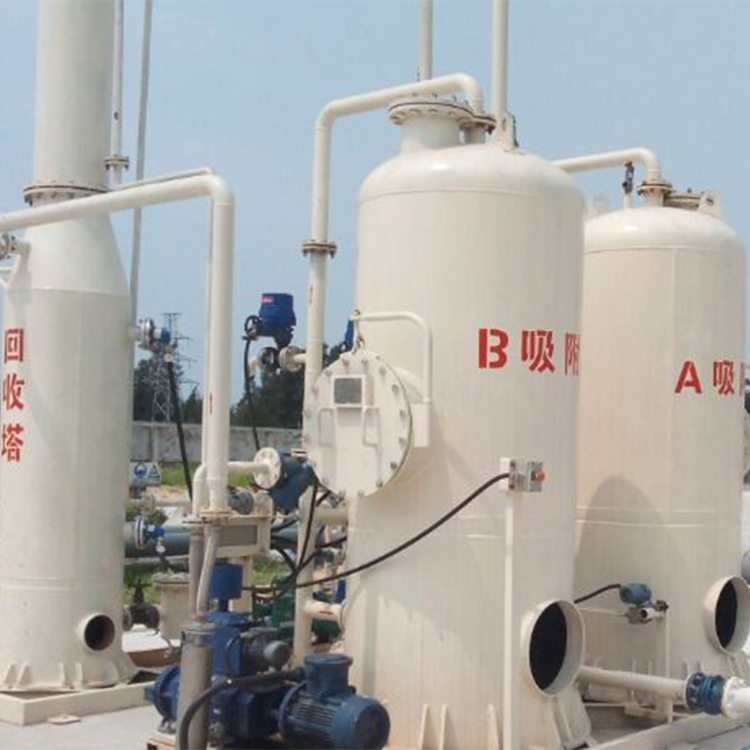
High concentrations of low-carbon hydrocarbon molecules are present in volatile oil and gas. Typically, the oil and gas are pressurized and pre-treated with absorption. The oil and gas enter from the bottom and exit from the top of the tower, while the absorbent enters from the top and exits from the bottom. Inside the absorption tower, most oil and gas molecules dissolve in kerosene or diesel, etc., heavy oils. Through the absorption tower, 60-80% of the oil and gas are absorbed, with a small amount of oil and gas components remaining in the overhead gas. The overhead gas then continues into the membrane system for further separation. Most oil and gas components pass through the membrane and concentrate on the downstream side. The concentrated gas returns to the compressor inlet to maintain system balance. The components that do not pass through the membrane still contain a small amount of organic substances, which are typically reduced to around 1v% and then enter the adsorption system for deep treatment to meet standards. Two adsorption tanks are set up, and the adsorbent regeneration operation is automatically switched based on the adsorption time. The regasified gas returns to the compressor inlet for reprocessing. The tail gas from the adsorption tower outlet is then达标emitted.
Process Flow Diagram:
| Serial Number | On-Site Information Category | On-Site Condition Description | Note | |
| 1 | Recovered Media | |||
| 2 | Equipment Inlet Concentration | |||
| 3 | Equipment processing capacity | |||
| 4 | Emission Standards | |||
| 5 | Equipment entry size | |||
| 6 | Loading Information | Oil yield | ||
| Loading method | ||||
| Charging pump flow rate | ||||
| Number of truck-loading pumps operating simultaneously | ||||
| Sealing Method | ||||
| Additional Information | ||||
| 7 | Tank Information | Tank Types and Capacities | ||
| Tank Temperature | ||||
| Inlet pump flow rate | ||||
| Is Nitrogen Sealed | ||||
| Other specifications | ||||
| 8 | Public Works Conditions | Recirculating Water | ||
| Instrument Wind | ||||
| Compressed Air | ||||
| Steam | ||||
| 9 | Special Customer Requirements | |||