








I. Introduction:
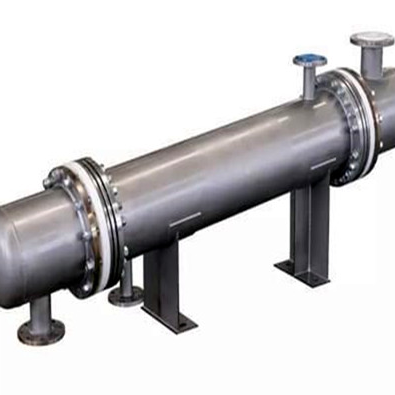
Cooling oil units are widely used in power systems as oil cooling equipment. They are also applicable to industries such as metallurgy, chemical engineering, mining, light industry, and heavy industry. Mainly used for circulating cooling in systems like equipment lubricating oil, variable speed system oil transformers, turbine oil, and grinding oil.
Currently, all domestically produced cool oilers follow a single model, which has many drawbacks after years of practice; they are large in size, have poor cooling efficiency, complex sealing, and are difficult to maintain. Our company has developed a new type of cool oiler that boasts excellent cooling performance, with the outlet oil temperature close to water temperature, simple structure, easy operation, and compact size.
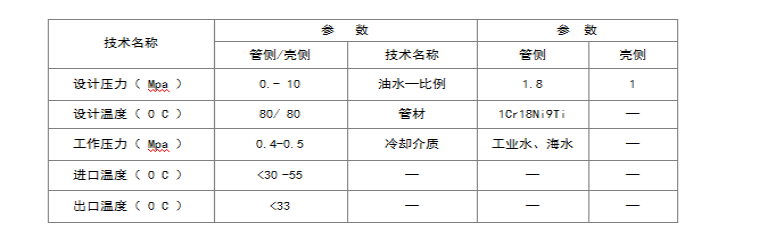
II. Technical Specifications:
III. Structural Features:
The new type of cooler produced by Lianyungang Huaneng Power Auxiliary Equipment Co., Ltd. features a simple structure, easy maintenance and disassembly, reliable sealing (oil and water isolation structure), compact size, and high heat exchange rate (the oil temperature at the outlet is close to the water temperature).
The heat transfer efficiency is 2-3 times higher than that of a plate-type cooler.
2. Low oil resistance: Due to the use of swirl guide plates, the oil enters in a tangential flow, which is conducive to fluid operation.
3. Long service life and easy installation/inspection: The heat exchange tubes have minimal thermal expansion stress, thus eliminating common issues such as tube expansion and leakage. Being still a tube-and-shell structure, installation and maintenance are convenient.
4. Utilize argon gas shielded welding in place of traditional expansion joints to eliminate leaks.
5. The oil-water separator employs a non-sealed structure, completely eliminating the phenomenon of oil and water mixing.
6. Employing a new heat exchange form, the oil and water run relatively, while utilizing the principle of lighter heat and heavier coldness of liquids, thereby enhancing heat exchange efficiency. This achieves a close temperature similarity between the outlet oil and water, generally >2-3°C. Additionally, the outlet oil temperature can be regulated using the cooling water valve.
7. Due to its advanced structure, the upper water chamber does not require an exhaust valve, making the operation of Huaneng's power auxiliary equipment simple.
8. Easy to maintain. Owing to its advanced structure and oil-free water-tight seals, the upper and lower water chambers can be easily opened for cleaning, making disassembly a breeze.
IV. Selection of Coolant Coolers:
When selecting a cooler, please inform us of parameters such as the cooling area.
1. Categorized by cooling tube form, there are LY type light tubes (commonly used) and LYC type finned types.
2. Cooled pipes are categorized into three types: carbon steel pipes (TP304, TP304L, TP316, TP316L), stainless steel pipes, and copper pipes (T2, HSN70-1, H63).
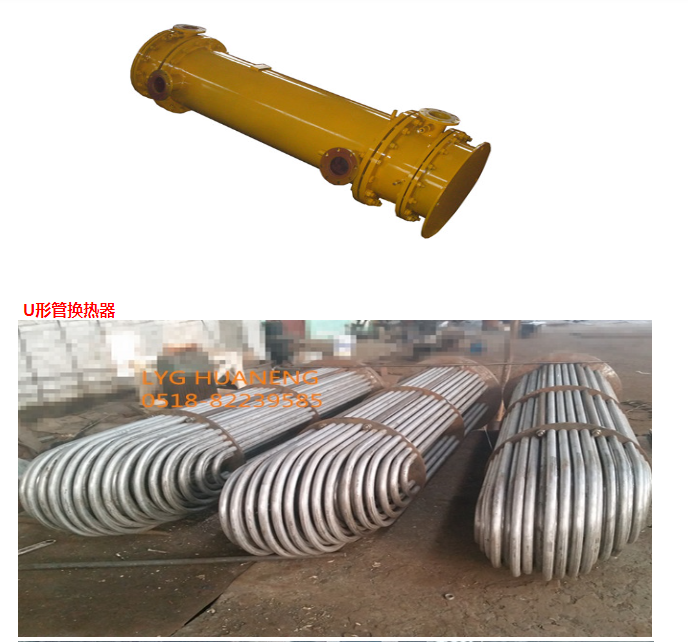
3. Structurally divided into fixed tube sheet, floating head, and U-tube heat exchangers.
4. Available in a range from 0.5 to 500 square meters in heat transfer area.
5. Available in vertical and horizontal installation types.
Select the appropriate option based on the specific occasion and performance requirements (or refer to the specifications we recommend for you).
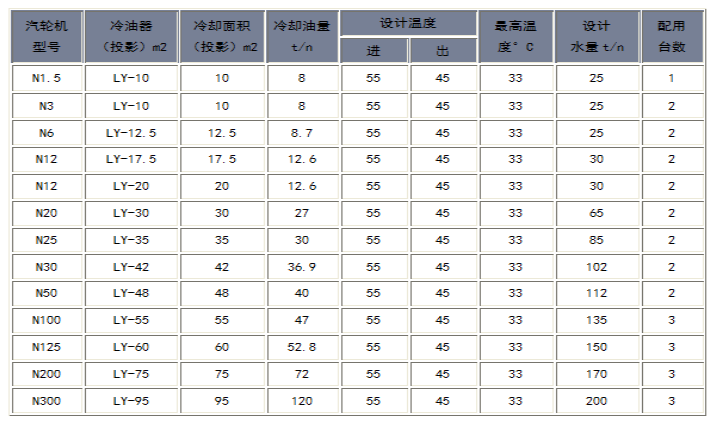
V. Refrigerant Cooler Model and Parameters (Select model based on actual operating conditions):