








Section 1: Analysis of Cooling Tower Noise Sources:
Cooling towers are mechanical equipment used in recirculating water systems to lower water temperature (typically 4℃-6℃, with industrial high-temperature cooling towers capable of dropping it to 10-15℃). Their operating principle is as follows: The cooling water in the bottom collection pool of the cooling tower flows down by gravity, then pumped into the condenser to absorb the heat released during the condensation of the refrigerant. This hot water is then discharged from the condenser and sent to the top of the cooling tower, where it is sprinkled into droplets and flows down through the packing material. As the hot water falls, it comes into contact with cooler air currents, facilitating heat exchange. At this point, some of the water evaporates, while the majority cools and returns to the collection pool.
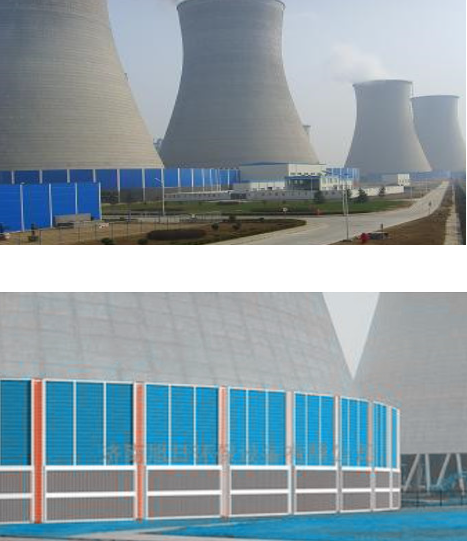
As the economy develops, factories, restaurants, hotels, office buildings, and karaoke halls spring up like bamboo after the rain. Particularly in the southern regions where the hot weather lasts long, installing a cooling tower is necessary for central air conditioning. In some industrial zones with a concentration of factories, it's not uncommon to see a single building equipped with a dozen or even twenty cooling towers. In mixed commercial-residential areas, companies are unable to place them on the rooftop or at the same level space, and thus have to place them on the ground. The strong noise and heat from the cooling tower exhausts often disturb residents, making it difficult for them to live in peace. Therefore, the noise issue of cooling towers has become a hot topic of environmental complaints. Analysis and spectral testing have identified that cooling tower noise originates from several aspects:
Fan Noise
It is the primary source of noise in mechanical ventilation cooling towers, which is aerodynamic noise, including turbulent and rotational noise. Theoretical analysis of the aerodynamic noise source indicates that the intensity of turbulent noise is proportional to the sixth power of the relative air velocity and is also related to blade shape, exhibiting continuous frequency spectrum characteristics. Rotational noise is generated by pulsations formed during blade rotation and is related to the number of blades, gas flow rate, static pressure, etc., with its frequency spectrum displaying narrowband low-to-medium frequency characteristics.
2. Spraying noise
Fan operation intake and exhaust noise, as well as spray noise, are radiated outward through the intake and exhaust ports and the tower body. Exhaust port noise is approximately 5-10 dB(A) higher than intake port noise, with a frequency spectrum predominantly consisting of low-frequency continuous sound, classified as low-frequency noise. The spray noise, generated when the recirculating hot water falls from the spray device and impacts the accumulated water in the tower base, is a high-frequency noise. The intensity of the spray sound is related to the height of the spray and the water flow rate per unit time.
3. Gearboxes and motor noise
The noise from reducers is primarily generated during gear meshing, while motor noise consists of electromagnetic and mechanical noise. Generally, these two noise sources have a negligible impact on the surrounding environment.
4. Pump Noise:
The pump is installed near the cooling tower to circulate cooling water, often resonating with pipes and emitting high-frequency, tuneful noises. If the noise is too intense, it requires joint treatment.
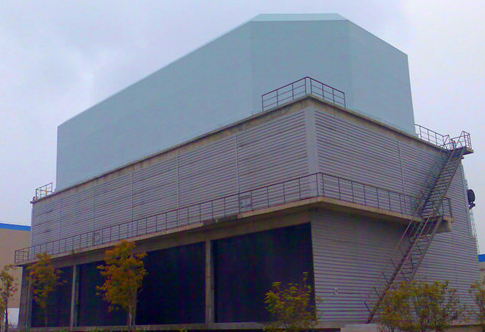
General noise control measures include:
Control the noise source of cooling towers, interrupt the pathways of transmission, and protect the victims. The noise from cooling towers affects the daily lives of residents, with a wide range of victims and high mobility. Measures to protect the victims are not feasible; only measures to control the noise source and interrupt the pathways of transmission can be taken. In response to the noise characteristics of cooling towers, the following treatment measures are adopted:
1. Replace standard motor blades with low-noise blades to fundamentally reduce the noise level at the source.
2. The exhaust air noise exhibits a continuous frequency spectrum characteristic; consider sound absorption treatment. Use waterproof sound-absorbing materials to create a silencing channel, achieving the purpose of noise reduction.
3. To prevent mechanical resonance and noise, the cooling tower is rigidly connected with vibration reduction treatment.
4. Add rapid filtration media to the water collection dish to reduce the noise of sprinkling.
5. Surround the tower and pump with waterproof sound-absorbing barriers to cut off the noise transmission paths.