








I. Overview of LS Salt and Drug Addition Unit Process:
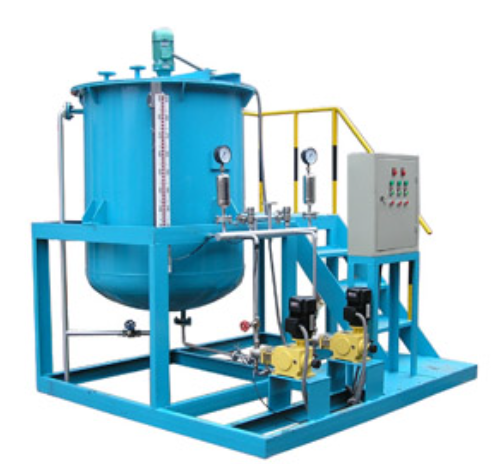
This LS salt dosing unit mainly consists of four parts: the drug solution preparation system, dosing system, safety system, and control system. Solid LS salt is added to the solution tank, then proportionally mixed with demineralized water or condensate water for dissolution, and added to the boiler drum by the dosing system. The dosing control can be manual or automatic, following the control signals from the higher-level system.
II. Process Principle of ls Salt Additive Device
Boiler feedwater calcium and magnesium hardness can undergo chemical reactions at high temperatures, or concentrate and crystallize, forming scale that is not soluble. This scale adheres firmly to the boiler's heat surfaces. It is a poor conductor of heat, which can impede heat transfer and, in severe cases, lead to boiler tube explosion. Additionally, it can induce and exacerbate the chemical corrosion of the metal beneath the scale, posing a significant risk. Although the boiler condensate and feedwater have undergone rigorous softening and desalination treatments, a small amount of calcium and magnesium hardness still enters the boiler water. If this hardness is not treated, it can also cause scaling that threatens the safe operation of the boiler. Currently, adding ls salt to the boiler water is the most suitable treatment method, with the following reaction:
10Ca2+ + 6PO43- + 2OH- = Ca10(OH)2(PO4)6 (Basic Calcium Phosphate)
Basic calcium carbonate is a soft sludge that is easily flushed out with boiler effluent and will not adhere to the pot to form scale.
Section 3: Introduction to the Functional Characteristics of the ls Salt Additive Device
This unit primarily consists of four components: the liquid medication mixing system, the dosing system, the safety system, and the control system. Solid ls salt is added to the medication solution tank, then dissolved by mixing with demineralized water or condensate in a proportional manner. It is subsequently added to the boiler drum by the dosing system. Dosing control can be manual or automatic, following the control signals from the upper-level system.
Section 4: ls Salt Additive Device Application Range:
Lianyungang Huaneng produces dosing systems including ammonia and hydrazine addition to make-up water, ls salt addition to boiler water, ammonia addition to condensate water, and dosing systems for circulating water treatment and wastewater treatment. The ls salt dosing system primarily consists of a control system, a mixing system, a chemical storage tank, a common platform, and a metering pump. The modular configuration is determined by the specific requirements of the user, with varying levels of automation (automatic or manual control), the selection of dosing pump types, flexible composition of various modular units, and installation on a base. This factory-assembled system is characterized by its compact structure, comprehensive equipment, quick installation, simple operation, and easy maintenance. The materials for the components of the ls salt dosing system modular assembly are mainly stainless steel, carbon steel, and lined carbon steel, which can be customized according to the user's needs. The company's performance covers industries such as water treatment, wastewater treatment, food, beverage, papermaking, textiles, dyeing and finishing, electroplating, chemical liquid addition, and chemical industries.