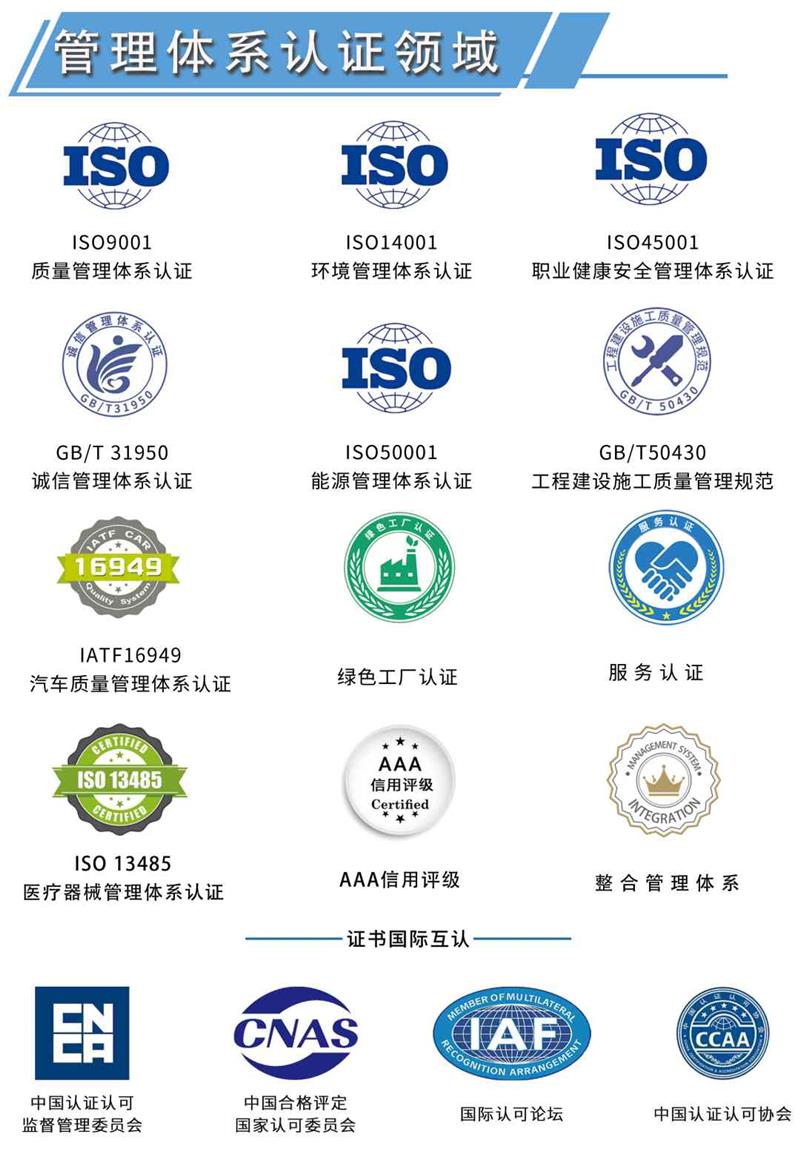








In accordance with current regulations, the audit plan must be submitted to the National Certification and Supervision Commission in advance.
The on-site audit team verifies and collects evidence of the audited organization's implementation and compliance with standards, applicable laws, regulations, and other requirements, as well as the organization's manuals, procedures, and other system documents.
The purpose of the intermediate review is to understand the planning, establishment, and operation of the organization's management system, preliminarily determine the scope of the review, and assess whether the conditions for conducting the second-stage audit are met; to verify if the management system complies with the certification standards and operates effectively, in order to decide on recommendations for certification registration, etc.
According to the ISO 14001 3.5 definition: An Environmental Management System is a component of an organization's overall management system, including organizational structure, planning activities, responsibilities, practices, procedures, processes, and resources required for establishing, implementing, achieving, reviewing, and maintaining environmental policy. It also encompasses management aspects such as the organization's environmental policy, objectives, and indicators.
The environmental management system can be described as: a planned and coordinated management activity with standardized procedures and documented control mechanisms. It is implemented through an organizational structure with clear responsibilities and obligations, aiming to prevent adverse impacts on the environment.
Principle 1: Commitment and Policy – An organization should establish an environmental policy and ensure commitment to environmental management within the environmental management system.
Principle 2: An organization should plan to achieve its environmental policy.
In the practice of ISO9001 certification audits, it is often found that many clients can self-identify issues such as internal audits, assessments, inspections, returns and exchanges, and complaints. They have also taken some measures, but many of these are merely superficial, addressing the issues at hand and only correcting the non-conformities. Post-audit, there are often recurring instances, such as surface oil污 on injection molded parts. Clause 8.5.2 of the ISO9001 standard clearly stipulates requirements for corrective actions. Not only should problems be addressed, but they should also be improved effectively. If resources are allocated to solve a problem, it should be resolved thoroughly. Effective problem-solving lies in eliminating the root cause of the issue.
All elements of the ISO 14001 Environmental Management System standard, including the control of significant environmental factors within the organization, and the extent to which objectives and indicators are achieved.
The environmental management system audit should ensure its objectivity, systematicity, and documentation requirements and should be conducted according to the audit procedures. The internal audit procedures should specify the following: the scope of the audit, which may include the geographical area, department, or system elements; the frequency of the audit, which should be determined based on the organization's own management status and external agency requirements; the methods of the audit, generally including reviewing documents and records, observing the site and operations, and conducting interviews with relevant personnel; the requirements and responsibilities of the audit team, such as the capabilities and responsibilities of the team leader and members; and the requirements and submission methods for the audit report and results. Before each audit, an audit plan (scheme) should be established, including personnel and time arrangements. The content of the audit should be based on the environmental importance (relevance) of the activities involved and the results of previous audits.
ISO9001 procedures and procedure documents. Procedures are the methods specified for completing an activity; the documents describing the procedures are called procedure documents; the procedure documents store the procedures, including source code and executable programs.
ISO 9001 Quality System Procedure Documents. These documents specify activities affecting quality; serve as supporting documents for the Quality Manual; should include all requirements and regulations of the elements adopted in the quality system; each quality system procedure document should address a logically distinct activity within the quality system.
One of the 81 indicators used to measure a country's innovation capability is the number of ISO 9001 quality management system certification certificates it has obtained.
According to the statistics of the National Certification and Accreditation Commission, currently, China has exceeded 450,000 ISO9001 certification certificates.
ISO9001 certification is hailed as the "passport to entering the international market." Currently, our country's ISO9001 certification certificates have exceeded 310,000, accounting for nearly 30% of the global total, ranking first in the world.
ISO9001 Quality Management System Standard is one of the influential standards issued by the International Organization for Standardization (ISO), which has been widely adopted globally since its release, significantly impacting the development of international trade and the enhancement of quality. ISO9001 certification has been extensively applied across various sectors of the national economy in our country, making a positive contribution to the improvement of enterprise quality management levels and market competitiveness.
WeChat Official Account

Scan to follow Official Account