










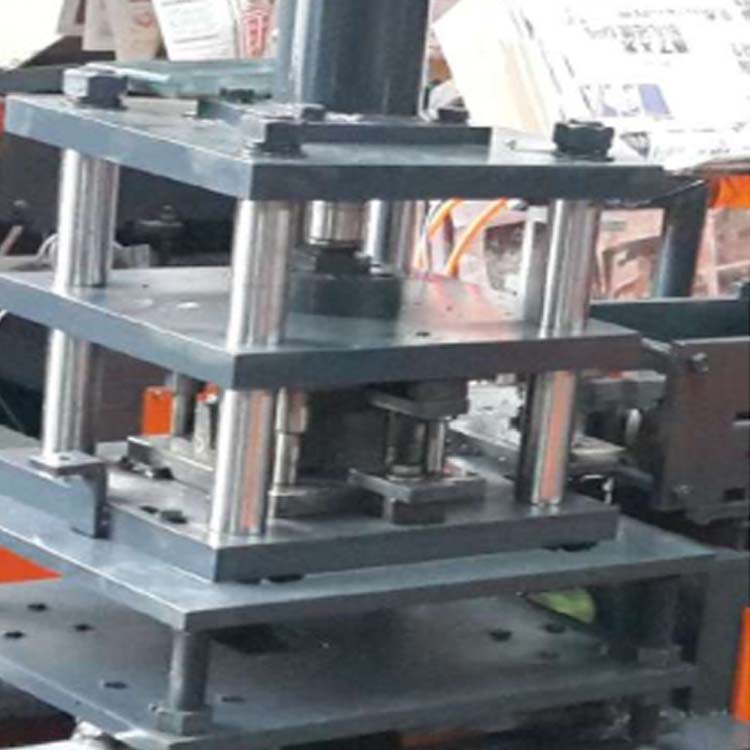
Cold Roll Forming Machine, Ball Bearing Guided Rail Machine Roller Design and Manufacturing Features:
1. Principle of average force distribution in each stage, even force distribution across all roller lines, balanced wear, and extended roller lifespan.
2. The use of C12MoV material for rolling mill rolls takes advantage of its wear resistance, but its specific strength and hardness are contradictory. During heat treatment, the red hardness of C12MoV must be utilized, and the hardness can only be achieved after two or even three tempering cycles following quenching.
3. The track arc section is the core part of the sliding track. After the initial forming of the arc during the first few passes, the formed arc should be effectively constrained during the subsequent folding of the vertical edge by using either the upper and lower roller or the cross roller. Otherwise, the arc position of the material will certainly change during the stretching process, with the radius (R) becoming triangular, the ball bearing not reaching the bottom, resulting in noise due to two-point contact. As the radius (R) increases, the track may vibrate when paired, causing the sliding track to operate with a blurred trajectory, uneven force distribution, deformation, and a shortened lifespan.
4. Rolling stability issue: Often encounter material lateral swing within the roller channel during production. It's actually due to the asymmetric force on a single roller set; the left side experiences more force, causing the material to swing to the right; the right side experiences more force, causing the material to swing to the left.