

Product Details
Jiangsu Jidingda Environmental Protection specializes in: sand and stone selection powder machines, three-separation vortex selection powder machines, sand and stone compound selection powder machines, fly ash selection powder machines, and twin-rotor selection powder machines.





价 格Negotiable
最小起订0 Piece库存0 Piece
 Business Card
Negotiable
Negotiable
Negotiable

Negotiable
 Bag dust collector for blast furn
Negotiable
Ceramic Powder Selection Separato
Negotiable
Grinding Mill for Slag Selection
Negotiable
Stone Powder Separator, Calcium P
Negotiable
Bag dust collector for blast furn
Negotiable
Ceramic Powder Selection Separato
Negotiable
Grinding Mill for Slag Selection
Negotiable
Stone Powder Separator, Calcium P
Negotiable
 Artificial (Mechanical) Sand and
Negotiable
Sifter
Negotiable
Artificial (Mechanical) Sand and
Negotiable
Sifter
Negotiable
 Pulse Jet Bag Filter
Negotiable
Pulse Jet Bag Filter
Negotiable
 Calcium Hydroxide Selection Mill
Negotiable
Calcium Hydroxide Selection Mill
Negotiable
 Improved O-Sepax Electrostatic Se
Negotiable
Improved O-Sepax Electrostatic Se
Negotiable
 Sand and gravel selection mill
Negotiable
Sand and gravel selection mill
Negotiable
· High-Efficiency Twin-Rotor Classifier Mill
·【Material Grain Size】≤0.5mm 【Production Capacity】20-400t/h
Application Fields
Cement powder grinding, sand and stone quarries, mining operations, coal mining, concrete mixing stations, dry mortar, quartz sand, etc.
Applicable Materials
Fly ash, stone powder, calcium hydroxide, calcium oxide, calcium carbonate, kaolin, river pebbles, granite, basalt, iron ore, limestone, quartz stone, dolerite, construction waste, iron ore, gold ore, etc.
Product Overview
Highlight Advantages
In the production of the powder industry, to enhance the efficiency of the selection system and reduce the energy consumption of the product, the circular flow powder grinding system is widely used. As an important component of this system, the performance stability of the selection mill directly affects the efficiency of the system. Therefore, the research and development of selection mills has always been a focus of scientific research institutions and industrial and mining enterprises.
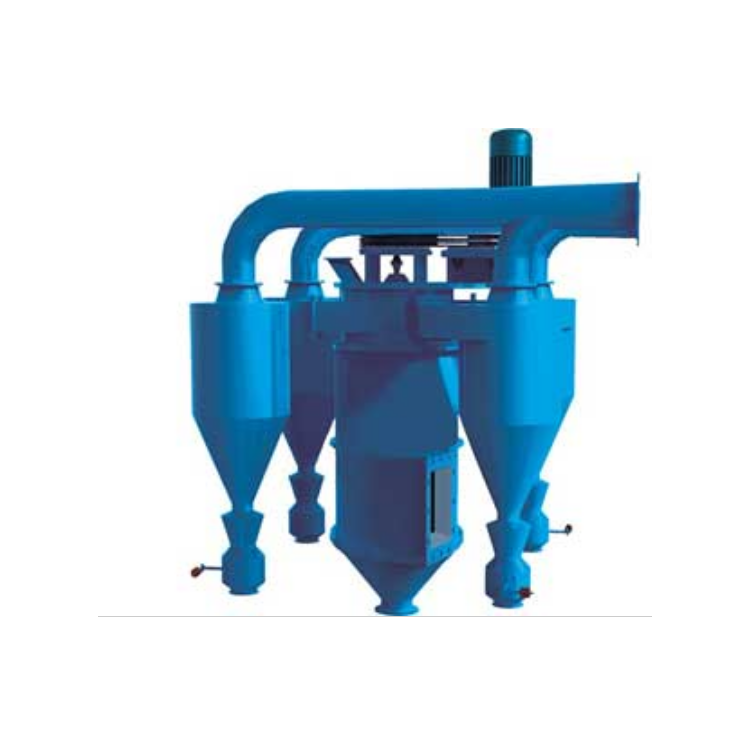
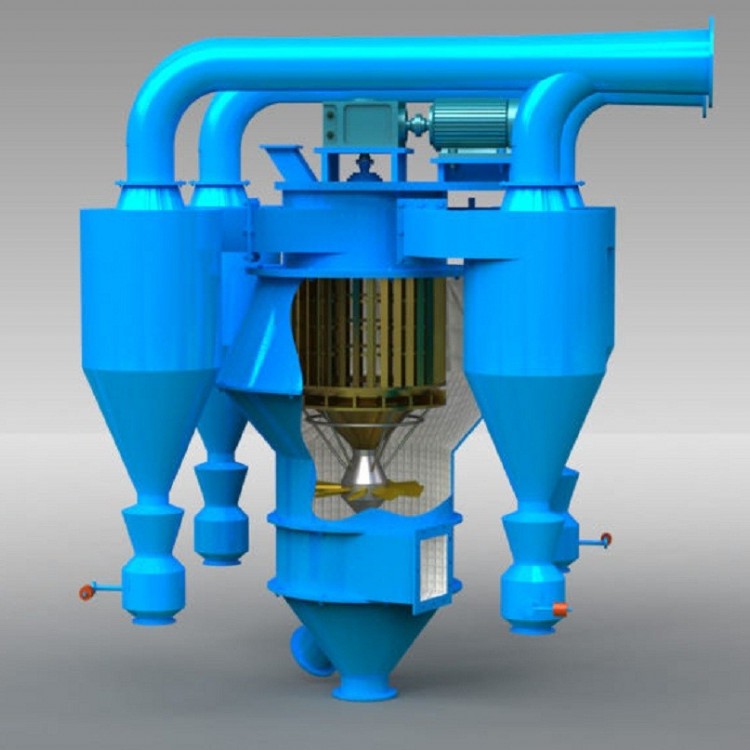
The JDD series high-efficiency anti-dew double rotor classifier is a new classifier developed and manufactured by Jiangsu Jidingda Company's technical team. It combines foreign classifier technology with the application of flat vortex theory in cyclone classifiers. Proven in use, the classifier achieves an efficiency of 85-90%, offers convenient and flexible fineness adjustment, and boasts stable and reliable performance.
Compared to traditional sifter machines, the JND series high-efficiency anti-dew combination twin-rotor sifter machine boasts the following unique advantages:
1. Equipped with a removable, modular spiral blade spreader. It not only serves as a spreading device but also generates an upward air current that causes the material particles on the spreader blade surface to boil and disperse. This enhances the material's grading and dispersibility.
2. Advanced grading principle. Combining multiple selection mechanisms, utilizing the equilibrium between opposite centrifugal forces and centripetal airflow forces, materials pass through the grading interface clearly and the selection zone, hence achieving high grading accuracy.
3. The wind guide, formed in series, re-raises and disperses the coarse powder particles separated from the selected powder chamber, further separating out qualified fine powder while ensuring the uniformity of the swirling airflow within the machine.
4. The classifier main shaft features stepless high speed operation, easy fineness adjustment, sensitivity, and reliability, with a wide range of adjustment.
5. The sifter area has been redesigned for improved space utilization in the lifting zone, enhancing sifting efficiency.
6. Utilizing high-efficiency, low-resistance cyclone dust collectors, featuring low equipment resistance and high dust collection efficiency.
7. Optimized in the machine, multiple anti-dew devices such as the elastic sweeper are designed, with excellent anti-dew performance.
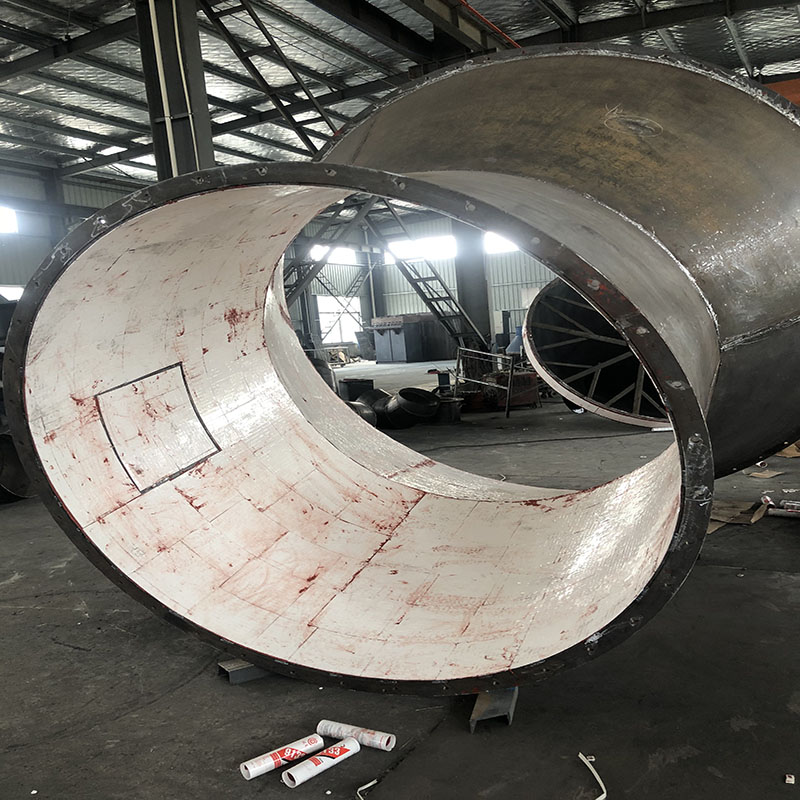
8. All vulnerable parts are protected with new multi-stage pads, effectively extending the main unit's lifespan.
9. The rotating system employs a dry oil workstation system, successfully resolving the issue of bearing vulnerability.
10. The use of statically determinate structures ensures minimal vibration operation of the entire machine; the application of dust-proof and vibration-reduction fans further reduces system vibration.
11. The coarse and fine powder tubes utilize dual-locked air valves, significantly reducing air leakage rates and overcoming the previous defect of excessive dust in the separator.
Operating Principle
1、Material enters the inner shell of the separator from the upper hopper of the sifter, falls onto the integrated combination spiral paddle feed disk, and is scattered outward under the high-speed rotation of the feed disk. Simultaneously, it is lifted upwards by the ascending air current generated by the paddle feed disk blades, creating a boiling effect on the paddle blades. Finer particles in the material rise upwards in a suspended and dispersed state, while coarser or heavier material is dispersed by the feed disk blades and falls along the筒 wall, completing the secondary sifting process.
2. A wind guide is located beneath the sprinkling pan, which lifts the fine powder from the coarse powder upwards back into the circulating air for reclassification. The coarse powder then passes through a dripping device and is discharged from the inner cone.
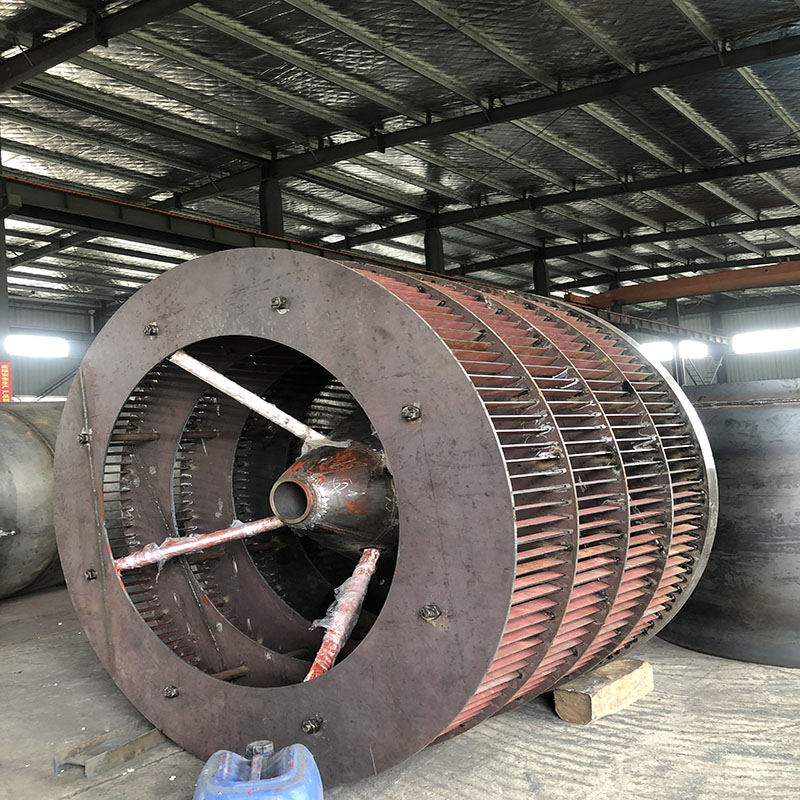
3. A cage-type rotor is positioned above the sifter, within the selection chamber. The airflow near the surface of the upper cage-type rotor classifier and the material dispersed in the airflow rotate at high speed along with the classifier. As they rotate rapidly, a uniform and strong swirling airflow is formed around the classifier. Within this area, the relationship between centrifugal force and suction force at any position remains constant. The centrifugal force experienced by the material in the airflow can be adjusted by varying the speed of the motor's main shaft. As the speed increases, this force also increases. If the air volume is kept constant, the particle size of the cut decreases, resulting in a finer product. Conversely, if the speed is reduced, the product becomes coarser.
4. After the rotor is graded by the hopper, the fine particles enter the various cyclone dust collectors with the circulating air. Due to the newly designed cyclone dust collectors featuring added guide vanes at the inlet, reflective screens in the inner cone, and speed-reducing plates at the bottom, the fluid resistance of the cyclone dust collectors is significantly reduced. The circulating air, under the action of the guide vanes, enters the cyclone collector at a higher velocity. The wind speed suddenly drops in the expanded snail-shaped part, accelerating particle settling, and also enhancing the dust collection efficiency of the cyclone dust collector.
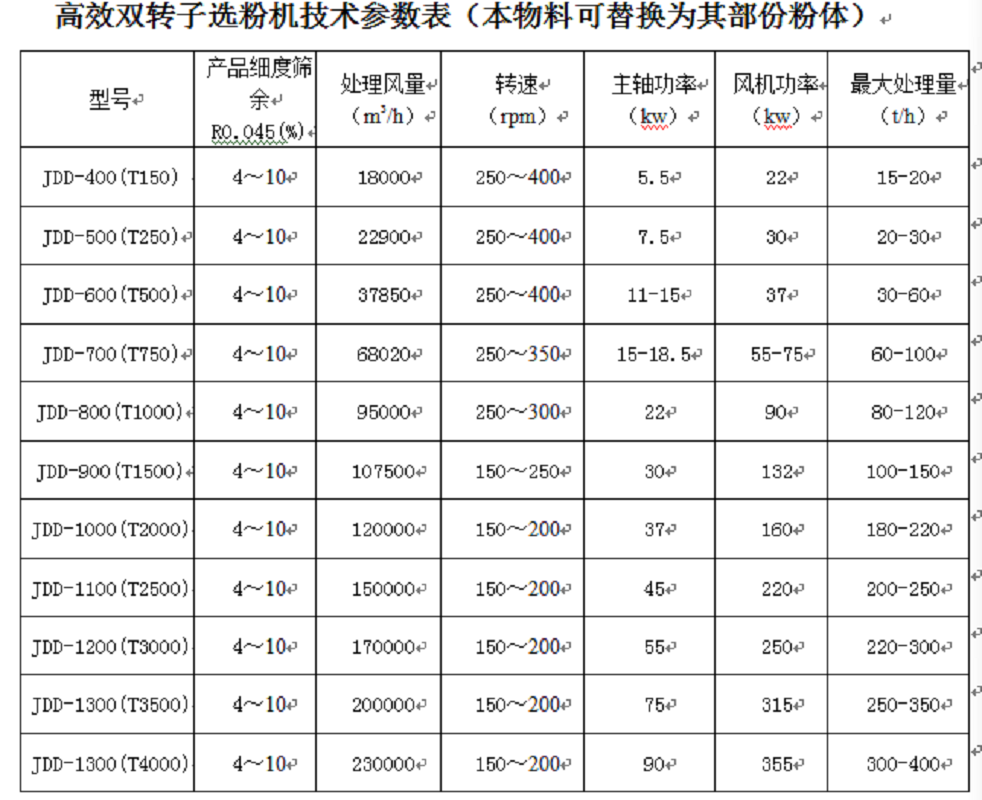
Technical Specifications
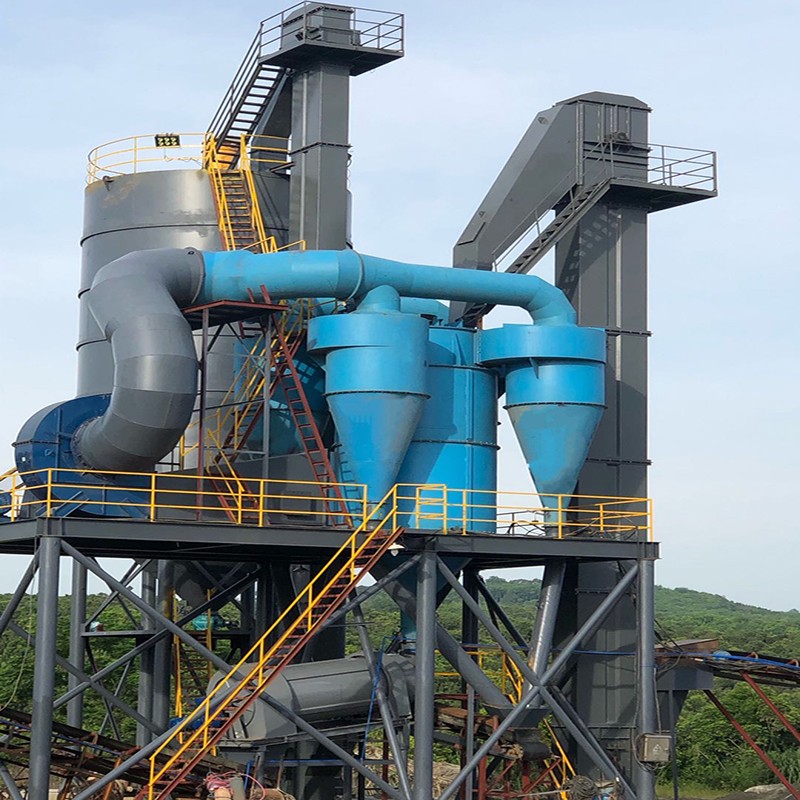
Installation in Real Life
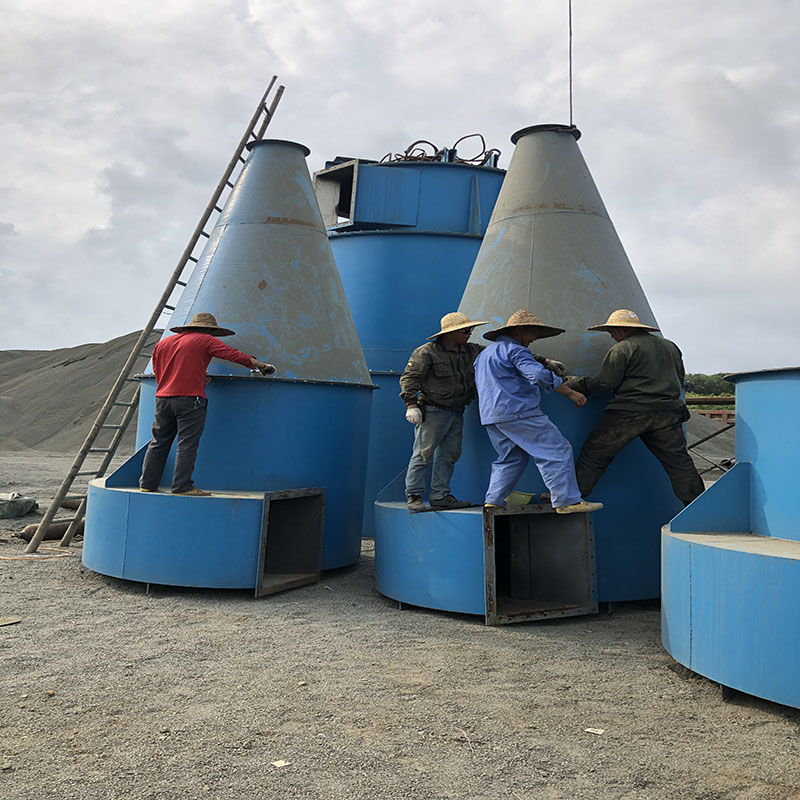
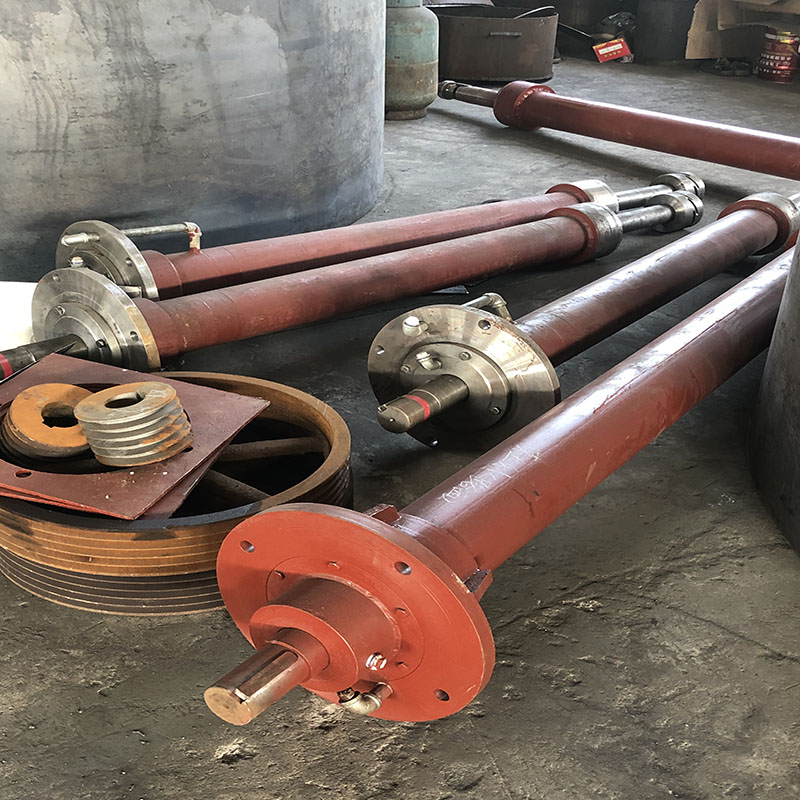
Factory photos

Phone Consultation