

Product Details
Capillary Rheometer, Torque Rheometer, Voltage Breakdown Resistance, Fully Automatic Melt Flow Index Tester, Dielectric Loss, Dielectric Constant


价 格Negotiable
最小起订0 Piece库存0 Piece
 Business Card
Negotiable

Negotiable

Negotiable

Negotiable
 High-pressure capillary rheometer
Negotiable
High-pressure capillary rheometer
Negotiable
 Voltage Breakdown Test Equipment
Negotiable
Voltage Breakdown Test Equipment
Negotiable
 Plastic Ball Indentation Hardness
Negotiable
Plastic Ball Indentation Hardness
Negotiable
 Fully Automatic Melt Flow Indexer
Negotiable
Capillary Rheometer Manufacturer
Negotiable
Fully Automatic Melt Flow Indexer
Negotiable
Capillary Rheometer Manufacturer
Negotiable
 PVC Material Torque Rheometer
Negotiable
PVC Material Torque Rheometer
Negotiable
 Rubber Capillary Rheometer
Negotiable
Rubber Capillary Rheometer
Negotiable
 Torque Rheometer Manufacturer
Negotiable
Torque Rheometer Manufacturer
Negotiable
 Torque Rheometer Test Main Unit
Negotiable
Torque Rheometer Test Main Unit
Negotiable
 Fluorinated Plastic Torque Rheome
Negotiable
Fluorinated Plastic Torque Rheome
Negotiable
Shear Viscosity Capillary Rheometer
HMLB-400A Equipment Features and Functions:
1. The rheometer is an intelligent, computer-controlled, constant-pressure capillary rheometer capable of operating under both constant pressure and constant speed conditions. It measures the extrusion speed of various specifications of capillaries under various pressures, at different rates of temperature increase, and at various temperatures.
2. Measures the flow properties and viscosity characteristics of high polymer polymers and thermoplastic plastics, providing crucial scientific data and detailed analytical reports for production and R&D, particularly for studying the rheological properties, shear rate, viscosity changes, quality management, product development, and testing of high polymer materials. Records extrusion speed, pressure, and heating temperature through a computer, automatically calculates viscosity values, plots curves, and prints complete report sheets.
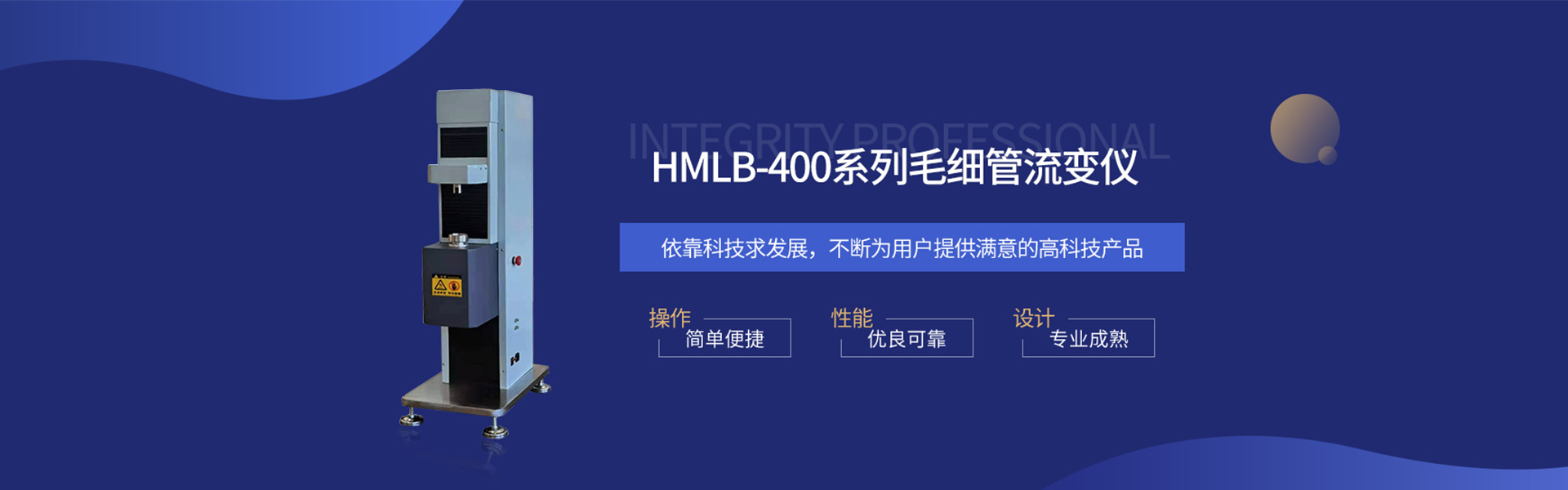
Image of the second-generation capillary rheometer, upgraded version:

Note: The product features exquisite and elegant appearance, with a touch of fashion and beauty, delicate and compact. The external dimensions are now 580mm x 320mm x 1213mm, with more pleasing color combinations.
This instrument's mechanical transmission components utilize imported ball screw, offering more precise transmission efficiency, greater stability, and longevity. Enhanced with an imported servo control system and servo motor, the instrument's operation is extended, accuracy is enhanced for durability, and it better meets the user's needs.
This instrument is equipped with an imported load cell sensor, ensuring high force measurement accuracy, precise force values, and stability. It can greatly meet user requirements and expand the force value measurement range, allowing for a wider testing scope and facilitating the selection of more suitable testing equipment for users.
IV. Main Technical Parameters:
Model | HMLB-400A | HMLB-400B | |||||||
Large test capacity | 5kN | 10kN | |||||||
Test Speed | 0.001-500 mm/min | ||||||||
Load Test Accuracy | ±0.5% | ||||||||
Load resolution | 300,000 yards | ||||||||
Pressure Measurement Range | 1-50Mpa±0.5% | ||||||||
Positioning Accuracy | ±0.5% | ||||||||
Forming Precision | ±0.5%FS | ||||||||
Deformed resolution | 0.01mm | ||||||||
Dynamic speed ratio | 1:40,000 | ||||||||
Maximum Test Temperature | 400°C | ||||||||
Temperature Control | PID control, resolution 0.1°C, accuracy < ±0.5°C | ||||||||
Rise rate | 1-10℃/min, continuous adjustable, and can rapidly increase temperature | ||||||||
Temperature Control Accuracy | Display ±0.5℃ | ||||||||
Temperature Resolution | 0.1℃ | ||||||||
Barrel diameter | 11.28 mm | ||||||||
Heating Barrel Length | 180 mm | ||||||||
Material of the barrel | Tungsten carbide | ||||||||
Test Barrel | Electronic Heating Test Chamber | ||||||||
Pressure Sensor | Capacity | 500 bar | 1000 bar | ||||||
Accuracy | < 0.25% | ||||||||
Pressure Resolution | 0.1Mpa | ||||||||
Material | Stainless steel, corrosion-resistant, high-temperature resistant | ||||||||
Capillary | Mouthguard Material | Tungsten carbide | |||||||
Dimensions (L/D) | 5/1、10/1、20/1、40/1mm | ||||||||
Plug diameter | φ11.28 -0.012mm-0.05mm | ||||||||
Filler area | 1cm2 | ||||||||
Test Mode | Constant Speed, Constant Pressure, Step Shear Mode | ||||||||
Control Software | HMBL System | ||||||||
Power Supply | 220V,50/60Hz,8A | ||||||||
Weight | 210 kg | ||||||||
Attachment | A set of manual cleaning tools | ||||||||
Primary Configuration List | |||||||||
Configuration Name | Quantity | Production Origin | |||||||
Tested Host | A set | Huabo Technology | |||||||
High-precision temperature control gauge | A piece | Xiamen Yu Di Group | |||||||
Servo Control System | A set | Imported | |||||||
Servo Motor | One unit | Imported | |||||||
Data Collection System | A set | United States蕊片Module | |||||||
Data Processing System | A set | USA * Chip Module | |||||||
High-precision sensor | A piece | ||||||||
Mold outlet 5/1, 10/1, 20/1, 40/1mm (standard) | One each | Zhuzhou Hard Alloy Works | |||||||
Mouth Mask Retainer | A piece | Zhuzhou Hard Alloy Factory | |||||||
Computer | A set | ||||||||
Color inkjet printer | One unit | ||||||||
Test Software | A set | HuaBo Technology (HMLB System) | |||||||
Tools | A set | HuaBo Technology | |||||||
Manual | A piece | Huabo Technology | |||||||
Warranty Card | A piece | HuaBo Technology | |||||||
Certificate of Compliance | A document | HuaBo Technology | |||||||
HMLB-400A Capillary Rheometer for Shear Viscosity Operation Principle
I. Application
Rheological properties are typically measured using rheometers, sometimes also referred to as viscometers. Among various instruments used to determine and study the rheological behavior of plastic melts, the capillary rheometer is a commonly used and suitable testing device. It offers multiple functions and a wide range of shear rate capacities. The capillary rheometer can measure the relationship between shear stress and shear rate of plastic melts within a capillary. It can also investigate the elastic and unstable flow phenomena (including melt fracture) of the melt by altering the capillary's length-to-diameter ratio while maintaining a constant stress, based on the diameter and appearance of the extrudate. This allows for the measurement of processing behavior, which serves as a basis for selecting compound formulations, optimizing molding process conditions, and controlling product quality; or it can provide essential data for the design of molding dies and plastic machinery.
In search of a precise melt index tester? Consider using a capillary rheometer. Standard melt index testers typically measure only a single point on the shear rate/viscosity curve, allowing for assessments of material flowability or average molecular weight. In contrast, a capillary rheometer can determine how material viscosity changes with temperature and pressure. During testing, the temperature is kept constant, and the piston moves at various speeds, revealing the relationship between viscosity, shear rate, and shear force.
Section II: Test Principle
The basic principle of the rheometer test is: in an infinitely long circular capillary, the flow of plastic melt within the tube is a stable laminar flow of an incompressible viscous fluid; due to its viscosity, the fluid necessarily experiences a force opposite to the direction of flow from the tube wall. By deriving the principles of fluid mechanics, such as the balance between viscous resistance and driving force, the relationship between the shear stress and shear rate at the tube wall and the melt flow rate can be obtained as follows:
The shear stress of the material flowing through the capillary is:
τ=R·⊿P/2L
(1)
R—the inner radius of the capillary, here R=0.635 mm
ΔP — Pressure Difference across Capillary, kg/cm²
L—Length of the capillary, for example, choose a capillary with a length-to-diameter ratio of 30:1, L=38.1mm
Cutting speed is:=4Q/πR3
(2)
Among them, Q—extrusion flow rate cm3/s
Therefore, under certain conditions of temperature and the ratio of length to diameter of capillary (L/2R), the flow rate Q of the plastic melt through the capillary at different pressures is measured. By calculating the shear stress and shear rate from the flow rate and the pressure difference ΔP at both ends of the capillary, a set of corresponding τ andPlotting flow curves on a logarithmic coordinate paper allows determination of the non-Newtonian index (n) and the apparent viscosity (ηa) of the melt; altering the temperature or the ratio of capillary length to diameter yields the activation energy representing the viscosity's temperature dependence; as well as physical parameters such as the modulus expansion ratio that characterize rheological properties.
Section 3: Experimental Materials
Thermoplastic plastics such as PE, PP, PS, and their compounds in the form of powder, granules, strips, or molded blocks; appropriate treatment, such as drying, should be performed prior to experimentation based on the material type and properties.
As the plastic melt passes through the capillary die, the pressure and temperature of the melt are measured by the pressure sensor and thermocouple mounted on the capillary die, with a microcomputer recording the pressure and temperature values.
1. Launch the operational software application.
2. Enter experimental report information.
3. Add data files and input experimental parameters to conduct the test operation.
4. Filter data. Review the filtered data, ensuring its validity and reasonability.
5. Graph display, data presentation.
6. Upon completion of the test, print and save the data and curves.
7. Shut down the system.
The model features the following characteristics and advantages:
The equipment offers a wide range of test forces from 5 kN to 10 kN for high load options, providing greater flexibility to meet various testing requirements. It also offers 8 selectable membrane outlet options, ensuring a comprehensive range of accessories for different material research needs. With high control precision (constant temperature, force, and speed), it minimizes control errors and delivers accurate test data to customers.
The real-time collection system utilizes higher U.S. *chip collection ratios, resulting in a larger volume of data transmission within a unit of time, ensuring the curve is delicate and accurate.
The instrument utilizes imported American ShiQuan sensors, which enhance the accuracy of the force value, resulting in more precise measurement results.
Four, this instrument is a desktop model; featuring a exquisite appearance, it utilizes imported servo motors, servo systems, and imported ball screw, which results in low transmission noise and highly precise displacement. It can compete with imported machines from abroad.
Five, Proprietary format file storage, superior to traditional methods with excessively small data storage. User-friendly interface design with clear layout of functional areas, convenient for user operation.
Six, users can independently edit suitable testing methods based on specific samples, making it very convenient to complete the testing function.
Section 7: Multiple curve combination methods, enabling "displacement" of "viscosity" curves for different high polymer materials at the same temperature; users of the control software can communicate for customized services.
Eight: Equipped with overload protection and limit protection, ensuring safe and smooth operation of the equipment.
Phone Consultation