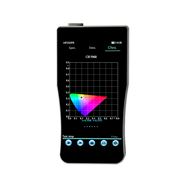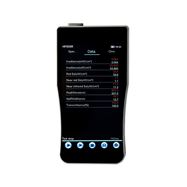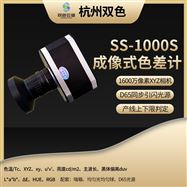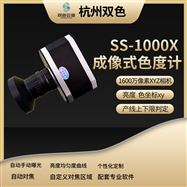

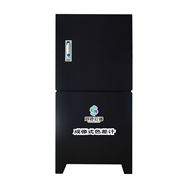


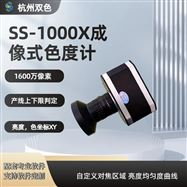
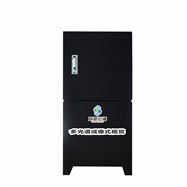
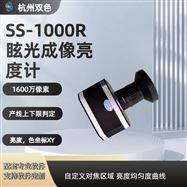






SS-2000XImaging ColorimeterColor difference detection involves measuring the color difference between two samples (the standard sample and the test sample). Traditional color difference detection relies on the naked eye, which can be influenced by the surrounding environment and the observer's own condition, resulting in less accurate measurements. As people's requirements for color accuracy increase, manual detection methods are no longer sufficient for professional color assessment. To achieve more precise color management, specialized instrumental imaging color difference meters are employed.
Imaging ColorimeterThe CIE chromaticity standard for color measurement, which regulates the optical path structure of traditional instruments and the angle of observation, includes specifications for D/8°, 45/0°, and observer's perspective at 2°, 10°. The sensor employs the YXZ photoelectric sensor and spectral dispersion. This allows for testing only local color differences and colors. The two-color cloud chart utilizes mature imaging technology, enabling analysis of each pixel of product color variation.Imaging ColorimeterA high-precision color measurement device based on image sensing technology, which captures multi-angle images of an object's surface and analyzes RGB or spectral data to quantitatively evaluate color differences. Its core advantage lies in simultaneously obtaining color information and surface texture features, suitable for complex samples or rapid online detection scenarios.Imaging ColorimeterAchieved dual quantitative detection of color and texture through multi-angle image fusion and spectral analysis technology.
Structure Principle: The integral ball, lighting source, and imaging camera (high resolution, global, large target area, low noise) are based on the CIE Lab color space: L*a*b* values represent brightness, red-green axis, and yellow-blue axis; ΔE* = √(ΔL*² + Δa*² + Δb*²) calculates the total color difference. Supports multiple color difference formulas: such as CMC(2:1), CIE94, CIE2000, adapting to different industry standards.
I. Key Test Parameters
Color Difference △E, L*a*b*, XYZ, Color Coordinates x, y, HUE, RGB Color Coordinates x, y, Brightness, Uniformity of Color Difference, Color Difference Distribution Curve, Color Difference Pseudocolor
CIE-Lab, CIE-LCh, HunterLab, CIE-Luv, XYZ, Yxy, RGB Color Difference (ΔE*ab, ΔE*cmc, ΔE*94, ΔE*00)
2. Whiteness (ASTM E313-00, ASTM E31373, CIE, ISO 2470/R457, AATCC, Hunter, Taube Berger Stensby)
3. Yellowing (ASTM D1925, ASTM E313-00, ASTM E313-73)
4. Blackness (My, dM), Colorfastness to rub, Colorfastness to wash, Tint (ASTM E313-00), Color Density CMYK (C, M, Y, K)
Repeatability dE*ab ≤ 0.01 dE*ab ≤ 0.12
II. Main Industry Standards
/T 3978,GB 2893,GB/T 18833,ISO77241,ASTM E1164,DIN5033 Teil7
Typical Application Scenarios
Textile dyeing and finishing industry, fabric online detection, with D65 standard light source.
2. Food and Cosmetics
3. Measure irregular surfaces (such as sauces, powders) by averaging data from multiple areas to address sample inconsistency, avoiding偏差 caused by the small measurement area of traditional colorimeters.
3. Industrial Quality Control
For products like plastics and coatings, we analyze color variation and surface luster simultaneously, quickly pinpointing differences between batches.
5. Surface light sources, point light sources, etc.
6. Textile & Apparel Industry, Printing Industry, Coatings & Paints Industry, Plastics & Rubber Industry, Food Industry, Cosmetics Industry, Automotive Industry, Pharmaceutical Industry, Building Materials Industry, Electronics & Appliance Industry
III. Technical Parameters
Camera Performance Parameters: Pixel size 3.45um x 3.45um, 4/3-inch CMOS image sensor with high-precision XYZ, V(λ) filters; Effective pixels 16 million, resolution @ frame rate 4112x4112 max @ 23.5fps, 12-bit AD width dot matrix, capable of capturing the entire scene: simultaneously measuring the brightness of each pixel point.
Pixel Capture: Automatic, Point, Multi-point, Multi-point Connection, Circular, Square, Polygonal, Elliptical, Curved, etc.
Test Parameters: Color Difference △E, L*a*b*, XYZ Color Coordinates, x, y HUE, RGB Color Coordinates x, y, Brightness, Color Difference Distribution Curve, Color Difference Pseudocolor
Key Features:
1. High-Precision Measurement: Filtered XYZ camera that strictly matches the human eye's visual function V(λ), capable of accurately obtaining true and precise grayscale chromaticity data.
2. Enhanced Software Features: Equipped with functions for uniform distribution of brightness and chromaticity pseudo-color maps for single-point, multi-point, and regional settings, with adjustable upper and lower limits for parameters.
3. Exposure Area: Can set exposure area of any pixel size to move
4. Supports secondary calibration function
5. Rich Interface: Equipped with input/output IO interfaces, capable of triggering tests with customers' PLCs and other automation equipment, providing PASS/NG indicators for pass/fail status, and also offering SDK software packages developed by third parties.