













Principle of Operation for Pipe Making Machine Production Line
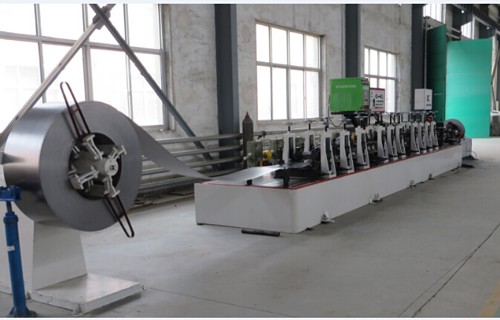
The working principle of the pipe-making machine production line involves various types and methods of equipment, each with its specific purpose and production process. Below is an overview of several common pipe-making machines and their working principles:
Centrifugal Concrete Pipe Making Machine: This equipment utilizes centrifugal force to produce concrete pipes. It is mainly composed of an electric motor, a reducer, and an overhanging centrifuge. During operation, cement slurry is injected into the mold of the centrifuge, then rotated at high speed by the overhanging centrifuge driven by the electric motor, generating strong centrifugal force that makes the cement slurry adhere to the inner wall of the mold and form concrete pipes of a certain thickness. By controlling the rotation speed and time, pipes of different specifications can be produced.
Extrusion Concrete Pipe Machine: Utilizes the extrusion molding principle to produce concrete pipes. It is mainly composed of an extrusion cylinder, extrusion mold, and transmission device. During operation, cement slurry is first injected into the extrusion cylinder, then the cylinder is rotated by the transmission device. Simultaneously, the extrusion mold is inserted into the cylinder, extruding the cement slurry and adhering it to the inner wall of the mold. By controlling the rotation speed of the extrusion cylinder, the insertion depth of the extrusion mold, and the extrusion time, pipes of various specifications can be produced.
Vibration Cement Pipe Production Machine: Utilizes the vibration molding principle to produce cement pipes. It is mainly composed of a cement slurry supply system, a vibration mold box, and a vibration molding device. During operation, the cement slurry is first supplied to the vibration mold box, then vibration is generated through the vibration molding device, causing the cement slurry to tightly adhere to the inner wall of the mold and form a cement pipe of a certain thickness under the vibration. By controlling the vibration frequency and time, cement pipes of different specifications can be produced.
Suspension type cement pipe making machine: This is a device that uses steel molds and cranes in coordination to produce cement pipes. It is mainly composed of steel molds, cranes, and fixed frames. During operation, the steel mold is first hoisted onto the fixed frame, then cement slurry is injected into the mold. Subsequently, the crane's force is used to slowly lower the steel mold, while compressing and vibrating the cement slurry to ensure it adheres tightly to the inner wall of the mold and forms a cement pipe of a certain thickness. By controlling the crane's descent speed and vibration frequency, cement pipes of different specifications can be produced.
Vertical Cement Pipe Making Machine: A specialized equipment for producing vertical cement pipes. It is mainly composed of a bracket, a main base, steel molds, positioning clamps, and dump trucks. During operation, the steel mold is first placed on the main base, then cement slurry is injected into the mold. Subsequently, using a dump truck, the steel mold is slowly lowered while the cement slurry is compressed and vibrated to ensure it adheres to the inner wall of the mold and forms a cement pipe of a certain thickness. Once the steel mold reaches a certain position, the cement pipe is fixed to the bracket using the positioning clamps.
These pipe manufacturing production lines achieve efficient and automated production from raw material processing to finished pipe products through different working principles and equipment configurations.