






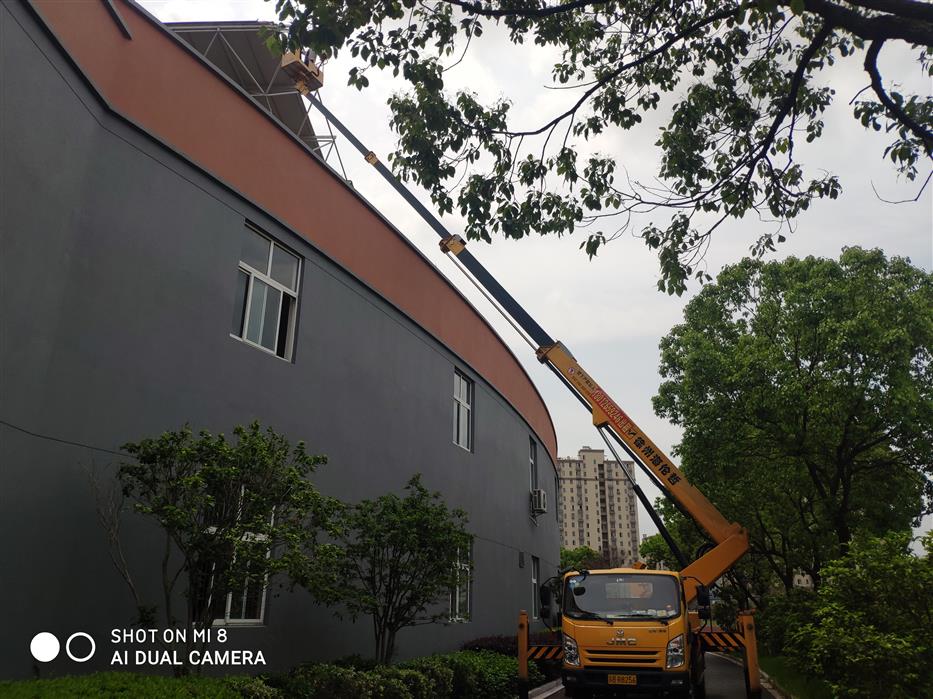
With the continuous improvement of national infrastructure in our country, a rapidly growing market for high-altitude operations has emerged, with its growth rate far surpassing that of developed regions. High-altitude vehicle equipment is primarily used in departments such as train stations, subways, stores, factories, power supply, and streetlight maintenance, but the market potential remains largely untapped and underdeveloped. The reason lies in the single product variety domestically, and the products still need innovation in terms of application and functionality. For instance, using high-altitude operation machinery to replace certain scaffolding construction, exterior wall decoration, cleaning, and maintenance of buildings; insulating wire and maintenance; fire rescue operations, and maintenance checks of large objects, but developing such products requires significant breakthroughs in adaptability and technology. What should one be aware of when entering the high-altitude vehicle market?
1. Beginner's Operation:
Due to newbies' lack of understanding of aerial work platforms or confusion about operation methods, it's easy to make mistakes that lead to defects and potentially cause mechanical accidents. Operators in this field must be patient in learning and only after receiving proper training should they be allowed to work.
2. Fast wear rate
Due to the factors of processing and installation for components of aerial work platforms, their friction surfaces are rough and the contact area is small. Under uneven load-bearing conditions, significant wear occurs. During operation, the uneven parts of the components on the aerial work platform interlock and rub against each other, with metal shavings falling off and acting as abrasive material, further accelerating the wear on the mating surfaces. Consequently, the磨合 period of aerial work vehicles is prone to component wear, with a rapid wear rate. At this point, if the aerial work vehicle is subjected to overload operations, it may lead to damage to the components and the occurrence of defects.
The trailer-mounted lift is powered by an external source for lifting and lowering equipment, primarily attached to a car trailer or other towing vehicles at the rear, offering convenient and quick movement, suitable for long-distance operations.
The main advantages of the trailer-mounted lift include: easy mobility, suitable for various rugged terrains in the field; equipped with an extendable arm structure, the entire unit is compact and flexible; made of new type steel, high strength and light weight; can be directly connected to AC power or powered by the vehicle's own engine; fast setup time; the work platform can be elevated, extended, and rotated; easy to maneuver over obstacles to reach the work location, making it an ideal高空work equipment.

Engineering equipment primarily used for construction projects, bridge building, ship manufacturing, airports, mines, port terminals, communication, and power facility installations, as well as for high-altitude operations in outdoor advertising.
Boom lifts available in sizes from 9 to 26 meters, powered by batteries, diesel, gasoline, or 220V AC power. We offer both articulated and straight arm options. All truck-mounted boom lifts sold by Yakari are chosen after a comprehensive consideration of product performance and pricing, ensuring our products offer high cost-performance value. Each model of truck-mounted boom lift has undergone rigorous market testing, guaranteeing both safety and reliability.
The compact lifting device is made of high-strength aluminum alloy, featuring attractive design, compact size, light weight, smooth lifting, and reliable safety. Its lightweight appearance allows for lifting capabilities in the smallest of spaces.