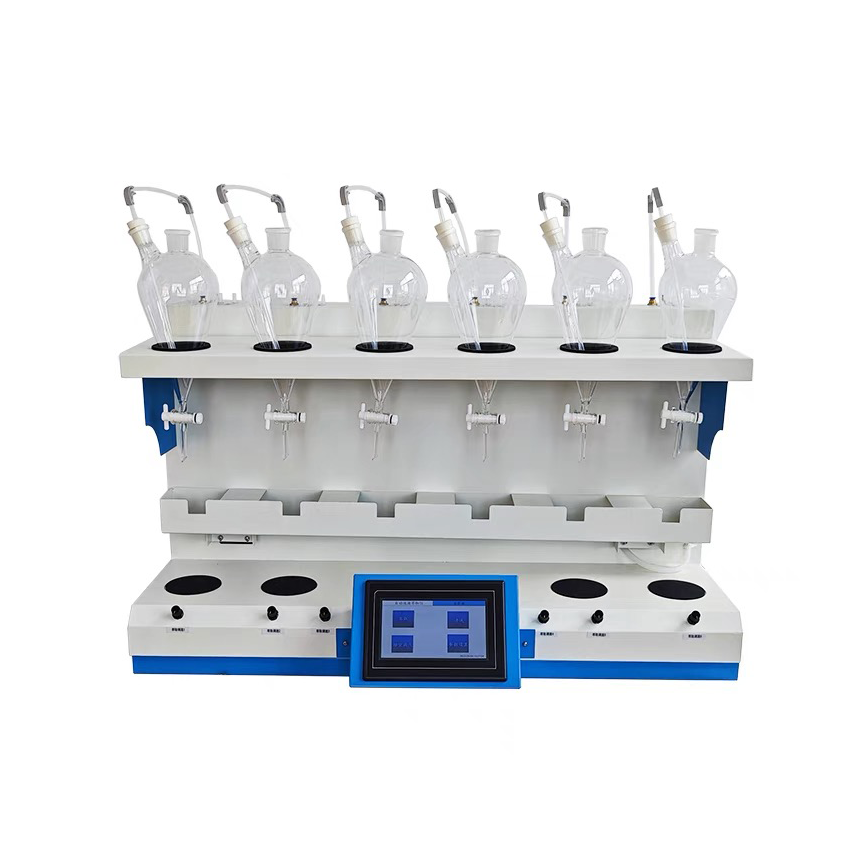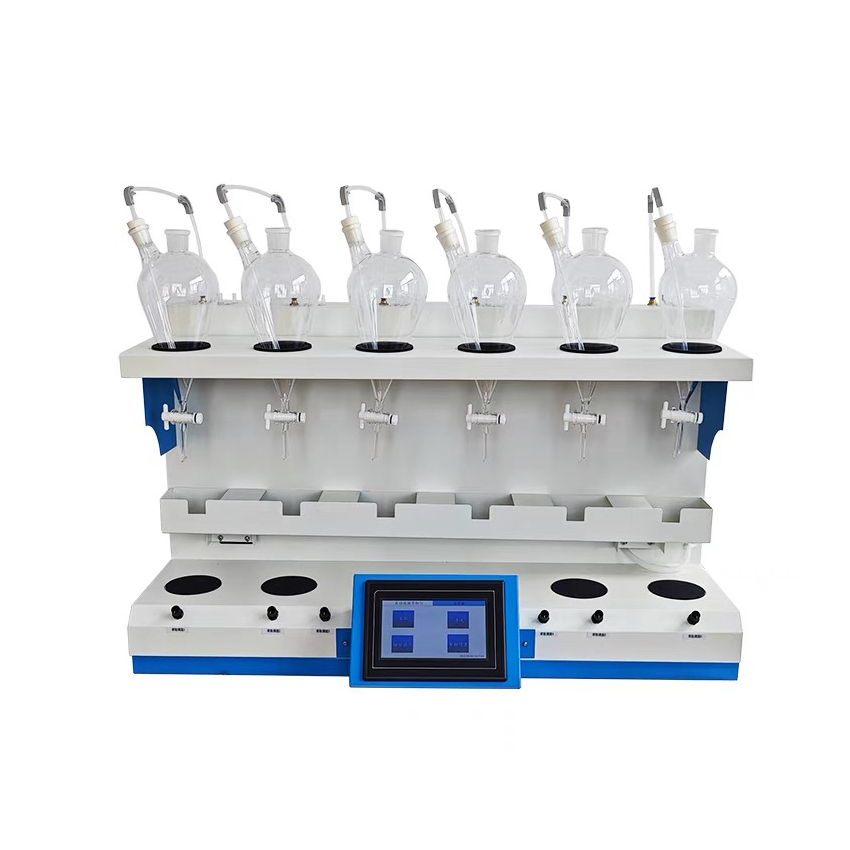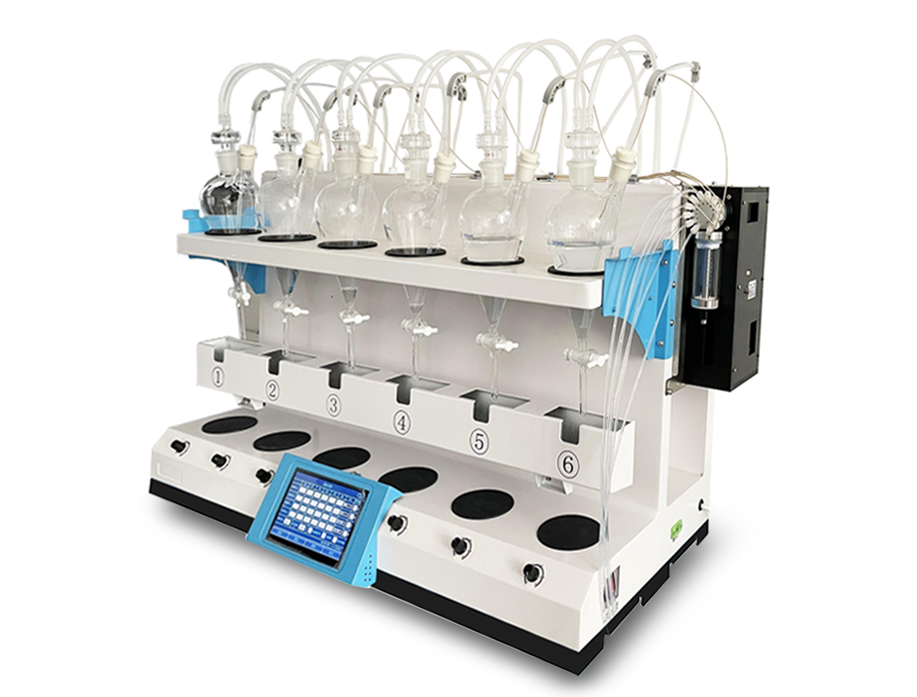


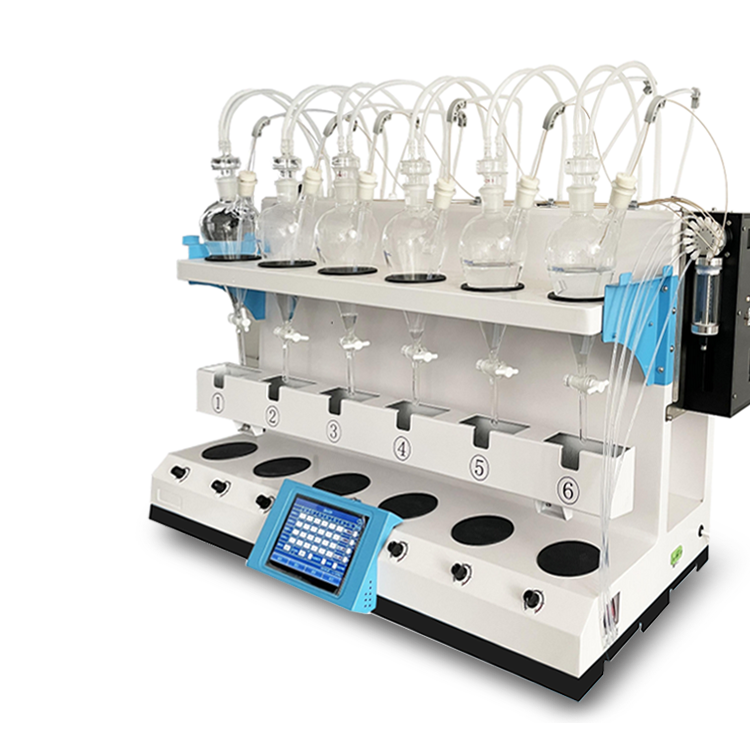









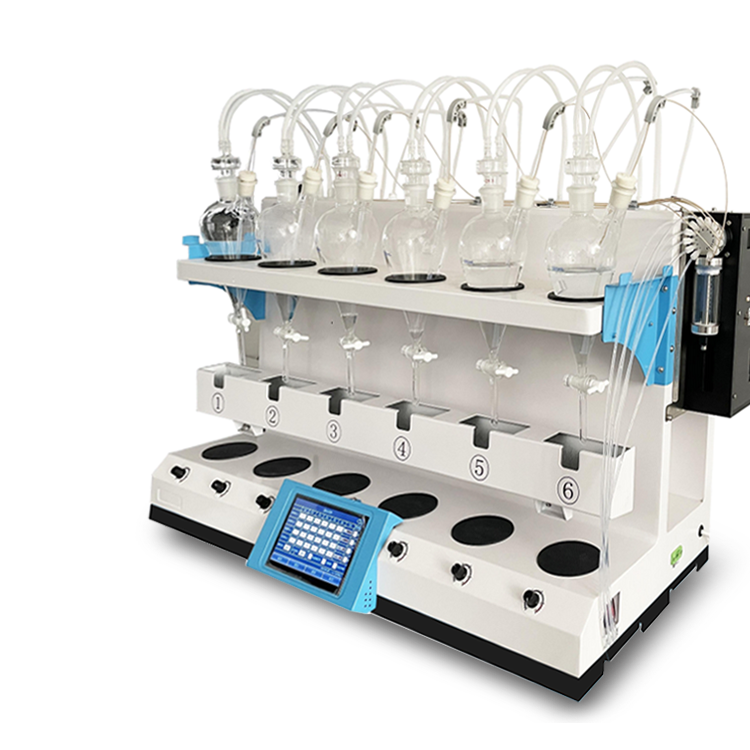

Fully Automatic Liquid-Liquid Extraction Apparatus CHZDCQ-6 with Automatic Reagent FeedingFully automatic liquid-liquid extraction apparatus, which, by adjusting the pressure, causes the sample to collide vigorously with the extracting agent for thorough mixing, achieving the liquid-liquid extraction function. The entire process is automated, reducing experimental risks and significantly enhancing extraction efficiency. The machine features one-touch operation, simplicity, and convenience. Both the automatic exhaust and waste liquid discharge systems are equipped with filtration, minimizing the contamination of the laboratory environment by the samples and ensuring the safety of the experimenters. Widely applicable in industries such as petrochemicals, environmental protection, metallurgy, and food processing.
Key Features:
1. 7-inch large LCD touch screen, one-touch operation system, display screen mounted directly in front of the machine for easy operation by lab personnel; allows for independent setting of various instrument parameters.
2. Supports the use of extract bottles in various specifications, with a snap-on design for easy and quick replacement; all gas valves are made of PTFE material.
3. 6-position operating system, capable of completing the extraction of 6 sets of samples in one go; automatic extraction program running, automatic settling and stratification, each sample can be controlled individually.
4. Extraction time, cleaning time, intermittent time, and extraction cycle can all be set and adjusted. An alarm feature is accompanied by a buzzer upon completion of extraction and cleaning.
5. Automatic waste liquid discharge, featuring a stainless steel telescopic waste liquid tank with an integrated activated carbon filtration and purification function. The waste liquid is filtered and adsorbed by the activated carbon storage tank before being collected and processed centrally, reducing environmental pollution. Suitable for the usage requirements of various reagents, it comes with a self-contained suction filtration system and manual waste liquid discharge.
6. Exhaust gases are generated during the reaction process, which are automatically collected and treated. Manual venting is also available, while simultaneously avoiding the risk of explosion associated with fully enclosed extraction bottles.
7. Cleaning Method: After extraction is complete, simply touch the screen to initiate one-touch cleaning. You can set the number of cleaning cycles, cleaning duration, and interval between cycles. The disassembly of the extraction bottle differs from the simple rinsing function of other instruments; this device uses a pressure-scattered wide-angle cleaning method, featuring dynamic pressure increase and covering the entire inner wall of the separatory funnel, resulting in superior cleaning effects.
8. The whole machine is equipped with electrical leakage protection, over-voltage and over-current protection devices, and an internal 6-set stable voltage system to enhance the consistency of the machine's extraction efficiency.
9. Extraction intensity can be adjusted via the dial, and each group can be individually set.
10. Utilizes an automated metering pump for sample intake and manual addition, eliminating direct contact with toxic reagents, safeguarding staff health, and offering quick and convenient operation.
11. Employing the semi-closed air flow oscillation principle, the continuous aeration by an internal air pump achieves oscillation extraction. The extraction intensity can be adjusted from weak to strong.
Fully Automatic Liquid-Liquid Extraction Apparatus CHZDCQ-6 with Automatic Reagent Solid-Liquid Extraction
Solid-liquid extraction, also known as leaching, is a process that utilizes solvents to dissolve soluble substances in solid materials for separation. Water is commonly used as a solvent, such as in brewing tea, decocting traditional Chinese medicine, and extracting sugar from beets. With the development of industry and the improvement of people's living standards, the application of solid-liquid extraction has become increasingly widespread, including extracting edible oils from plant seeds, extracting preparations from various plants, and producing instant coffee, food seasonings, and food additives.
Almost all solid-liquid extractions require preliminary processing of the raw materials, typically involving grinding them into fine particles or thin slices. Useful components (solute) are dispersed within insoluble solids (carrier), and the solvent and solute must pass through the carrier's pores to transfer the solute to a solution outside the solid. This process has a significant mass transfer resistance. After the solid material is ground, the increased contact area with the solvent and the shortened diffusion distance significantly enhance the extraction rate. Over-grinding can produce dust, increase the amount of retained liquid in the solid phase during extraction, and make solid-liquid separation difficult, thereby reducing extraction efficiency.
Consider the following principles when selecting solvents:
The solute has a high solubility, thereby saving solvent usage.
(2) Sufficient difference in boiling points between the solvent and solute for easy recovery and reuse.
(3) The solute has low diffusion resistance in the solvent, meaning a high diffusion coefficient and low viscosity.
(4) Easily accessible, low corrosiveness, etc. The solubility of the solute generally increases with temperature, and the diffusion coefficient of the solute also increases. Therefore, increasing the temperature can accelerate the extraction rate.
2. Liquid-Liquid Extraction:
Liquid-liquid extraction, also known as solvent extraction or extraction, is the process of separating and extracting components from liquids using a solvent.
Add a selected solvent that is immiscible (or slightly miscible) with the liquid, utilizing the differing solubilities of its components in the solvent to achieve separation or extraction.
For example, separation from coal tar using benzene as a solvent, and recovery of acetic acid from dilute acetic acid solution using isopropyl ether as a solvent. Laboratory operations are conducted using instruments such as separatory funnels. In industry, these processes are carried out in packed towers, sieve plate towers, centrifugal extractors, and spray extractors, among others.
Applied in industries such as chemistry, petroleum, food processing, rare elements, and nuclear energy.
Chuanhong Liquid-Liquid Extractor Advantages: Utilizes vertical oscillation extraction method; capable of processing 150ml-2000ml separatory funnels, colorimetric tubes, conical flasks, volumetric flasks, and various types of containers in the same batch; automatic degassing during extraction, with gas sources centrally collected and processed through a protective core; one-button start, intelligent program settings, and leakage protection for the full automation of the extraction experiment. This instrument boasts high automation, enhancing extraction efficiency while effectively preventing human contact with toxic gases.

Fully Automatic Liquid-Liquid Extraction Instrument CHZDCQ-6 with Automatic Reagent FeedingI. Basic Concepts
Liquid-liquid extraction is one of the unit operations for separating homogeneous liquids. It achieves separation by utilizing the differences in solubility of various components in a solvent. Extraction is a mass transfer process. This chapter mainly discusses the extraction process of a binary homogeneous liquid (A+B).
The solvent used is called Extractant S, the component separated from the mixture is referred to as Solute A, and the component in the original mixture that is either immiscible or only partially miscible with the extractant is called Original Solvent B. The solution obtained after operation, primarily composed of the extractant, is called Extract Phase E, while the solution primarily composed of the original solvent is called Residual Phase R. The liquid obtained after removing the extractant from the extract phase is called Extract E', and similarly, the liquid obtained after removing the extractant from the residual phase is called Residual Liquid R'.
Clearly, the extraction process includes the following steps: (1) Mixing and contacting the feed liquid (A+B) with the extractant; (2) Separating the extract phase E from the raffinate phase R; (3) Recovering the extractant from both phases to obtain the products E' and R'.
II. Application of Extraction in Industrial Production
1. The relative volatilities of the components in the solution are very close or can form a constant-boiling mixture. Separation using conventional distillation methods requires a large number of theoretical plates and a high reflux ratio, resulting in high operational costs and oversized or even non-separable equipment.
2. The components have high thermosensitivity, and distillation methods are prone to cause thermal decomposition, polymerization, and other chemical changes.
3. The solution has a high boiling point and requires distillation under high vacuum.
4. The concentration of the solute in the solution is very low, which makes the energy consumption of the distillation process too high, and it is not economically feasible.
The application of liquid-liquid extraction technology is not limited to the aforementioned aspects but holds a wide range of prospects. The two separation methods, extraction and distillation, can complement each other. Practice has proven that with the appropriate choice of either distillation or extraction, almost any liquid can be effectively and economically separated into its components.
Section 3: Liquid-Liquid Equilibrium Relationship
Liquid-liquid extraction involves at least three substances: the solute A in the feed liquid, the original solvent B, and the extracting agent S. The added extracting agent can form a ternary system with the feed liquid (A+B) in three types: (1) Solute A is soluble in both the original solvent B and the extracting agent S, but the extracting agent S is immiscible with the original solvent B, forming a pair of immiscible mixtures; (2) The extracting agent S is partially miscible with the original solvent B and completely miscible with the solute A, forming a pair of partially miscible mixtures; (3) The extracting agent S is partially miscible with both the original solvent B and the solute A, forming two pairs of partially miscible mixtures.