











To understand the features of the Fangtian PLM system, let's first get to know the challenges that companies currently face in developing products on their own:
1. In the fierce external market competition, how can a company ensure that the design department quickly provides clients with accurate and reasonable quotes?
2. How do we swiftly design new products that meet requirements after receiving an order? How do we quickly respond to customers and the market?
3. When there is a turnover of design staff, resulting in the loss of a large number of drawings, how to manage the design staff's design drawings?
4. How does the superior manager allocate design tasks and oversee, as well as approve, the design process of products and designers?
5. Product design often determines 80% of a product's cost. How can design and product costs be reduced from a development perspective?
6. How to rapidly transmit frequent design changes to other departments (such as the Engineering Department, Production Department, and Business Department)?
7. How to find a new or similar version of drawings that are scattered across multiple computers?
8. How to extract a Product Design BOM from CAD data and process it into a Manufacturing BOM that guides ERP production and procurement? 9. Can design drawings with annotations be viewed without installing any CAD software?
The Fantian PLM (Product Lifecycle Management) is a product-centric, application software-driven strategic business model. It employs a suite of consistent business solutions to support the creation, management, distribution, and use of product information across the entire enterprise and throughout the product's entire lifecycle (from conception to end-of-life). It integrates numerous elements such as processes and information. With Fantian PLM, companies can better manage their intellectual assets, enhance product innovation, and achieve core competitiveness with "market adaptation, flexibility, and scalability." It provides data management, project management, change management, collaborative management, standardized management, and safety management for products, offering a scalable R&D management platform for manufacturing enterprises.
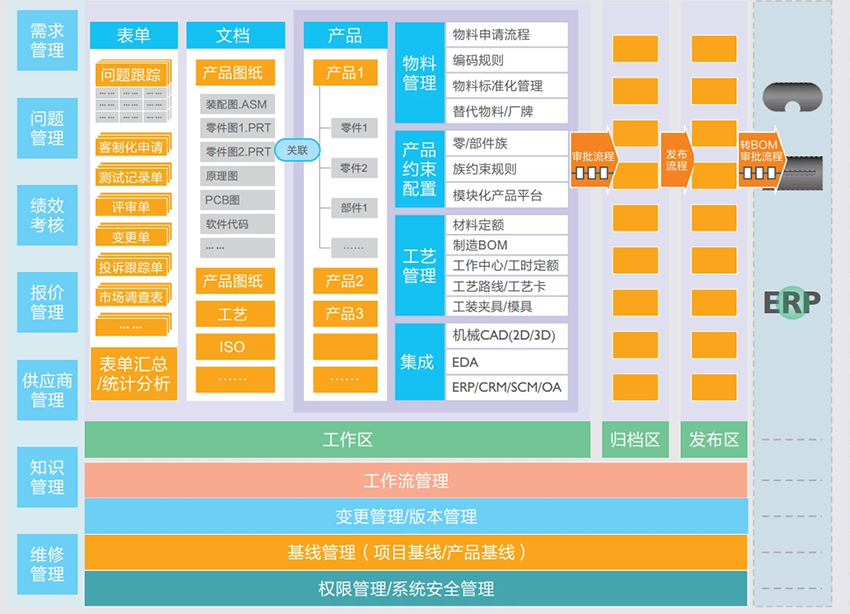
Primary Functions
01. Automatic Coding
The Fantian PLM system utilizes a unique coding definition method, capable of handling various types of coding definitions. It primarily offers two methods: tree coding and segmented coding; it can define coding principles for raw materials, components, standard parts, finished products, equipment, and tools for the enterprise. After defining the principles for each coding item, you can directly generate the required codes based on these principles.
02. CAD Integration
The Fangtian PLM system can manage various types of documents. Currently, the system can directly manage approximately 200 different software types. It's easy to add unknown types of software files. Each type of software requires defining a template file for that type. CAD system interfaces include (Autocad, CAXA, Solid Edge, Solid Works, UG_Ⅱ, Pro_e, Ideas, Word, Excel...). Interfaces with electronic CAD systems like PROTEL.
03. Tiered Access Permissions
Establish the company's departments and staff under each department. This includes user IDs, names, passwords, roles, and departments.
04. Document Management
The Fangtian PLM system is based on a distributed file management system, with distributed file cabinets that can be established on a local area network or a wide area network. File cabinets can be located on a single machine or multiple machines. A file cabinet refers to a physical space for storing graphic and text file information. Each file cabinet requires the definition of access rules. The definition of access rules for each file cabinet can vary greatly.
05. Documentation Management
We offer design document management, administrative document management, archiving, borrowing, blueprint distribution, circulation, feedback form management, controlled library management, approval of drawings and documents, and management of changes to drawings and documents.
06. Project Management
Project categories management, project initiation, project process management, project approval, project document management, and project monitoring.
07. Product Design Management
Primarily composed of template registration, structural design, product structure inquiry, and specification design.
08. Approval of Drawings
Highly efficient and practical series of auxiliary tools, supporting output formats from over a hundred design software browsers; workflow approval for graphic and text files, with the ability to issue comments. Documents with error annotations can be returned to the submitter.
09. Product Configuration Management
Configuration management provides a quick copy feature for the entire product design; when designing a new product structure, if a mature component structure that has been designed before is found, the required structure can be copied from previous products.
10. Process BOM Management
The product design tree is reconfigured into a process tree by the engineering staff, along with the processing attributes for each component. For example: raw material processing, outsourced blank processing, outsourced raw material processing, purchased production materials, etc.
11. Process Route Management
Primarily includes material management, equipment record management, material quotas, process management, and process route preparation, etc. In this process route preparation module, edit process routes for each component, including the equipment and processes used. Also, prepare process cards for components.
12. Process Card Management
Manage various process cards, including machining cards, heat treatment cards, etc.
13. Design Cost Management
We primarily offer two modules: Price Management and Cost Calculation. Price Management provides the purchase price or manufacturing cost for each component. Then, within the Cost Calculation module, the overall cost price for the entire design tree or part is calculated.
14. Custom Workflow
The workflow definition primarily consists of approval processes for workflows, graphic and text files, modification processes for graphic and text files, borrowing processes for graphic and text files, ISO9000 standard rule definitions, knowledge rule definitions, and design knowledge management. The definition of work processes can generate various templates, and different projects can choose different templates for workflow approvals. This module also allows for defining multiple graphic and text file approval templates, selecting the appropriate approval process for graphic and text files based on different real-world situations.
15. Visual Project Monitoring
Project Monitoring is the real-time tracking of the progress of work processes.
The network schedule diagram outlines who will perform each project step and how long it will take, which is then filled out based on actual conditions, providing reasons for delays. This allows leaders to monitor the progress of specific work in real-time.
Application Value
01. Manage product data throughout its entire lifecycle with Fangtian PLM, driving product innovation
FT PLM focuses on product structure management, linking all technical data related to products, including components, design drawings, engineering drawings, process documents, product documents, materials, APQP, etc. By integrating CAD, ERP, OA, and other information management systems, it achieves data management throughout the entire lifecycle of the product.
02. Utilizing the application of the Fandian PLM for managing design projects enables efficient quality control of the designed products.
The Fantian PLM Collaboration Platform is an integrated tool for multiple project members to协同complete project tasks. The main functions include: team establishment, project planning and task decomposition, automatic task dispatch strategy to implement work precedence and automated workflows, color-coded task status for easy tracking and monitoring, project data management and role-based control, hierarchical control of sub-projects and projects, achieving integrated management of people, processes, and data.
The Fangtian PLM Project Management Module integrates the concepts of quality systems like APQP and FMEA, facilitating successful application in APQP management for enterprises.
Businesses can monitor and track project progress through Gantt charts and the execution status of project tasks, coordinate the smooth operation of projects, and manage the output results of projects.
Fangtian PLM can also implement hierarchical control of project teams in project planning.
The project manager is responsible for defining the project team or plan, and then each group leader maintains their team members and their respective stages. According to international project management standards, it is typically the project manager who is in charge of establishing and maintaining the project team, as well as all project plans. However, in the actual execution process, especially for large projects, the project manager often bears an excessive workload in maintaining the project plans.
03. Fengtian PLM offers change data management solutions, ensuring the integrity, accuracy, and consistency of product data.
Due to various reasons within the company, frequent engineering changes are required. Compared to traditional manual methods, the key features of FT PLM Change Management are the complete integration of the review and implementation processes of change orders, meaning the approval of change orders is equivalent to the completion of data changes. It can be applied to all types of product data objects and can perform overall changes to a collection of data objects, thereby ensuring the completeness, accuracy, and consistency of product data.
04. The Fangtian PLM enables collaborative operations between enterprises and their upstream and downstream partners, as well as among different departments within the same enterprise.
Companies can collaborate with suppliers through the Fangtian PLM to ensure they are aware of supplier's component design and production schedules, controlling component quality to reduce the risk of product defects, decrease inventory, and guarantee timely market entry. Additionally, companies can integrate customer feedback on product quality into product improvement designs through Fangtian PLM, to develop products that competitors can't match and clients love, enhancing customer satisfaction.
Fangtian PLM provides shared access to all design data, allowing engineers, production, and procurement departments to quickly grasp the dynamics of design and process data, enabling timely adjustments and enhancing the company's responsiveness. The Fangtian PLM also integrates with information management platforms like CAD, ERP, and OA, ensuring seamless data flow within the enterprise and eliminating information silos.
05. The Fangtian PLM significantly reduces product costs through standardized product management.
Fangtian PLM standardizes product design and work specifications through standardized settings of output tasks and workflows. Additionally, companies can enhance the standardization of materials by analyzing the statistics of standard parts, general parts, and special parts provided by Fangtian PLM, as well as the frequency of part references, thereby reducing production costs. Moreover, group companies can centrally manage group materials and lower procurement costs through group purchasing.
06. Fanti PLM ensures data security management throughout the entire product lifecycle with system security management.
FT PLM divides data objects and their attributes into various permission definition methods horizontally and vertically: six types including functions, data, categories, pagination, views, and queries. Companies can determine which permissions different roles have. Additionally, by defining different permission levels for various departments, project teams, and data objects at different stages, the company can ensure that all data within the same project team works in a coordinated and consistent parallel manner.