









The Okazaki Management Model, a unique business philosophy created by the Japanese business sage Katsujiro Ono, is the driving force behind the growth and enduring success of the two companies he founded—Kyocera and KDDI. It was the Okazaki Management Model that allowed these businesses to thrive. On February 1, 2010, Ono took on the role of Chairman of the bankrupt Japan Airlines (JAL), serving until the end of March 2011, a total of 424 days. As President of the bankrupt Japan Airlines Corporation (JAL), Ono is attempting to implement the Okazaki Management Model within the airline. In fact, the Okazaki Management Model, along with Kyocera Accounting, are considered the two pillars of Ono's management philosophy.
The essence of the Amoeba Management Model
As they say, "No destruction, no creation." The first step in advancing the Amoeba management system is to "destroy" the traditional pyramid organization. Initially, transform it into an "upside-down triangle" structure, where all levels of the organization serve products and customers. The "upside-down triangle" organization alters the perception of hierarchical roles, making "leadership" about service and guidance rather than command and control. The value is created at the "tip" where direct contact with customers occurs.
Step 2 of the Amoeba transformation targets "networking" and "decentralization," making two significant structural adjustments: building a foundational business platform and transforming business departments into "micro-companies." All original departments, such as procurement, R&D, manufacturing, and logistics, are converted into business platforms. The business units under each department are all abolished, with employees forming "micro-companies" with different capabilities through self-organization. Employee roles shift from division and department managers to platform leaders, micro-company owners, and creators. Here, creators emphasize entrepreneurial and innovative activities, essentially being one with the micro-company owners. Platform leaders are responsible for the operation of the business platform, with the main task being to attract more resources into the platform for the benefit of micro-companies. Micro-companies directly interface with users, creating value by identifying needs, developing products and services.
Tightly aligned with the organizational restructuring is the transformation of operational mechanisms. There is no hierarchical or command relationship between the platform and small and micro enterprises; the traditional incentive mechanisms have lost their organizational foundation. The internal operational mechanisms of enterprises mainly include "assemble and disassemble according to orders," "user evaluation and payment," and "profit sharing." "Assemble and disassemble according to orders" refers to building teams centered around user needs; each user need represents a new product proposal and a value growth point. Orders can be published by users or small and micro enterprises onto the system platform, where micro enterprises with different capabilities gather independently to form a large solution team, developing products that meet these needs.
Amoeba management software implementation
How to implement the Amoeba system through software, which Katsuhiro稻盛 and his counterparts haven't discussed, and there are few precedents worldwide. That's the question I've been pondering. Based on my dual understanding of software and the mold, fixture, and non-standard industries, I proposed a guiding principle for my R&D team to develop Amoeba software: "Organize flexible units with real-time independent accounting."
After nearly a year of research and development, an Amoeba management software for the mold industry has been born, providing IT technical support for the localization of Amoeba applications. At the same time, we have seamlessly integrated the Amoeba management software into the Fangtian Mold ERP management system, allowing businesses to quickly implement Amoeba management without reorganizing or implementing their operations.
01. Organized Flexible Units
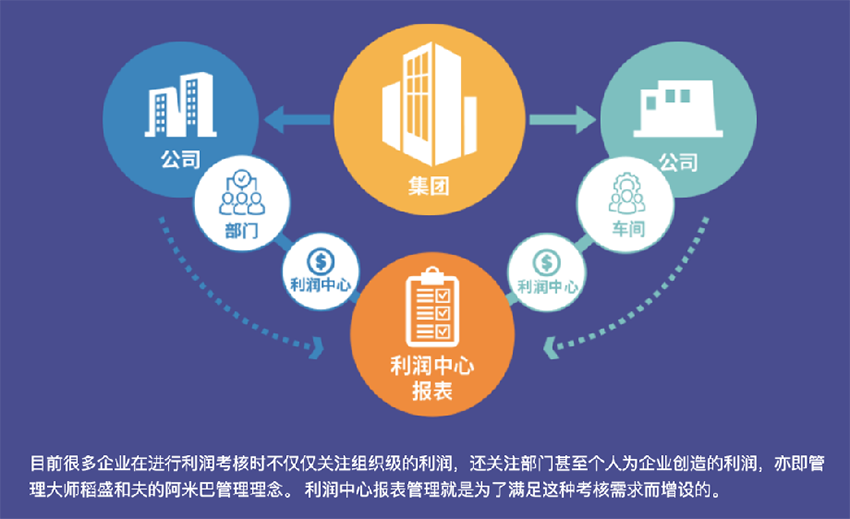
The mold company is organized into individual "Amoeba" small collectives (project teams, manufacturing centers, etc.), each collective acting as a small and medium-sized enterprise, each being an independently accounted BU (business unit). The company's assessment indicators are directly applied to all units, big or small.
The system supports down to the cell-SBU level (Cell-SBU Quantitative Delegation), which can be defined by the company according to its own situation within the "Design Flexible Unit" module of Fangtian.
02. Real-time Independent Accounting
Implementing the Amoeba management system in the software requires a robust financial management system, which is not a difficult task for us as we had planned the financial module from the initial system architecture. However, we faced numerous challenges in the process. We found that the original financial system was designed based on financial accounting and management accounting, focusing more on post-event financial calculations. The Amoeba software, on the other hand, must be developed under the guidance of operational accounting to truly help businesses solve operational issues.
So, we made significant adjustments to our financial system to accommodate this change, achieving real-time independent accounting and promptly identifying any unreasonable phenomena in the income and related expenses of the company's production and operation, striving for "maximizing profits and minimizing costs."
Peel back the essence of business through the lens of digital Amoeba organizations. Involve every employee in the business process, allowing them to clearly see their own contributions, and enhance their sense of belonging and responsibility.
Where do these important assessment goals come from? The system directly links to the Feitian Mold ERP Quotation System's gross margin indicators, calculated entirely based on market prices. Therefore, to survive, each "Amoeba" must strive to reduce the cost of products or services as much as possible.
The benefits of real-time or unit-time accounting are that it allows for the setting and implementation of short-term goals, ensuring they are completed. It instills a subconscious drive in employees to meet their goals no matter what. Solutions to all issues and answers are right there on the spot.
The successful development of Fangtian's ABEOM management software has filled a technical gap in the domestic market and has become an integrated ABEOM management software in the mold industry's ERP management system, further solidifying its position in the industry.
By implementing the Fangtian Ameba Management Software, it is certain to enhance the overall management and operation level of Chinese mold enterprises, and accelerate their efficient operation.