












Fangtian CRM (Customer Relationship Management)Customer Relationship Management (CRM) refers to the use of CRM by enterprises to manage relationships with customers. CRM is a business strategy for selecting and managing valuable customers and their relationships, requiring a customer-centric business philosophy and corporate culture to support effective marketing, sales, and service processes. If a company has the right leadership, strategy, and corporate culture, the application of CRM will enable effective customer relationship management.
Key Features
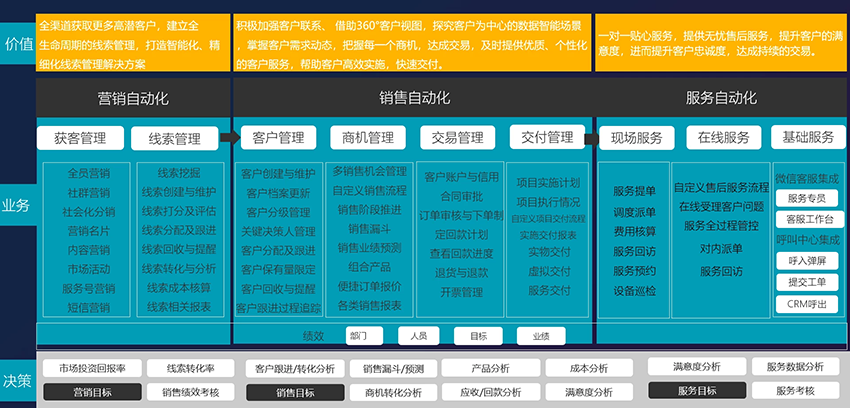
The Fangtian CRM system is a customer relationship management system that integrates management ideas and technical achievements, serving as a powerful assistant for enterprises to implement a customer-centric strategic orientation. It includes the following four subsystems:
01. Customer Collaboration Management System
The Customer Relationship Management system should emphasize a customer-centric approach, first by enabling clients to communicate and interact with the company in various ways, which is a feature that the Customer Collaboration Management system possesses.
02. Business Operation Management System
Each department in the company needs to interact with customers, particularly marketing, sales, and customer service departments, which do so more frequently. Thus, a Customer Relationship Management (CRM) system is essential to support these departments, giving rise to Business Operations Management systems. These systems primarily accomplish three basic functions: marketing, sales, customer service, and support.
03. Data Analysis Management System
In the Data Analysis Management System, functions such as data warehousing, data marts, and data mining will be implemented, upon which Business Intelligence and Decision Analysis will be achieved. This system is primarily responsible for collecting, storing, and analyzing various information related to the market, sales, services, and the entire enterprise. It provides a multi-dimensional understanding of customers, offering a basis for market decision-making for the company. This helps to align the relationship between the company's resources and customer needs, enhance customer satisfaction, and achieve goals such as acquiring new customers, supporting cross-selling, retaining existing customers, identifying key customers, and providing personalized services for specific customers.
04. Information Technology Management System
Due to the fact that the operation of all functional modules and related systems of customer relationship management is secured by advanced technology, the management of information technology has become a key factor for the successful implementation of CRM systems.
Application Value
01. Maintain existing clients, seek new prospects
Research shows that the cost of acquiring a new customer is five times that of maintaining an existing one. By establishing a CRM system, businesses can effectively collect, organize, and analyze customer information, achieve internal resource sharing, and improve service levels, thus maintaining relationships with long-term clients. Moreover, CRM systems, supported by information platforms and data analysis platforms, help businesses analyze potential customer groups and predict market trends, aiding in identifying target clients, seizing business opportunities promptly, and capturing a larger market share. They are crucial allies for businesses in continuously expanding their customer base and entering new markets.
02. Avoid customer loss due to overly dispersed customer resources
Many companies accumulate customer resources in a scattered manner, which directly leads to incomplete and low-value customer information records. Additionally, due to the turnover of sales staff, customer resources are constantly lost. A CRM system can help decision-makers accurately understand the overall progress of customers and identify existing issues, enabling timely business guidance and strategy adjustments to prevent unnecessary customer loss.
03. Enhance Customer Loyalty and Satisfaction
CRM systems enable businesses to thoroughly understand customer information, enhance communication with clients, coordinate customer service resources, and provide timely and excellent service. They also help establish long-term and stable reciprocal relationships with clients, significantly boosting customer loyalty and satisfaction.
04. Reduce Marketing Costs
The company can achieve resource sharing and optimize collaboration processes internally through the CRM system, while externally, it can enhance market understanding, effectively predict market trends, thereby not only improving operational efficiency but also significantly reducing operational costs.
05. Monitor Sales Rep Performance
The mobile CRM system enables supervisors to accurately track the location and work status of sales representatives, preventing dishonest practices and personal business, which is conducive to the company's performance evaluation and enhancing the efficiency of sales personnel.