













Tailored suits, business attire customization, work jackets, cotton jackets, rain jackets, hoodies, sweatshirts, T-shirts, baseball jackets, etc.
Custom work uniforms, repair work uniforms, workshop uniforms, engineering uniforms, antistatic work uniforms, sanitation work uniforms, electrician work uniforms, and more, offering over 1,000 styles. Wide color selection, accepts sample or custom designs, and supports custom embroidery and printing. Main fabrics include polyester-cotton, cotton, and antistatic processes.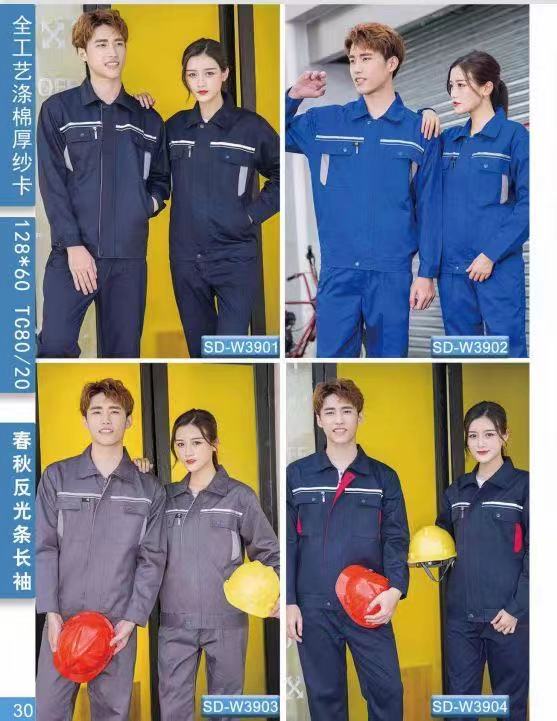
The process of receiving work uniforms worn by employees is not as simple as receiving them directly from the vendor. In fact, the customization process for work uniforms can be somewhat complex. Shenzhen workwear manufacturers have been in this industry for many years and are very familiar with the customization process, which mainly includes the following four aspects:
1. Style Design & Sample Garment Production: Upon receiving the client's initial cooperation intention, the workwear manufacturer proposes a reasonable design plan based on the client's requirements, determines the basic style. Once the style is confirmed, the fabric confirmation process begins, followed by the production of sample garments. If both parties agree without any disputes, a signature is used to finalize the design.
2. Contract Signing: In accordance with the relevant industry's "Contract Law" in our country, a cooperative agreement is drafted and signed upon mutual agreement of the parties, thereby acquiring legal efficacy.
3. Delivery: At the time of contract signing, there is a delivery time limit. The safety wear company will complete the task according to regulations and either transport the safety wear by special vehicle or deliver it via logistics to the customer.
4. After-Sales Service: This is a crucial aspect. If customers receive goods that are substandard or require rework, they should promptly contact the manufacturer. The manufacturer has a duty to handle the issue properly and protect the customers' interests.
What types of fabrics are available for custom work uniforms?
Cotton fabric: A general term for various cotton textiles. It is commonly used to make fashion, casual, underwear, and shirts. Its advantages include ease of warmth, softness, moisture absorption, and excellent breathability. However, it is prone to shrinking and wrinkling, lacks a crisp, attractive appearance, and requires frequent ironing when worn.
2. Hemp fabric: A type of cloth made from fibers of various hemp plants, including flax, ramie, jute, sisal, and abaca. It is commonly used for making casual and workwear, and is also increasingly used for making regular summer clothing. Its advantages include high strength, moisture absorption, heat conduction, and excellent breathability. Its drawbacks are that it is not very comfortable to wear, has a rough and stiff appearance.
3. Silk: A general term for various silk fabrics woven from silk. Like cotton fabrics, it comes in a wide variety with distinct personalities. It can be used to make various types of workwear, particularly suitable for ladies' workwear. Its advantages include its lightness, fit, softness, smoothness, breathability, vibrant colors, luster, elegance, and comfort to wear. However, its drawbacks are that it tends to wrinkle easily, absorb moisture, be not very sturdy, and fade quickly.
4. Velvet: Also known as woolen cloth, it is a general term for fabrics woven from various types of wool and cashmere. It is commonly used to make formal wear, suits, overcoats, and other formal and work uniforms. Its advantages include wrinkle resistance, durability, soft texture, elegance, firmness, elasticity, and strong warmth retention. Its main drawback is that it is difficult to wash and is not suitable for summer clothing.
5. Leather: It is a material made from animal skins that have been tanned. It is commonly used in the production of fashion and winter clothing. It can be divided into two categories: first, leather, which refers to skins that have been dehaired. Second, fur leather, which is processed skins with hair intact. Its advantages include lightness, warmth, and elegance. However, its drawbacks are its high price and the high requirements for storage and care, making it not suitable for widespread use.
6. Chemical Fiber: Abbreviation for chemical textile fibers. It refers to textiles made from fibers produced using high molecular compounds as raw materials. Typically, it is categorized into two main types: artificial fibers and synthetic fibers. Their common advantages include vibrant colors, soft texture, good drape, and smooth comfort. However, their disadvantages include poor wear resistance, heat resistance, moisture absorption, and breathability, as well as tendency to deform when heated and generate static electricity. While they can be used to make various work clothes, they generally do not reach high quality standards and are not suitable for formal occasions.
7. Blended Fabric: A fabric created by blending natural fibers with chemical fibers in specific proportions. It is used to make various work uniforms. Its advantages lie in its combination of the respective benefits of cotton, linen, silk, wool, and synthetic fibers, while also minimizing their individual drawbacks. Additionally, it is relatively inexpensive, making it very popular.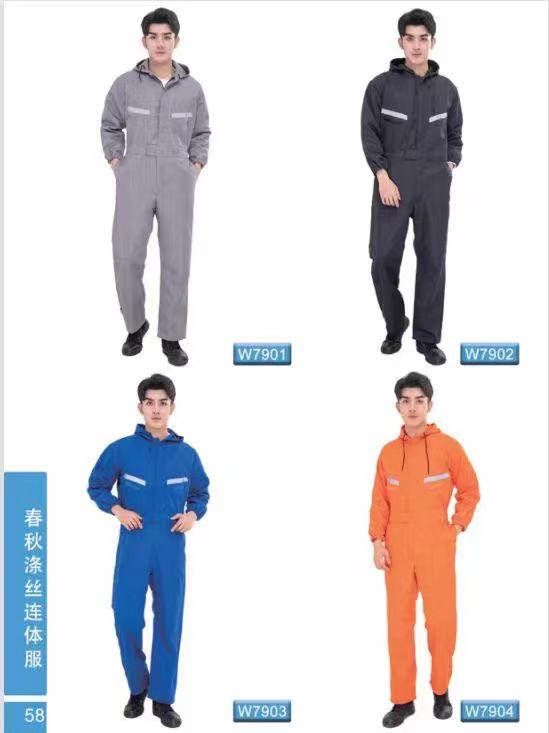
What to consider when customizing work uniforms:
1. Custom Workwear Colors to Match Corporate Style: Different companies have distinct styles. This is not determined by personal preference but rather by the various trades within each company. For example, factories producing food, beverages, and noodles require brighter workwear colors such as white, sky blue, and pink. In contrast, factories in the machinery and metal industry should opt for darker workwear colors like dark blue, gray, and coffee brown, which are easier to clean. Generally, adhere to the three-color rule, meaning no more than three colors should be used. Common colors are black, blue, and gray.
2. Custom Workwear Styles: Both style and color are considered simultaneously; some require separates, others need a full-body design, or other specific requirements.
3. Custom Workwear Fabrics: Choose fabric based on the nature of the job, ensuring work uniforms are easy to keep clean and tidy.
4. Accessories (zippers, buttons, elastic). For some positions, metal zippers cannot be used, and buttons or plastic zippers can be used as alternatives.
5. Sewing Technique: Thread should be neatly arranged, with minimal thread ends to avoid affecting the appearance.
6. Ensure accurate sizing: As needed, take measurements to ensure employees can wear the clothing comfortably.
7. Embroidery and Printing: Most are embroidered, but printing is also quite good now; it can be chosen based on the fabric.
8. Targeted Approach: The concept of targeted design refers to tailoring or selecting work uniforms based on the industry, job role, nature of work, and gender. Considering these factors, it is crucial to have detailed discussions with the uniform manufacturer's designers when choosing or customizing work uniforms to ensure the final design is suitable for the work environment.
9. Cost-effectiveness. This is primarily reflected in the fabric, style, and design of custom work uniforms, as well as the manufacturing process and procedures involved.
Guangxi Bi Ren Garments Co., Ltd. is a full-service clothing company encompassing design, production, and sales. The company boasts a dedicated design team and utilizes its own equipment and cutting facilities. Rush orders can be dispatched on the same day, with production strictly based on the provided design drafts, style sketches, or sample garments. Our selection offers a wider range than what's available in stores.
WeChat Official Account

Scan to follow Official Account




















