





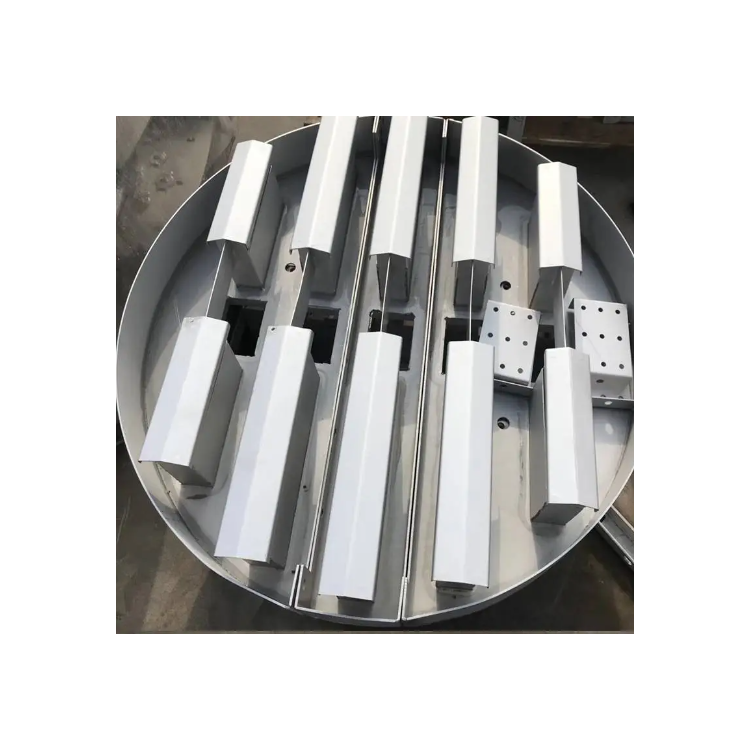
Floating valve trayOver the nearly five decades since its development, extensive research, wide application, and rapid promotion have placed it at the forefront among various tower plates. This is all due to its excellent performance, which is primarily characterized by the following points:
①High operating flexibility: As the gas load varies within a relatively wide range, the float valve opening adjusts accordingly, while the gap gas velocity remains nearly constant. Therefore, by designing the gas jet outlet of the float valve to create good bubbling in the liquid layer, excellent mass transfer conditions can be provided over a wide gas load range, maintaining a high separation efficiency.
② High separation efficiency: For various materials systems,Floating valve trayThe efficiency of the tray towers is superior to that of the bubble cap towers. Generally, the efficiency of the floating valve towers can be 10%-15% higher than that of the bubble cap towers, and it can still maintain this efficiency under low load conditions. Therefore, it produces fewer defective products during the initial startup. Compared to other tower shapes, the floating valve tower can ensure product quality or reduce the reflux ratio to save energy and cooling water. Changing a bubble cap tower to a floating valve tower without replacing the tower body to improve the separation process is typically successful.
③. High Processing Capacity: The compactness of the floating valve arrangement on the tray is better than the bubble cap, resulting in a higher hole rate; plus, the airflow blows into the valve below the horizontal direction around the valve (unlike some trays where there's an upward acceleration splashing when the airflow is ejected around the valve), allowing a significantly higher allowable gas flow in the bubble zone without a significant increase in mist entrainment. Generally, the production capacity of a floating valve tray can be 20%-40% higher than that of a similar-sized bubble cap tray. Therefore, when constructing new towers, investment can be reduced, and when modifying old towers, output or quality can be improved.