

Product Details
Reverse Osmosis Equipment | Water Purification Equipment | Ultrafiltration Equipment | Pure Water Equipment | Smart Water Management | Water Supply Equipment | Disinfection Equipment | Soft Water Equipment | Sewage Treatment Equipment | Water Treatment Consumables


价 格Negotiable
最小起订0 Piece库存0 Piece
 Business Card
Negotiable

Negotiable

Negotiable

Negotiable
 Rural Drinking Water Disinfection
Negotiable
Rural Drinking Water Disinfection
Negotiable
 EDI Deionization Equipment
Negotiable
EDI Deionization Equipment
Negotiable
 Building Direct Drinking Water Eq
Negotiable
Building Direct Drinking Water Eq
Negotiable
 Reverse Osmosis Water Purificatio
Negotiable
Reverse Osmosis Water Purificatio
Negotiable
 Electrolytic Chlorine Dioxide Gen
Negotiable
Electrolytic Chlorine Dioxide Gen
Negotiable
 Ozone Generator
Negotiable
Ozone Generator
Negotiable
 Industrial Pure Water Equipment
Negotiable
Industrial Pure Water Equipment
Negotiable
 Small sewage treatment equipment
Negotiable
Small sewage treatment equipment
Negotiable
 Boiler Softening Water Equipment
Negotiable
Boiler Softening Water Equipment
Negotiable
 Large-scale soft water equipment
Negotiable
Large-scale soft water equipment
Negotiable
Fully Automatic Softening Water Equipment
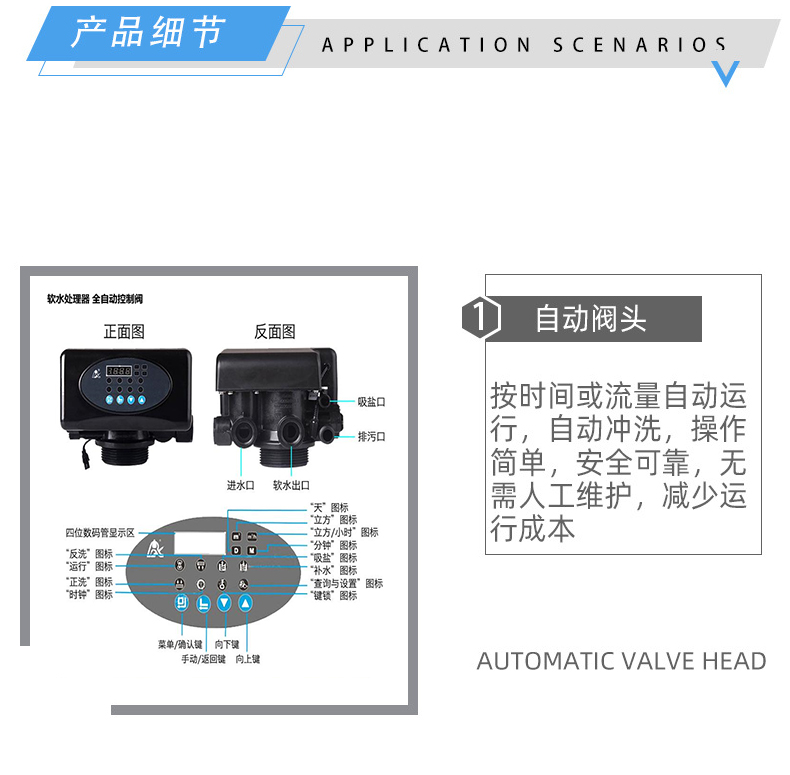
Industrial softening water equipment, also known as industrial water softeners, is an ion exchange soft water system that operates through a running and regeneration process. It utilizes sodium cation exchange resins to remove calcium and magnesium ions from water, thereby reducing the hardness of the raw water. It is applied in boiler make-up water treatment, cooling water softening, chemical batching softening, groundwater softening, food-grade water softening, industrial water softening, and more. The purpose of reducing hardness is to prevent scaling from forming in pipes, containers, and boilers due to carbonates. It significantly saves investment costs while ensuring smooth production. It is now widely used in the circulating make-up water of various steam boilers, hot water boilers, heat exchangers, steam condensers, air conditioners, and direct combustion engines, as well as their systems.
Fully Automatic Softening Water Equipment Product
Industrial soft water equipment can be divided into process water softening equipment and circulating cooling water softening equipment based on different application scenarios.
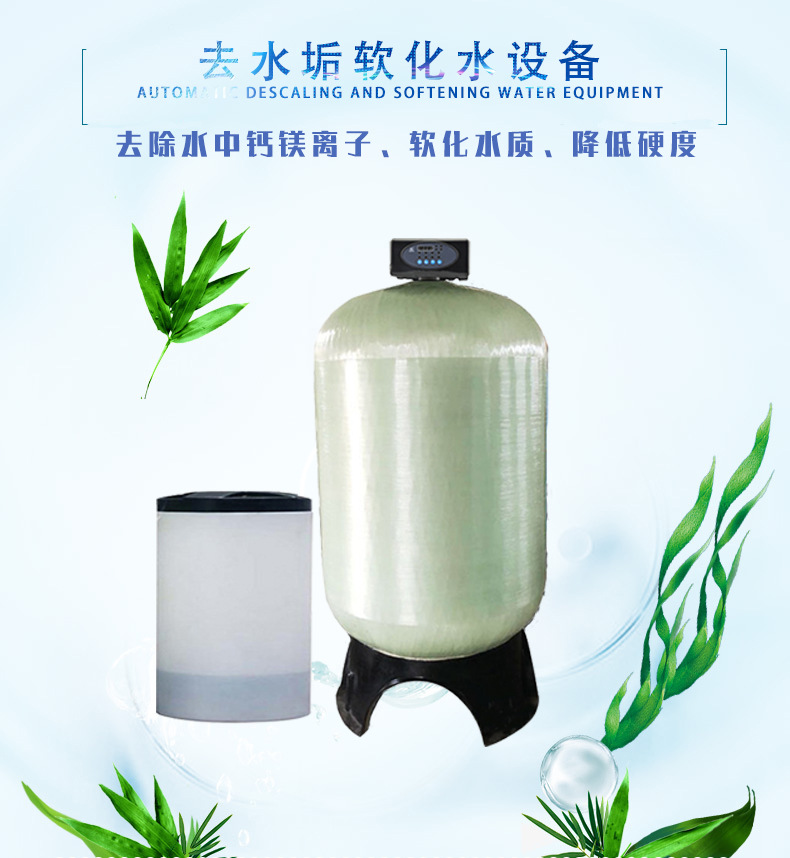
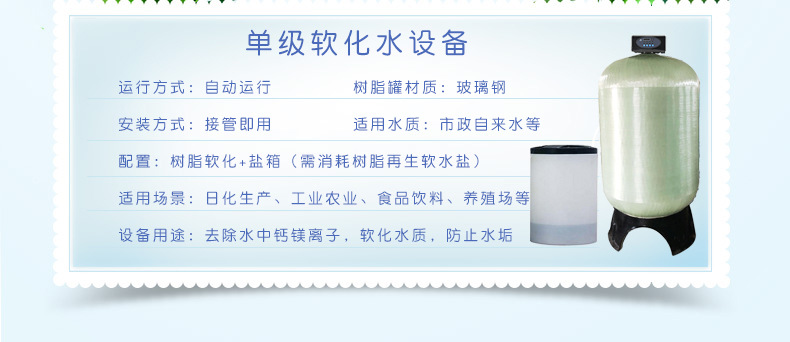
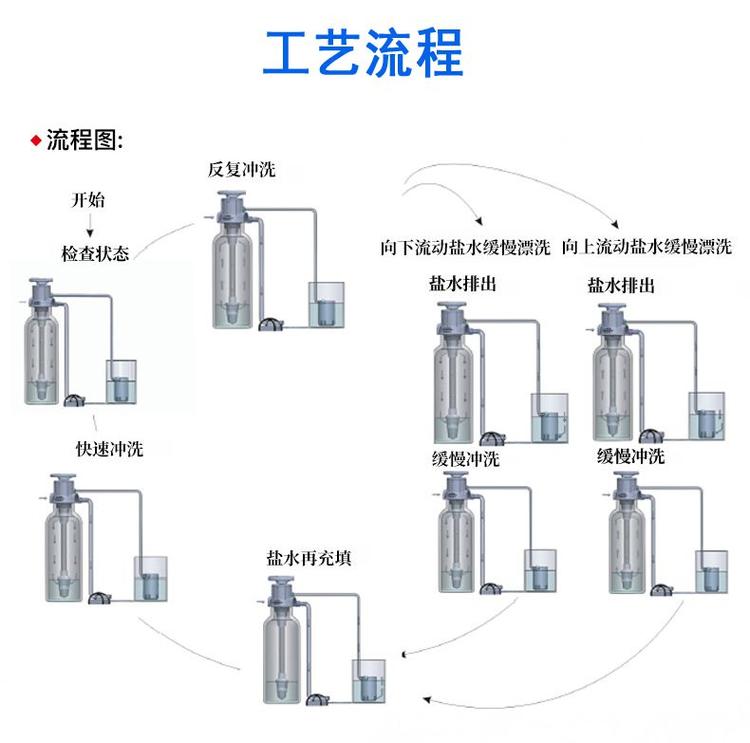


Water hardness is primarily formed by calcium and magnesium and is indicated by these elements. Generally, cation exchange resins (water softeners) are used to pass the raw water through sodium cation exchange resins, allowing the hardness components Ca2+ and Mg2+ in the water to exchange with Na+ in the resin. This吸附s the Ca2+ and Mg2+ in the water, softening it. As the concentration of Ca2+ and Mg2+ in the resin increases, the resin's effectiveness in removing them gradually diminishes. After the resin absorbs calcium and magnesium ions, it needs to be regenerated. The regeneration process involves rinsing the resin bed with brine from the salt tank, displacing the hardness ions from the resin, which are then排出s with the regeneration waste fluid. The resin then regains its softening and exchange capabilities.

Phone Consultation