

Product Details
Reverse Osmosis Equipment | Water Purification Equipment | Ultrafiltration Equipment | Pure Water Equipment | Smart Water Management | Water Supply Equipment | Disinfection Equipment | Soft Water Equipment | Sewage Treatment Equipment | Water Treatment Consumables


价 格Negotiable
最小起订0 Piece库存0 Piece
 Business Card
Negotiable

Negotiable

Negotiable

Negotiable
 0.5 T/H soft water treatment equi
Negotiable
0.5 T/H soft water treatment equi
Negotiable
 Reverse Osmosis Water Purificatio
Negotiable
Reverse Osmosis Water Purificatio
Negotiable
 Industrial Pure Water Equipment
Negotiable
Industrial Pure Water Equipment
Negotiable
 Building Direct Drinking Water Eq
Negotiable
Building Direct Drinking Water Eq
Negotiable
 Industrial Pure Water Equipment
Negotiable
Industrial Pure Water Equipment
Negotiable
 Brine Reverse Osmosis Equipment
Negotiable
Brine Reverse Osmosis Equipment
Negotiable
 Direct Drinking Water Equipment
Negotiable
Direct Drinking Water Equipment
Negotiable
 Rural Drinking Water Disinfection
Negotiable
Rural Drinking Water Disinfection
Negotiable
 Photovoltaic Sodium Hypochlorite
Negotiable
Photovoltaic Sodium Hypochlorite
Negotiable
 Water Softening Equipment
Negotiable
Water Softening Equipment
Negotiable
Building Direct-Draw Water Purification Equipment
When operating pressure above the natural osmotic pressure is applied to the concentrated solution side, the natural osmotic flow of water molecules reverses; a portion of the water molecules in the incoming (concentrated) solution pass through the reverse osmosis membrane to become the purified product water on the dilute solution side. It can block dissolved salts and organic substances with a molecular weight greater than 100, but allows water molecules to pass through. The desalination rate of the reverse osmosis composite membrane is generally greater than 98%.
The pressure-driven membrane separation process filters with precision ranging from 0.005 to 0.01 μm, effectively removing particles, colloids, bacteria, heat sources, and high molecular organic substances from water. It is widely applicable in the separation, concentration, and purification of substances. The ultrafiltration process has no phase transition, operates at room temperature, is suitable for separating heat-sensitive substances, and exhibits excellent temperature, acid-base, and oxidation resistance. It can be used continuously for an extended period under conditions of 60℃ or below and pH levels between 2 and 11.
Building Direct-Draw Water System Components
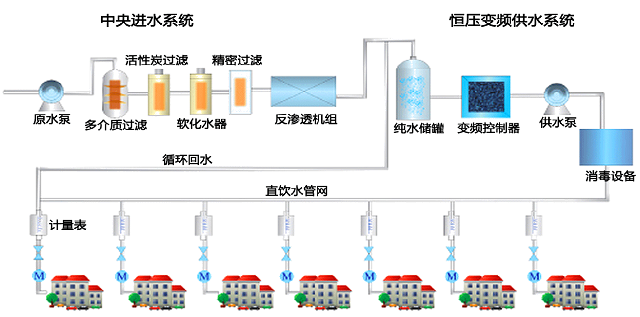
Typically includes pretreatment systems, reverse osmosis units, post-treatment systems, cleaning systems, and electrical control systems, etc.
The pretreatment system typically includes a raw water pump, quartz sand filter, activated carbon filter, and precision filter, among others. Its primary function is to reduce the pollution index of raw water and residual chlorine as well as other impurities to meet the requirements for reverse osmosis feedwater. The equipment configuration of the pretreatment system should be determined based on the specific conditions of the raw water.
Reverse osmosis systems mainly consist of multi-stage high-pressure pumps, reverse osmosis membrane elements, membrane housing (pressure vessel), brackets, etc. Their primary function is to remove impurities from water, ensuring the treated water meets usage standards.
The post-treatment system is an additional configuration added when reverse osmosis fails to meet the water output requirements. It primarily includes one or more of the following equipment: anion exchange, cation exchange, mixed bed, sterilization, ultrafiltration, and EDI. The post-treatment system can further improve the water quality from reverse osmosis, ensuring it meets the usage standards.
The cleaning system is mainly composed of a cleaning tank, a cleaning pump, and a precision filter. When the reverse osmosis system is contaminated and the water output quality fails to meet the requirements, it is necessary to clean the reverse osmosis system to restore its efficiency.
The electrical control system is used to ensure the normal operation of the entire reverse osmosis system. It includes the instrument panel, control panel, various electrical protections, and electrical control cabinets.
Advantages of Building Direct-Drinking Water Equipment Manufacturers
1 Sanitation: Sanitary pipes remove all inorganic and organic substances from drinking water, fully complying with the Ministry of Construction's CJ94-2005 Drinking Water Quality Standards. Additionally, there is no secondary contamination, making them hygienic.
2 Freshness: Since the water in the pipeline drinking water system is in a continuous circulation state, even if the user does not use a drop of water, the clean water in the pipes returns to the water purification station after some time, gets reprocessed, and then delivered to the user again. Therefore, the drinking water the user consumes is freshly produced that day, unlike bottled water which typically takes 5-20 days from production to the user's consumption.
3 Convenience: Direct-piped drinking water is delivered to customers' homes through drinking water pipes, allowing them to enjoy clean drinking water by simply opening the control valve. It's easy to use, and additionally, the direct-piped drinking water system typically doesn't require an automatic meter reading billing device, making management convenient.

Phone Consultation