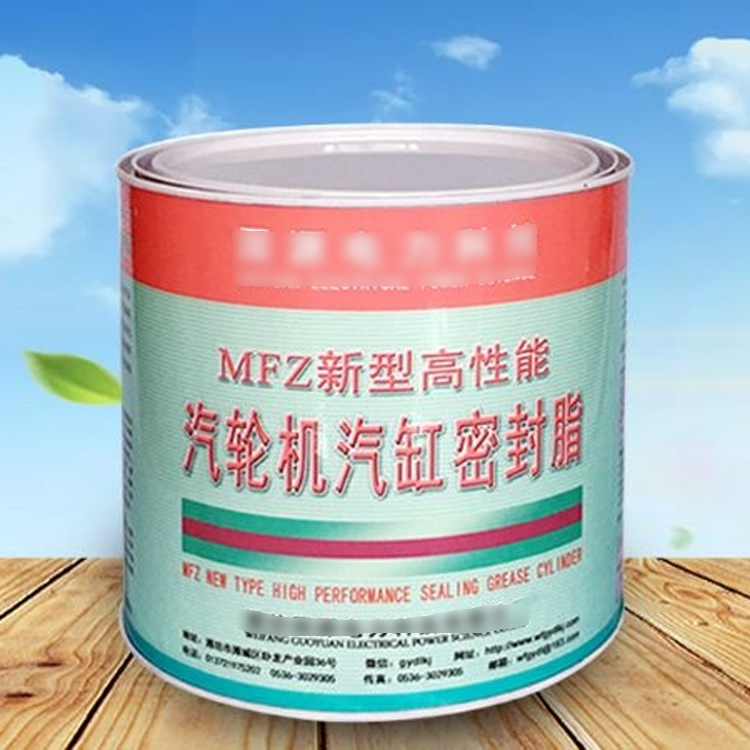
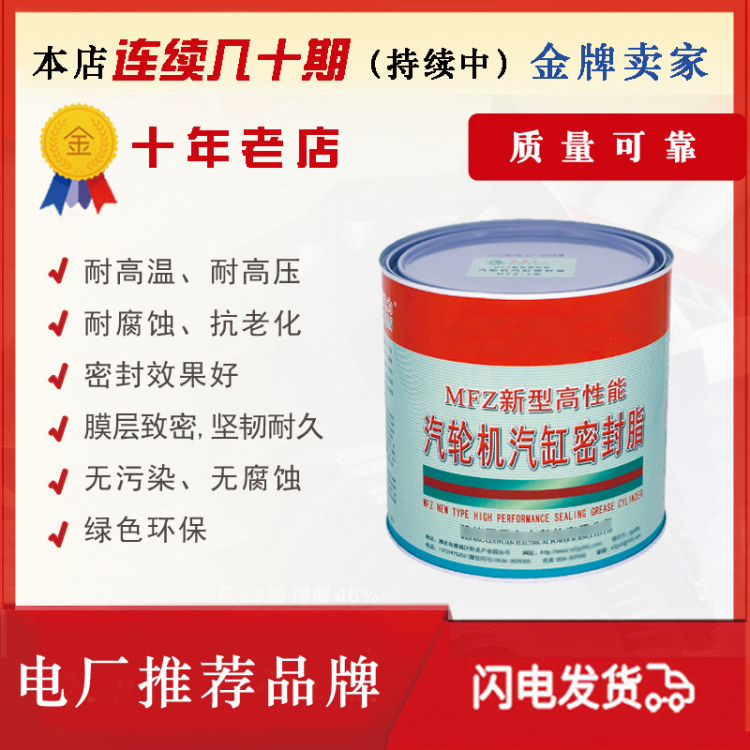
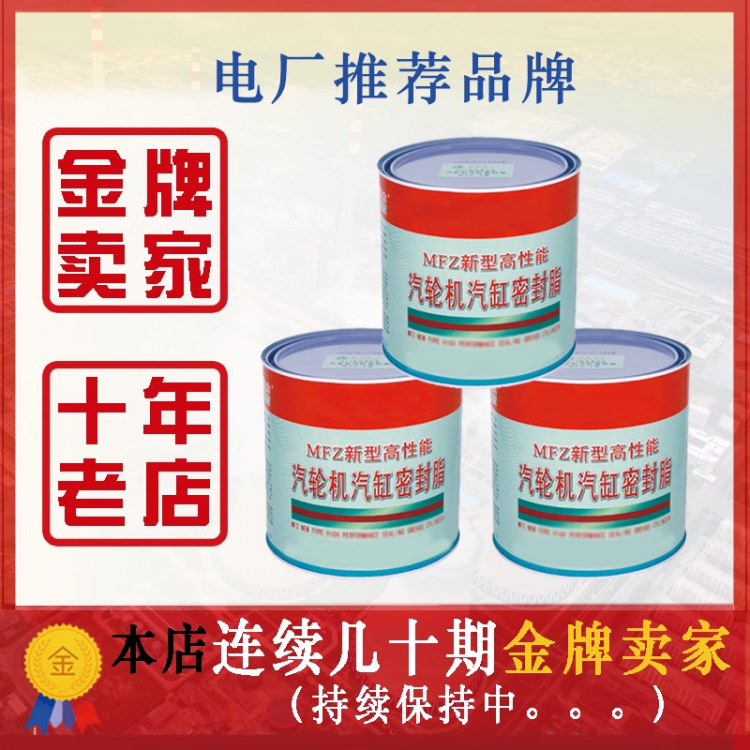
Primarily produces cylinder sealant, high-temperature anti-seizing agents, conductive grease, and other industrial adhesives.
0536-8686992
Turbine cylinder sealant is a sealing agent used on the joint surfaces of steam turbines in thermal power plants, requiring long-term stable performance under high temperature, high pressure, and high load conditions. The cylinder sealant is mainly composed of two parts: grease and solid powder. It is primarily used for sealing the joint surfaces of turbine cylinders, where the cylinder seal is a metal-to-metal contact. Only when the cylinder sealant forms a sticky oil film in the sealing area of the cylinder surface can a tight seal be achieved. The quality of the cylinder sealant directly affects the sealing effectiveness of the cylinder.
Turbine cylinder and shaft seal sleeve leaks during operation. If the leakage is not significant, it can be temporarily neglected. Severe leakage requires a cylinder overhaul. There are various methods for overhaul, depending on the specific equipment and leakage conditions. Generally, there are the following options:
Determine the deformation and gap location and size of the cylinders
Thoroughly inspect the tightness of the sealing surfaces for one-third of the法兰 bolts. If the gaps are evenly distributed, prioritize issues with bolt tension and coating quality. If gaps are only present in localized areas, mark the gap locations, lift the top cylinder, clean the sealing surfaces, and carefully measure the shape and size of the gap between the flat ruler and the flange plane using a long flat ruler and feeler gauge or depth gauge on the bottom cylinder sealing surface, especially on the marked section. To determine if the gaps are uniformly changing, forming regular convex or concave shapes, if so, increase the clamping arc length (increasing bolt tension) within the effective elongation range of the cylinder horizontal sealing surface bolts, and use cylinder-shaped sealing grease (Type III) in conjunction.
Determine the method for handling flat deformation of flanges.
An analysis of cylinder clearance measurement records. For cylinders with significant deformation and large clearance surfaces, surface dressing should be performed on the mating surfaces; for flange flat surfaces with localized deformation or deep dents, it is generally advisable to first brush plating or spray coating, followed by surface dressing.
Section 3: Research on the Flange Interface
First, use a long straight edge or a large flat plate along with a scraper to abrade the mating surface of the cylinder flange until the plane meets the quality standards. Then, use the qualified upper flange plane as a reference to abrade the lower cylinder flange plane. The method is briefly described as follows: Apply a very thin layer of red lead evenly on the mating surface of the lower cylinder flange, place the upper cylinder and drag it back and forth slightly to allow the flanges to abrade against each other. Lift the upper cylinder and adjust the high points on the lower flange surface based on the coloration. When the metal thickness to be abraded is greater than 0.2mm, use a polishing machine or a flat grinding machine to grind first, and use a straight edge to track the change in gaps. Then, use a fine oil stone to polish the ground surface smooth, clean the surface, and use the upper cylinder flange for coloring and abrasion until the protrusions are flattened and the gaps disappear.
Four: Combine surface flange plating, spraying, and补焊 (Note: "补焊" is a Chinese term that refers to "re-welding," but since it's not a complete word, it may need to be contextualized or translated into a phrase that best fits the context. Here's a possible translation: "and re-welding techniques.")
Brush plating, also known as electroplating, involves applying a thin layer of metal to the flange surface using electroplating principles and welding techniques. This method is simple and reliable, suitable for repairing flat surfaces with deep dents where the area is not large. The thickness of the plated layer can be controlled within a range of 0.001 to 1.5mm based on the flat surface deformation. Brush plating is widely used for repairing cylinder joints, but requires specialized equipment and professional operation.
2. Combined with face flange spraying. Spraying involves using a specialized gun to expel high-temperature gas, which melts the metal wire placed inside and blows it into a mist, then sprays it onto the specially treated concave area of the flange face. The characteristics of this process include minimal heat absorption by the cylinder, preventing deformation, and a tight bond between the coating and the flange face with a certain porosity, which facilitates compression and sealing.
3. Welding sealing strips. When the gap area is not large and there are distinct air flow marks, a single or double sealing strip about 8-10mm wide can be welded perpendicular to the air leakage flow. Connect the two sides of the gap pattern, smooth it out, and then scrape it. After completion, the empty cylinder should be checked for no gaps. There are many methods and ways to handle cylinder gaps; please supplement and correct any shortcomings or mistakes.
Contact us

Service Hotline
13721975202
Company Telephone
0536-8686992

Address
Shandong Province, Weifang City, Weicheng District, Xiguan Street, 101st Floor, Building 2, Junhe Yungu Weicheng Science and Technology Valley Industrial Park
b2b.china9.net © Zhongshang 114 Hebei Network Technology Co., Ltd.Address: Room 6009, Oriental New World Center, No.118 East Zhongshan Road, Qiaoxi District, Shijiazhuang City, Hebei ProvincePlatform Service Hotline: 4006299930