






Product Overview
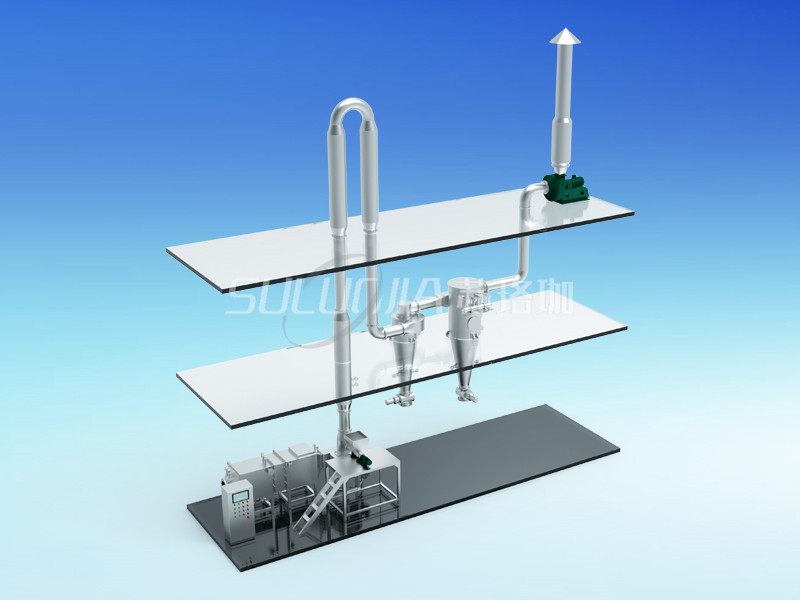
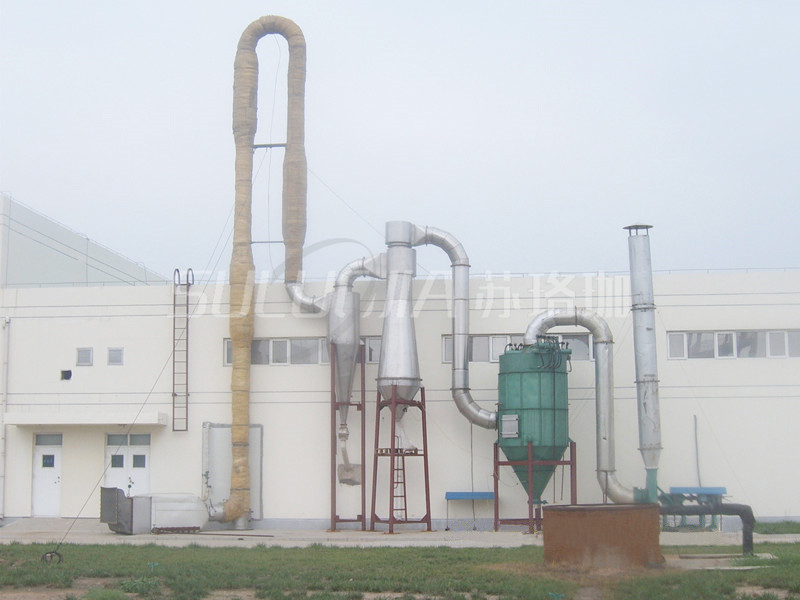
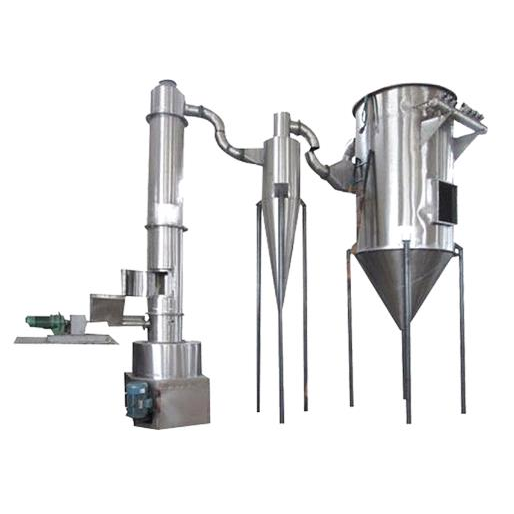
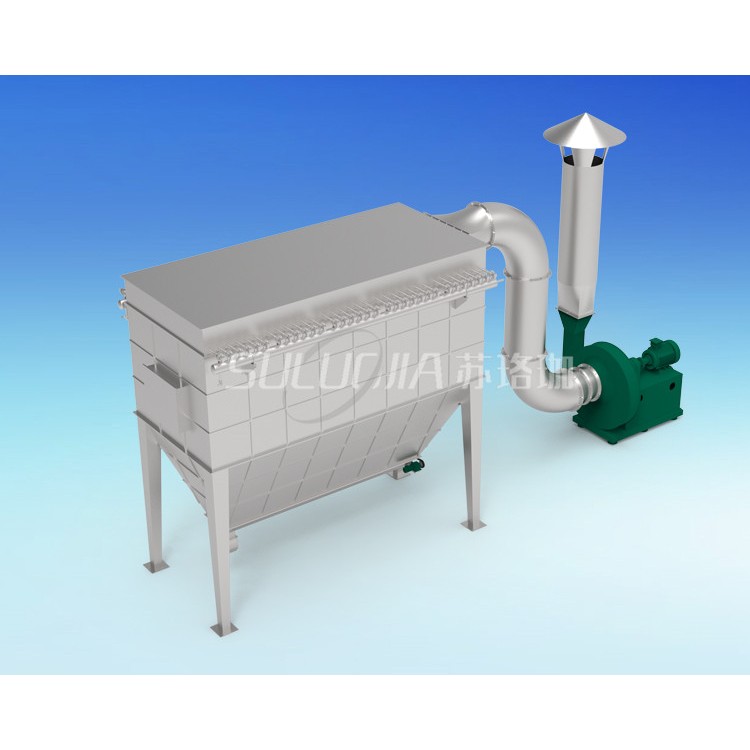
The QG series pulse jet air dryer is a bulk drying equipment that utilizes the principle of instant drying, taking advantage of the rapid movement of heated air. Drive wet material, suspending it in hot air, which enhances the entire drying process and increases the rate of heat and mass transfer. Materials dried by air flow can nearly completely remove non-bound moisture (e.g., feed moisture content of starch materials ≤40% can be reduced to 13.5% in the finished product), and the dried material does not undergo any deterioration. The yield can be significantly higher than that of conventional dryers, allowing users to achieve higher economic returns in a short period.
Product Features
QG Airflow Dryer, suitable for drying and dehumidifying powdery materials in industries such as pharmaceuticals, chemicals, food, building materials, plastics, etc. Examples include starch, fish meal, salt, distiller's grains, feed, gluten, plastic resins, mineral powder, coal powder, sugar chloric acid, A·S·C benzoic acid, 2·3 acid, polychloric acid polypropylene, sodium sulfate, sodium metabisulfite, and the drying of various materials such as these.
Our company consults on air flow drying equipment and provides design and manufacturing services for non-standard air flow dryers.
Application Scope
Our company produces the QG Airflow Drying Equipment, utilizing advanced technology and equipment imported from the United States. With unique design, it has reached international standards. The entire equipment is highly automated, requires minimal investment, low energy consumption, and uses less labor and factory space. It has a wide range of applications and is an ideal modern piece of equipment.
Working Principle
Airflow drying can quickly remove moisture (mainly surface moisture) from easily dehydrated granular and powdered materials. In airflow drying, the short residence time of the material in the dryer ensures controlled quality of the dried product. Our factory's reinforced airflow dryer is an upgraded version of the basic model, featuring a reinforced unit with an infinitely variable speed. Wet material enters the reinforced unit through a spiral feeder, where it is thoroughly mixed with hot air. Under the action of rapidly rotating cutting knives and propulsion, the material is broken into fine particles, moves towards the outlet during drying, and finally enters the drying tube under the force of the wind for further even drying. Wet heavy particles that cannot be attracted by the wind are continuously broken down and dried until they can be picked up by the wind and enter the drying tube.
Operating Principle
The FG series dryer operates by dividing the drying of wet materials into two steps. The raw material is first subjected to a primary pressure drying using a mixture of the secondary drying exhaust gas and supplementary hot air. The used high-temperature, low-moisture exhaust gas is discharged outside the machine. The semi-finished product after drying is then subjected to a secondary vacuum drying with fresh hot air. The dried finished product is measured and packaged. The high-temperature, low-moisture exhaust gas used is employed for the primary drying, thus completing an excellent cyclic drying process. The amount of supplementary hot air can be adjusted as needed, making the machine highly versatile.

Suitable Material
This equipment is used for drying powdered and granular materials in industries such as food, chemicals, pharmaceuticals, and building materials. Products that have been dried using this series include starch, grape juice, fish meal, sugar, edible sugar, lees, feed, gluten, plastic resins, coal powder, and dyes, among others.
Specification parameters
| Specification parameters | QG-50 | QG-100 | QG-250 | QG-500 | QG-1500 | |
| Water Evaporation Rate | kg/h | 50 | 100 | 250 | 500 | 1500 |
| Air Filter | Square Meters (m²) | 4 | 6 | 18 | 36 | 60 |
| Quantity | 1 | 1 | 1 | 2 | 2 | |
| Replacement Time (h) | 200 (Filter Bags) | 200 (filter bags) | 200 (Filter Bags) | 200 (Filter Bags) | 200 (Filter Bags) | |
| Heater | Square Meters (m²) | 30 | 43 | 186 | 365 | 940 |
| Steam Consumption (kg) | 120 | 235 | 450 | 972 | 2430 | |
| Working Pressure (MPa) | 0.6-0.8 | 0.6-0.8 | 0.6-0.8 | 0.6-0.8 | 0.6-0.8 | |
| Fan unit | Model | 9-19-4.5 | 9-26-4.5 | 9-19-9 | 9-19-9 | 9-26-6.3 |
| Quantity | 1 | 1 | 1 | 2 | 4 | |
| Power (kW) | 7.5 | 11 | 18.5 | 37 | 125 | |
| Dosage unit | Flow Rate (kg/h) | 150 | 290 | 725 | 1740 | 4350 |
| Control Method | Electromagnetic Variable Speed Motor | Electromagnetic Variable Speed Motor | Electromagnetic Variable Speed Motor | Electromagnetic Variable-Speed Motor | Electromagnetic Variable Speed Motor | |
| Power (kw) | 0.6 | 1.1 | 3 | 3 | 7.5 | |
| Vortex Separator | Model | CLK-350-400 | CLK-500-450 | ZF12.5 | ZF12.5 | |
| Efficiency (%) | 98 | 98 | 98 | 98 | ||
| Quantity | 2 | 2 | 2 | 3 | ||
| Bag filter | Quantity | 1 | 1 | 1 | 1 | 1 |
| Water consumption | 3.6-20.0 | |||||
| Model | Evaporation Rate: kg/h (As calculated by surface moisture) | Installed Power kW | Land Area: m² | Height: m |
| JG 50 | 50 | 10 | 20 | 9 |
| JG 100 | 100 | 20 | 32 | 11 |
| JG 200* | 200 | 31 | 40 | 11 |
| JG 250 | 250 | 32 | 64 | 13 |
| JG 500* | 500 | 54 | 96 | 13 |
| JG 1000* | 1000 | 135 | 120 | 15 |
| JG 1500* | 1500 | 175 | 200 | 16 |
| *Note: Items marked with an asterisk represent secondary drying, installed power, and occupied area calculated by steam heating method. | ||||
Model | Evaporation Rate (kg/h) | Installed Power kw | Land Area: sq. m | Thermal Efficiency (%) |
FG0.25 | 113 | 11 | 3.5x2.5 | >60 |
FG0.5 | 225 | 18.5 | 7x5 | >60 |
FG0.9 | 450 | 30 | 7x6.5 | >60 |
FG1.5 | 675 | 50 | 8x7 | >60 |
FG2.0 | 900 | 75 | 11x7 | >60 |
FG2.5 | 1125 | 90 | 12x8 | >60 |
FG3.0 | 1150 | 110 | 14x10 | >60 |
FG3.5 | 1491 | 110 | 14x10 | >60 |
Image Gallery


Engineering Case Studies
Wood Chips (Sawdust) Drying Production Line