








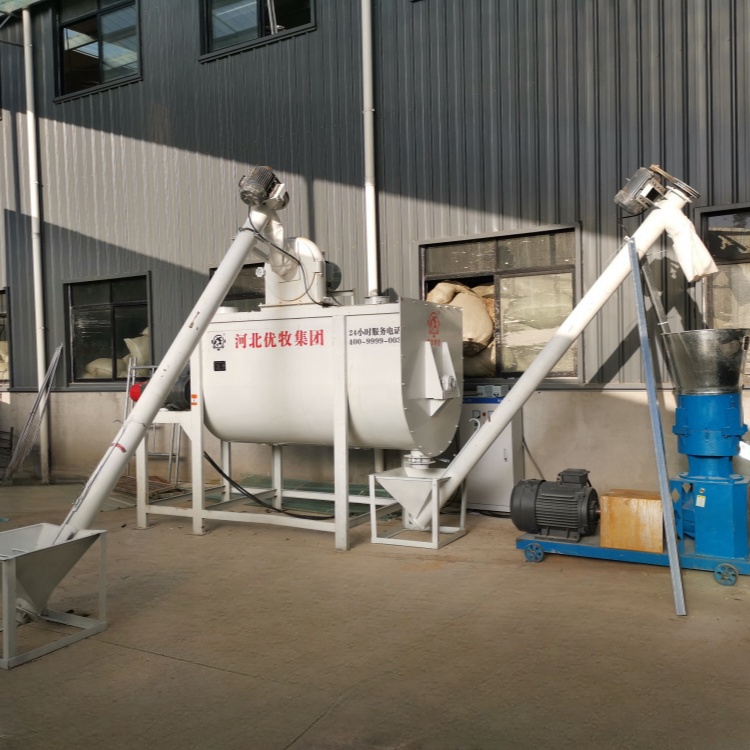
Agricultural industryFlat Die Pellet MillA key equipment used to compress powdered feed raw materials (such as corn, soybean meal, straw, etc.) into granular feed. Its core function is to enhance the palatability, digestibility, and storage convenience of the feed through physical pressing. Below is a detailed introduction to the flat die granulator:
I. Structure and Composition
Flat Die Mold
Horizontally placed circular steel molds with uniformly distributed holes (adjustable hole size of 2-12mm) that determine the particle diameter.Roller System
1-2 roller(s), rotating in conjunction with the mold, pressing the raw material into the mold cavity to form granules through extrusion.Transmission System
Motor or diesel engine driven, powered by gears or belts to operate the roller and mold.Cutting Device
Cut the extruded pellets, adjust the length.Material feeding system
Spiral feeder or gravity feed opening, controlling the even entry of raw materials into the pressing zone.
II. Working Principle
The raw material (powder) is fed into the gap between the pressure roller and the flat mold through the feeding system.
The roller rotates, exerting pressure through friction with the flat mold, forcing the raw material into the mold cavity.
The raw material is matured and shaped under high temperature and pressure, then extruded out from the other end of the mold hole.
The cutter slices the extruded strips of feed into pellets, which can then be packaged or fed after natural cooling.
Section 3: Core Advantages
Adaptable
Can handle various raw materials (finely processed feed, rough fiber, straw, etc.), suitable for different farming needs such as livestock, poultry, and aquaculture.High energy-saving efficiency
Compared to ring mold granulators, the flat mold design is simpler and consumes less power, making it suitable for small to medium-sized farms.High-quality finished products
Medium particle hardness, smooth surface, reduces animal pickiness, and improves nutrient absorption rate.Maintain ease
Mold and roller disassembly is convenient, with a low cost of replacement.
Section 4: Applicable Scenarios
Livestock and Poultry FarmingManufacturing granulated feed for chickens, ducks, pigs, cattle, sheep, etc.
AquacultureFish and shrimp puffing granular feed (requires puffing process).
Specialty farmingRabbit and other small animal feed.
Resource utilizationPelletizing of coarse fiber raw materials such as straw and forage.
V. Important Notes
Raw material pre-treatment
Moisture content should be maintained between 12-18%, as either excess dryness or wetness can affect molding effects.Mold Matching
Select hole sizes based on animal type (e.g., chicken feed 2-4mm, cattle/sheep feed 6-8mm).Regular maintenance
Clean mold residue, inspect roller wear, and lubricate transmission parts promptly.Safe Operation
Avoid metal debris from entering the machine to prevent equipment damage or injury to personnel.
Section 6: Common Model Parameters
| Model | Power (kW) | Capacity (kg/h) | Applicable Subjects |
|---|---|---|---|
| Small (Household) | 7.5-15 | 100-300 | Family farms, small-scale livestock farmers |
| Medium | 22-37 | 500-1000 | Medium-sized farmyard |
| Large | 55-90 | 2000-5000 | Large feed mill |
The flat die granulator has become the preferred equipment for small and medium-sized farms due to its high cost-performance ratio and flexible operation. When selecting, it is necessary to match it based on the scale of farming, type of raw material, and granule requirements (hardness, diameter). At the same time, pay attention to the manufacturer's after-sales service and component supply capability.