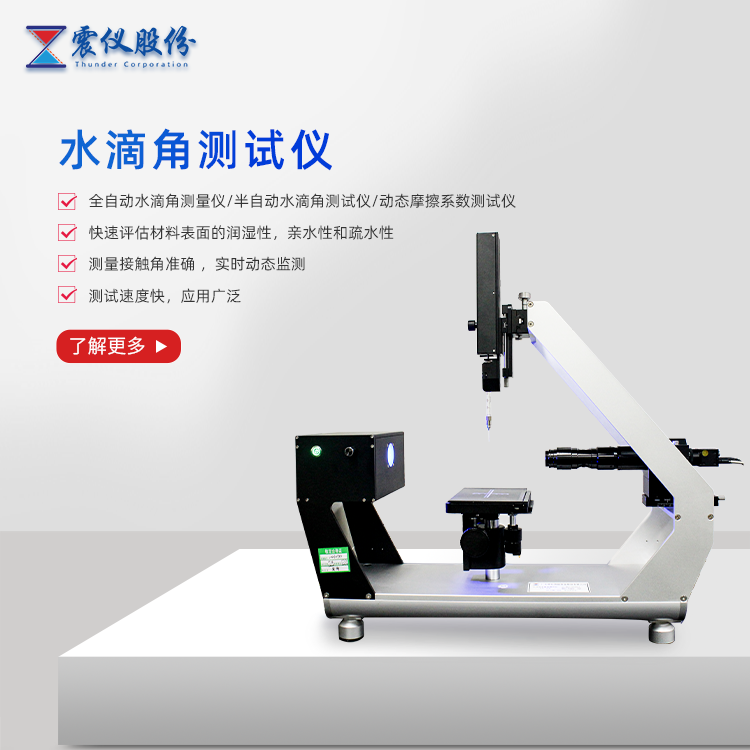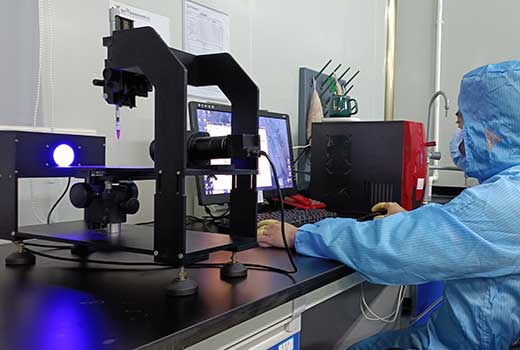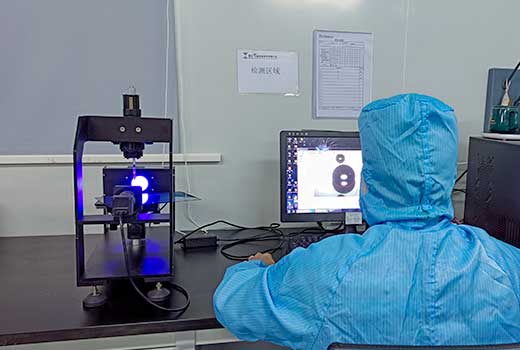


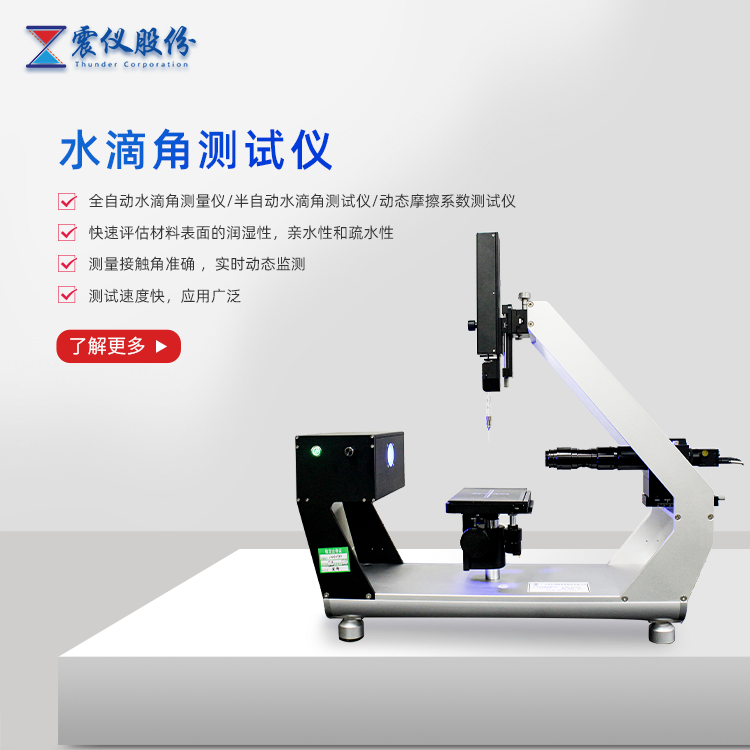
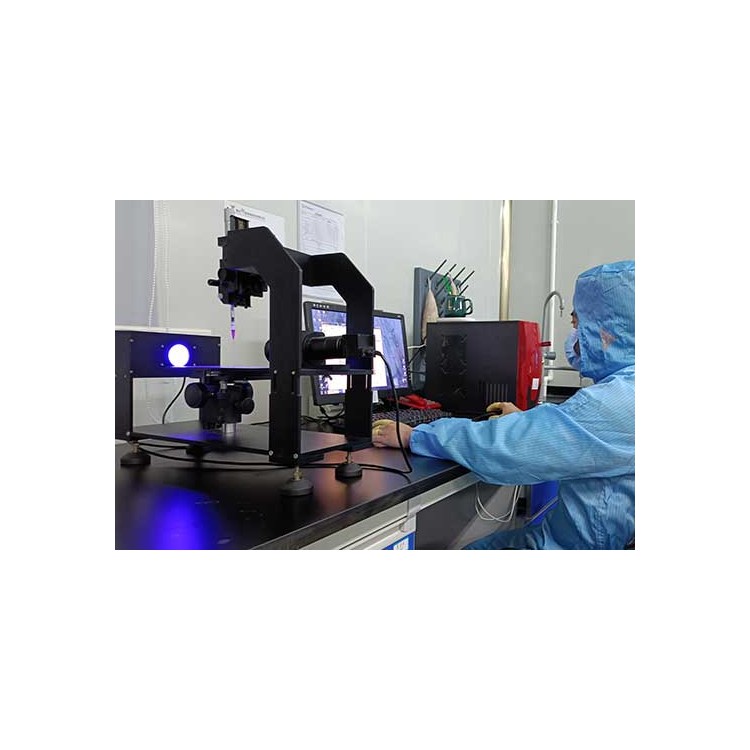
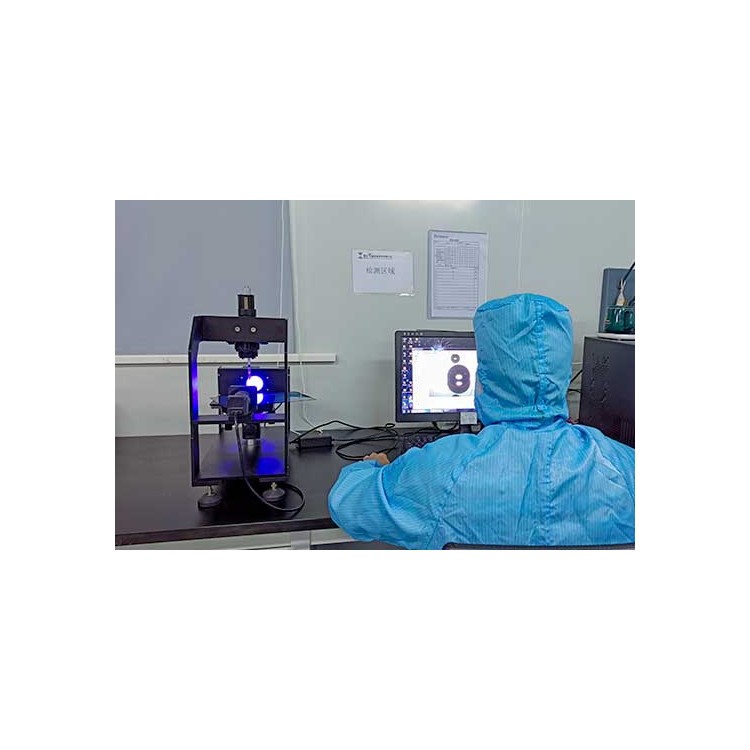







Drop Angle Tester (Contact Angle Meter) primarily tests the contact performance at the solid-liquid-gas interface. By using the three-in-one principle of the equipment's hardware (optical system; liquid injection system; light source system), it performs professional analysis of the contours of liquid and solid samples through the principle of optical projection!
The definition of the contact angle is the angle between the gas-liquid interface and the solid-liquid interface at the triple phase junction of solid, liquid, and gas. The contact angle is a measure of the moisture on a solid surface, determined by the majority of adherent liquid droplets. A low contact angle indicates high humidity (hydrophilic) surfaces that are easy to stick to. A high contact angle suggests a hydrophobic surface, possibly with heavy organic contamination or poor surface adhesion. The contact angle of a liquid in contact with a flat solid surface is determined by the endpoint of the water droplet curve at the liquid-solid-gas junction point and the point of contact with the solid surface, analyzing the cleanliness of the surface. The contact angle is a measure of the moisture on the solid surface, determined by the majority of adherent liquid droplets. A low contact angle indicates high humidity (both hydrophilic and hydrophobic) and a low surface energy.
Drop Angle Tester (Contact Angle Measurement Instrument) is manufactured using modern technology. The instrument features an advanced dedicated CMOS digital camera, paired with a high-resolution zoom microscope and a high-brightness LED background light source system. Equipped with a 3D sample stage, it allows for vertical, horizontal, and forward-backward movement of the workbench. It achieves micro-sampling and precise up-down and left-right movement. Additionally, an adjustable telescopic rod structure workbench is designed to accommodate thicker materials for different users. The instrument frame can be adjusted in size to fit various patterns, expanding the instrument's application range. The software includes a correction function, allowing multiple test results to be saved under the same report, which enhances user control over material data. The instrument is designed to be aesthetically pleasing, easy to operate, and meets user requirements. It is suitable for users in various industries who need to measure contact angles.

1. Contact Angle Measurement Range: 0-180° Contact Angle Measurement Accuracy: +/-0.1°
2. Contact Angle Testing Method: Sessile Drop Method
3. Contact Angle Analysis Methods: Manual Horizontal Measurement, Manual Inclined Plane Measurement, Width and Height Measurement Method, Manual Tangent Line Method
4, 2x Magnification High-Definition Microscope
5. Digital CMOS Camera
6. Video Recording/Playback
7. Instant Screenshot
8. Export Any Movie Clip Individually
9. Workbench Surface Dimensions: 100mm x 120mm
10. Workbench Surface Size: 100mm x 120mm
11. Work Taiwan Mobile: Bottom - 50mm, Left - 50mm, Front - 30mm
12. Workbench height adjustment: 30mm
13. Workbench Fixed Plate Movement: 150mm Forward and Backward
14. Sample Loader Movement: Up/Down 100mm, Left/Right 100mm
15. Microscope Movement: 80mm forward and backward (fine adjustment 3mm)
16. Sample Size: 100mm (Width) x 80mm (Thickness) x ~
17. Instrument dimensions: 320mm (Width) * 530mm (Length) * 430mm (Height)