













Metal 3D printing services can directly fabricate complex-shaped metal functional parts or molds; a wide range of machinable metal or alloy materials is available, and the manufacturing of heterogenous material parts is achievable; it also facilitates the processing of high melting point and difficult-to-process materials.
Basic Concepts of Metal 3D Printing:
The core concept of metal 3D printing technology originated in the late 19th century in the United States, but it wasn't until the mid-1980s that it began to take shape. In 1986, American Charles Hull invented the 3D printer. China started researching 3D printing technology in 1991, and around the year 2000, these processes began to transition from laboratory research to engineering and product development. At the time, they were known as Rapid Prototyping (RP), which refers to physical models created before the development of a product. Today, they are also called Rapid Manufacturing and Additive Manufacturing. However, to make it more accessible to the public, this new technology is commonly referred to as 3D printing. 3D printing is a form of rapid prototyping that relies on digital model design and uses materials like powdered metal or resin to construct three-dimensional objects by layer-by-layer additive printing. Metal 3D printing is hailed as "the thought and technology of the last century, the market of this century."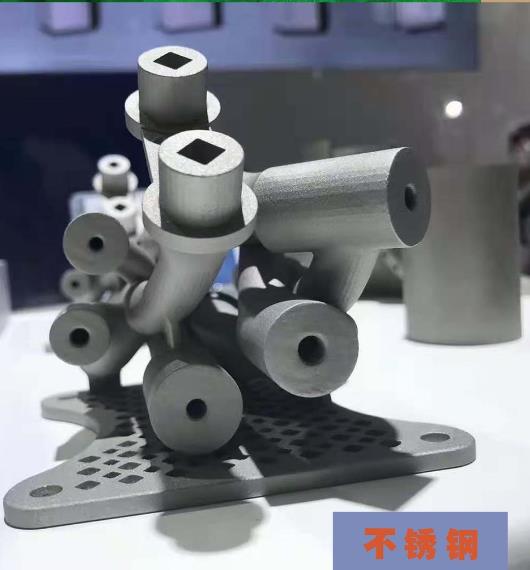
Metal 3D printing materials are a crucial material foundation for the development of 3D printing technology. To some extent, the advancement of materials determines the wider application of 3D printing. Currently, metal 3D printing materials mainly include engineering plastics, photosensitive resins, rubber-like materials, metallic materials, and ceramic materials. In addition, colored plaster materials, artificial bone powder, cellular biological raw materials, and sugar-based food materials are also applied in the field of metal 3D printing.
These raw materials for metal 3D printing are specifically developed for metal 3D printing equipment and processes, differing from common plastics, plaster, resins, etc. Their forms typically include powdered, filamentous, sheet-like, and liquid states. Generally, depending on the type of printing equipment and operating conditions, the particle size of the powdered metal 3D printing materials ranges from 1 to 100 μm. To maintain good flowability of the powder, it is usually required to have high sphericity.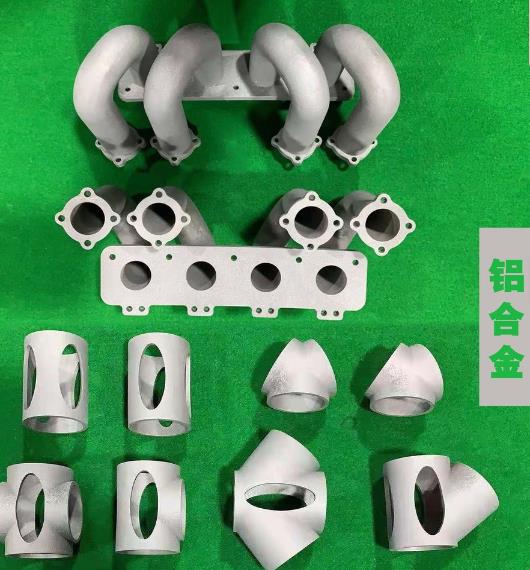
Features of Metal 3D Printing:
1. High precision.
The precision of current metal 3D printing equipment can generally be controlled below 0.05mm.
2. Short lead time.
The process of metal 3D printing without molds significantly reduces the production time for models, often taking just a few hours or even minutes to complete a print.
3. Customizable.
Metal 3D printing has no limit on the number of models to be printed; whether it's one or multiple, they can be produced at the same cost.
4. Diverse material options.
A metal 3D printing system typically allows for printing with various materials, and this diversity in materials can cater to the needs of different fields.
5. Cost is relatively low.
Although metal 3D printing systems and 3D-printed metals are relatively expensive, they offer a lower cost for producing personalized products.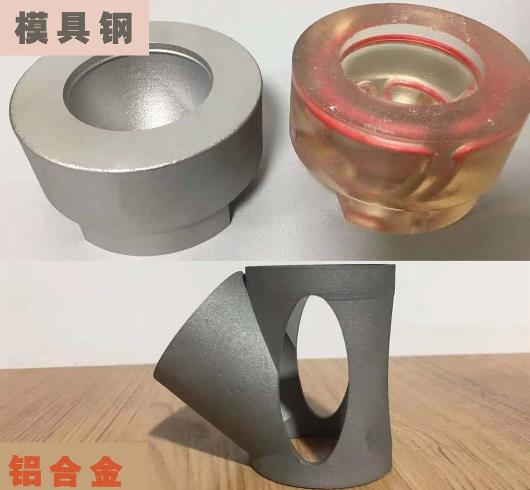
3D printing services are a digital, intelligent, low-cost, and short-cycle manufacturing technology that achieves the direct production of complex three-dimensional structures by simply adding materials layer by layer in a two-dimensional manner. It breaks through the principle limitations of traditional part forming and manufacturing technologies. Theoretically, it is not dependent on traditional industrial infrastructure and can directly produce any three-dimensional structures with arbitrary internal and external shapes and geometric dimensions through simple "two-dimensional digital printing."
Due to its transformative advantages over traditional forming manufacturing techniques, 3D printing technology has become a hot direction in current fields such as equipment manufacturing, structural design, and new materials. Metal 3D printing technology is an important branch of 3D printing, playing a crucial role in the production of high-performance metal components.
Our company will adhere to the people-oriented principle, fostering a harmonious development environment, establishing modern corporate systems, operating in a standardized manner, and persistently pursuing the path of technological and quality-driven growth. We follow the corporate spirit of "unity, collaboration, rigorousness, realism, and innovation," meticulously crafting our products, and providing satisfactory services to both new and existing customers.
WeChat Official Account

Scan to follow Official Account




















