










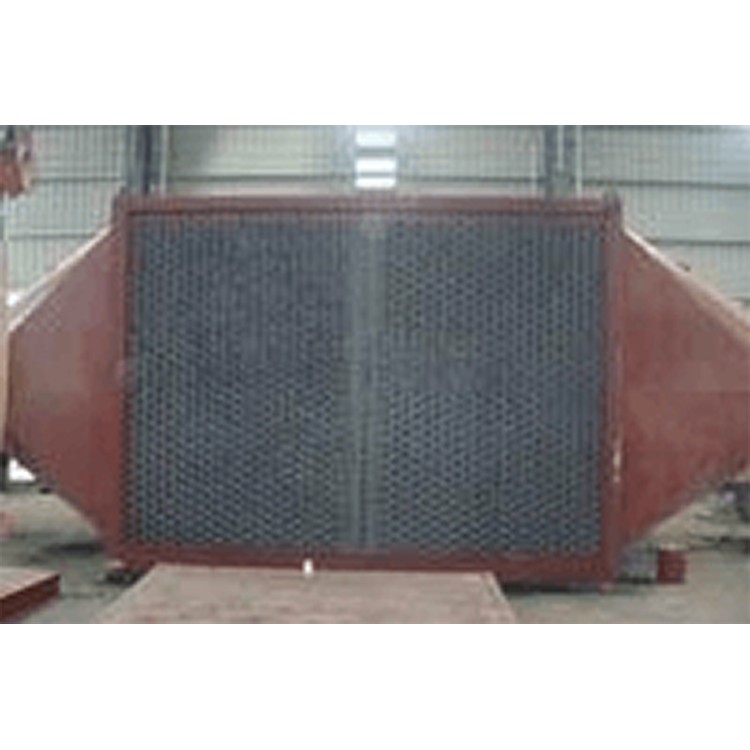
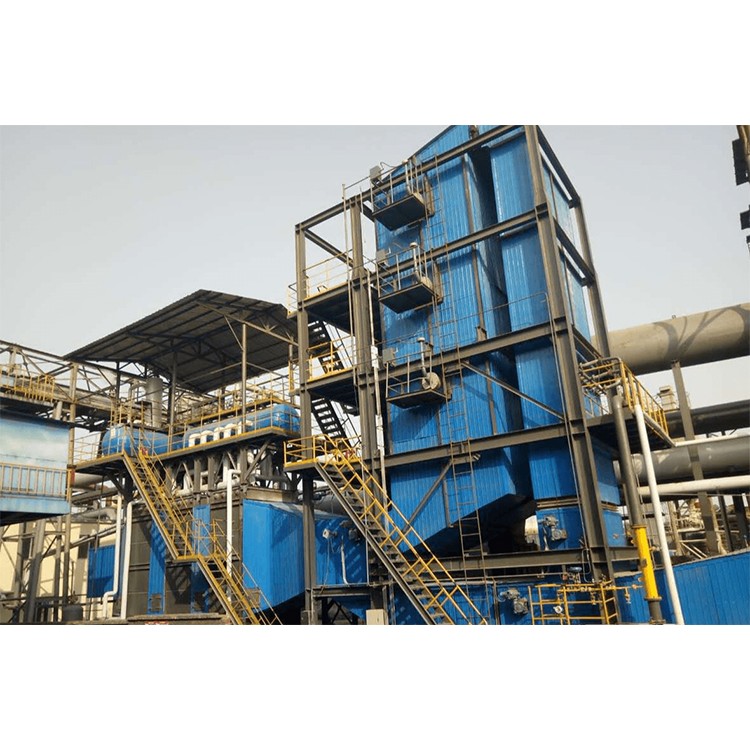
Product Product Say Ming:
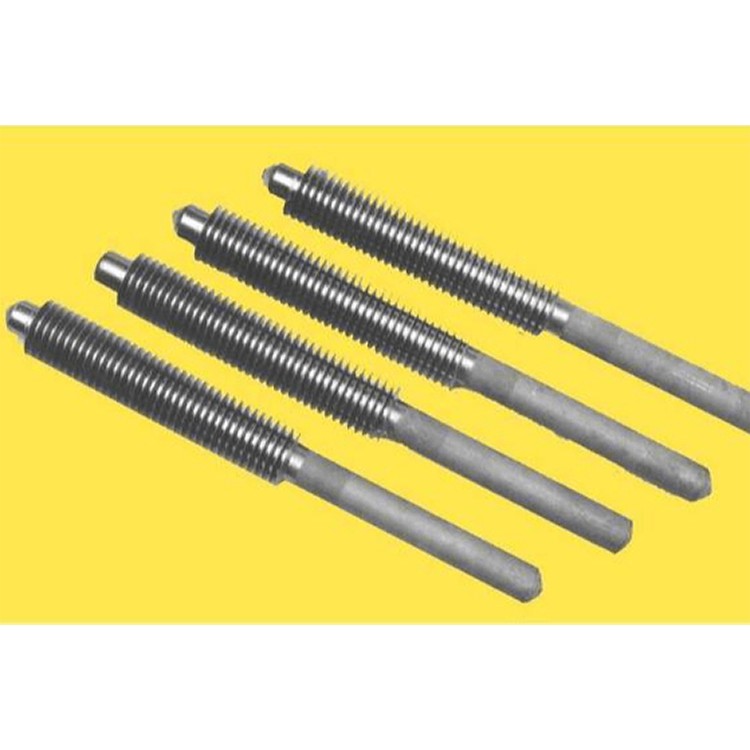
Heat pipes transfer heat through the phase change latent heat of the working medium inside an enclosed vacuum tube shell, with their thermal conductivity resembling that of superconductors, featuring high heat transfer capacity and efficiency.
Capillary heat pipes are first evacuated to a vacuum within the sealed tube, then a small amount of working fluid is introduced. At the lower end of the heat pipe, the working fluid absorbs heat and vaporizes into steam. Under minimal pressure difference, the steam rises to the upper end of the heat pipe, releasing heat to the outside and condensing back into a liquid. The condensed liquid, under the force of gravity, returns to the heated section along the inner wall of the heat pipe, where it reheats and vaporizes again. This cycle repeats continuously, transferring heat from one end to the other without interruption.
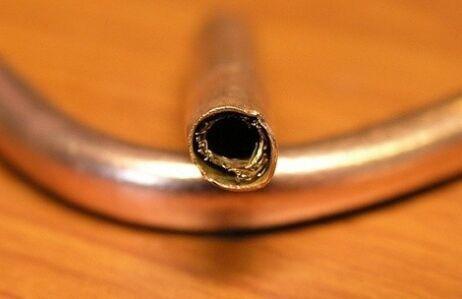
The working principle of heat pipes
In the evaporation section of the heated tube, the working fluid inside the tube core is heated and evaporates, carrying away heat. This heat is the latent heat of vaporization of the working fluid. The steam flows from the central channel to the condensation section of the heat pipe, condensing into liquid while releasing latent heat. Under the action of capillary force, the liquid returns to the evaporation section. Thus, a closed loop is completed, transferring a large amount of heat from the heating section to the cooling section.
When the heating section is below and the cooling section is above, with the heat pipe in a vertical position, the return of the working fluid is adequately satisfied by gravity, eliminating the need for a capillary structure in the tube core. This heat pipe without a porous body core is known as a thermosyphon. The thermosyphon structure is simple and widely used in engineering applications.
Basic Function of Heat Pipes
A typical heat pipe is composed of a shell, a wick, and end caps, which evacuate the air inside the tube.1.3×(10^-1 - 10^-4) Pa vacuum is applied, and an appropriate working fluid is filled. After the capillary porous material adhering to the inner wall of the tube is filled with liquid, it is sealed. One end of the tube is the evaporation section (heating section), and the other end is the condensation section (cooling section). An insulating section can be arranged between the two sections as needed for application. When one end of the heat pipe is heated, the liquid in the wick evaporates and vaporizes, flowing to the other end under a small pressure difference to release heat, condense into liquid, and then flow back to the evaporation section due to capillary action through the porous material.
This cycle repeats, with heat transferred from one end of the heat pipe to the other.—End. In the process of achieving this heat transfer, the heat pipe involves the following six interrelated main processes:
(1) Heat is transferred from the heat source to the (liquid-vapor) interface through the wall of the heat pipe and the absorbent core filled with working fluid.
(2) The liquid evaporates at the (liquid-vapor) interface within the evaporation section.
(3) Steam within the steam chamber flows from the evaporation section to the condensation section.
(4) Condensation occurs at the vapor-liquid interface within the condensation section:
(5) Heat is transferred from the (vapor-liquid) interface to the cold source through the absorbent core, liquid, and tube wall.
(6) Due to capillary action, the condensed working fluid returns to the evaporation section within the absorbent core.
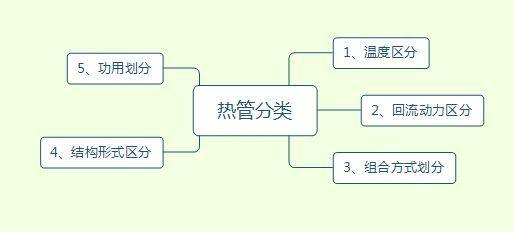
Heat Pipe Classification
Due to the diverse applications, types, and designs of heat pipes, along with their differences in structure, materials, and working fluids, there are many ways to classify heat pipes. Common classification methods include the following.
1. Temperature Variations
According to the working temperature inside the heat pipe, heat pipes can be divided into low-temperature heat pipes-273℃ - 0℃), room temperature heat pipes (0-250℃), medium temperature heat pipes (250-450℃), high temperature heat pipes (450-1000℃), etc.
2. Recirculation Power Classification
According to the working fluid return force, heat pipes can be classified into core heat pipes, two-phase closed-loop thermosyphons (also known as gravity heat pipes), gravity-assisted heat pipes, rotating heat pipes, electrohydrodynamic heat pipes, magnetohydrodynamic heat pipes, osmotic heat pipes, and so on.
3. Method of Combination
By the combination method of casing and working fluid, (which is a conventional method of classification), it can be divided into copper—Water Heat Pipes, Carbon Steel—Water Heat Pipes, Copper Steel Composite—Water Heat Pipes, Aluminum—Acetone Heat Pipes, Carbon Steel·Rong Heat Pipes, Stainless Steel·Sodium Heat Pipes, etc.
4. Structural Forms Distinguishing
Structurally, they can be categorized into standard heat pipes, split heat pipes, capillary pump loop heat pipes, micro heat pipes, flat heat pipes, radial heat pipes, and more.
5. Function Classification
By the function of heat pipes, they can be classified into heat transfer heat pipes, thermal diodes, thermal switches, heat control heat pipes, simulation heat pipes, refrigeration heat pipes, and so on.
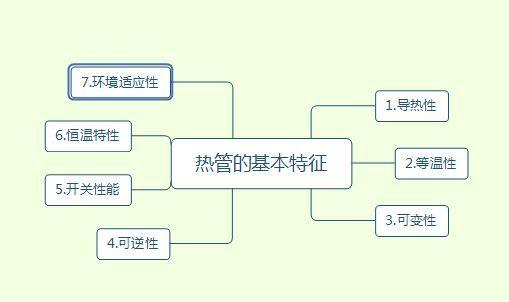
Basic Characteristics of Heat Pipes
Thermal conductivity
The heat pipe primarily relies on the phase change of the working fluid between vapor and liquid for heat transfer, resulting in a very low thermal resistance and high thermal conductivity. Compared to metals like silver, copper, and aluminum, a heat pipe of the same weight can transfer several orders of magnitude more heat. Of course, high thermal conductivity is relative, as temperature differences always exist and it's impossible to violate thermodynamic laws. The heat transfer capability of the heat pipe is limited by various factors, with certain heat transfer limits. The heat pipe has strong axial thermal conductivity, with minimal improvement in radial thermal conductivity (except for radial heat pipes). [1]
2. Isothermal properties
The steam inside the heat pipe is in a saturated state, with the pressure of the saturated steam depending on the saturation temperature. The pressure drop is minimal as the saturated steam flows from the evaporation section to the condensation section. According to thermodynamic equations, the temperature drop is also very small, thus the heat pipe exhibits excellent isothermal properties.
3. Variability
Thermal pipes can independently alter the heating area of the evaporation section or the cooling section, meaning they can input heat with a smaller heating area and output heat with a larger cooling area, or vice versa—input heat with a larger heat transfer area and output with a smaller cooling area. This allows for adjusting the heat flux density and overcoming heat transfer challenges that other methods struggle to address.
4. Reversibility
A horizontally placed core heat pipe, due to its internal circulation driven by capillary force, can use either end as the evaporation section when heated and the opposite end as the condensation section for heat dissipation. This feature is applicable for temperature equalization in spacecraft and satellites in space, as well as for heat exchangers and other devices that release and absorb heat sequentially. [1]
5. Switch Performance
Heat pipes can be designed as thermal diodes or thermal switches. A thermal diode allows heat to flow in only one direction, not the opposite; while a thermal switch starts working when the heat source temperature exceeds a certain threshold, and ceases to conduct heat when the temperature falls below that threshold. [1]
6. Constant Temperature Characteristics
The thermal resistance of each part in a standard heat pipe generally does not vary with the amount of heating, so when the heating amount changes, the temperature of each part of the heat pipe also changes accordingly. However, people have developed another type of heat pipe...——Variable thermal conductive tube, which reduces the thermal resistance of the condensation section as the heating amount increases and increases it as the heating amount decreases. This allows the steam temperature to change little even when the heating amount fluctuates greatly, achieving temperature control, which is the isothermal characteristic of the heat pipe. [1]
7. Environmental Adaptability
The shape of heat pipes can vary according to the conditions of the heat and cold sources. They can be made into motor shafts, gas turbine blades, drill bits, surgical knives, and more. Heat pipes can also be designed as separate units to accommodate long-distance or situations where hot fluids cannot be mixed for heat exchange. They are suitable for use on the ground (in the gravitational field) as well as in space (in the absence of gravity field).