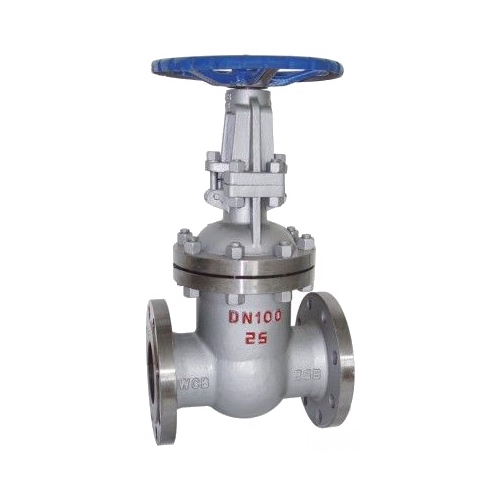
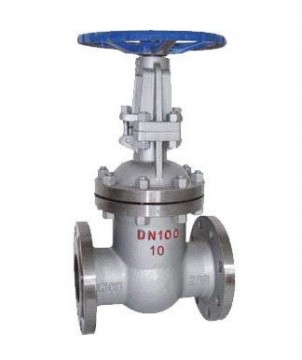
Gate valve is a shut-off device with a gate plate, the movement of which is perpendicular to the fluid direction. The gate valve can only be fully open or fully closed and is not adjustable by gate parameters. The angle is typically 5°, and 2°52' when the medium temperature is not high.Enhance its processability, compensating for the angle deficiency on the sealing surface.ManufacturingDeviation generated during the process; such a gate plate is called an elastic gate plate.
The gate valve's opening and closing element is the gate plate, which moves perpendicular to the fluid direction. The gate valve can only be fully open or fully closed; it cannot be used for regulation or throttling. The gate plate has two sealing surfaces, and the two sealing surfaces of the gate valve form a wedge shape, with the wedge angle varying with the valve parameters, usually 5°, and 2°52' when the medium temperature is not high.The gate disk of a wedge gate valve can be made as a single piece, known as a rigid disk; or it can be designed to undergo slight deformation, enhancing its workability and compensating for deviations in the sealing surface angle during the manufacturing process. Such a disk is called an elastic disk. When the gate valve is closed, the sealing surface can be sealed solely by the pressure of the medium, which presses the sealing surface of the disk against the opposite side of the valve seat to ensure sealing, a feature known as self-sealing. Most gate valves employ forced sealing, meaning that when the valve is closed, external force is used to forcibly press the disk against the valve seat to ensure the sealing integrity of the sealing surface. The gate disk of a gate valve moves in a straight line along with the valve rod, referred to as a rising stem gate valve or a through stem gate valve. Typically, there is a trapezoidal thread on the rising stem, which, through the nut at the top of the valve and the guide slots on the valve body, converts rotational motion into linear motion, effectively transforming the operating torque into thrust. When opening the valve, when the lift height of the disk equals 1:1 of the valve passage diameter, the fluid passage is fully open. However, this position is unmonitored during operation. In practice, the top point of the valve rod is used as a reference, indicating the fully open position. Generally, the valve is turned back 1/2 to 1 turn after reaching the top point to indicate the fully open position. Therefore, the fully open position of the valve is determined by the position of the disk or the stroke. Some gate valves have the valve rod nut mounted on the disk, and the handwheel rotating drives the valve rod to lift the disk. Such valves are called rotating stem gate valves or blind stem gate valves.