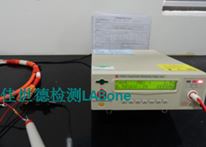
















Contact Resistance/Voltage Drop Test
Brief Introduction: In a mating state, a contact area of the connector forms a resistance known as the contact resistance. The purpose of contact resistance testing is to determine the resistance generated when current flows through the electrical contact surfaces of the contact parts. If a high current passes through a high-resistance contact, excessive energy consumption may occur, potentially leading to dangerous overheating of the contacts. In many applications, a low and stable contact resistance is required to ensure that the voltage drop across the contacts does not affect the accuracy of the circuit condition. Common test conditions are an open-circuit voltage of 20mV and a current not exceeding 100 mA.
In the field of automotive connector and harness testing, the contact level of the terminal pairs is often assessed by measuring the voltage drop, which involves passing a rated current through the circuit and then measuring the voltage at both ends of the section to be tested. The voltage drop in the contact area is then calculated using a formula.
Application Fields: Electrical Connectors, Automotive Wiring Harnesses, Switches, etc.
Key Instruments: Low Resistance Tester, Precision Voltmeter, and Current Source.
Reference Standards: EIA-364-23, SAE USCAR-2, etc.
Case Introduction:

Insulation/Voltage Resistance Testing
Brief Introduction: Insulation resistance refers to the resistance of an insulating material. Note: The insulation resistance is defined as the ratio of the voltage applied between the two electrodes to the total current between the electrodes after the measured material is placed in standard electrodes for a given time. With the rapid development of modern life, people cannot do without electricity for a moment. In the process of using electricity, there are safety issues related to electricity use. In electrical equipment such as motors, cables, household appliances, and so on.
Dielectric voltage withstand testing is one of the primary methods to assess the ability of electrical appliances, electrical equipment, electrical installations, electrical circuits, and electrical safety equipment to withstand overvoltage. It is divided into two types: AC withstand voltage testing and DC withstand voltage testing. Leakage current is a very important judgment parameter.
Application Fields: Electrical and electronic products, automotive parts, connectors and cables, electrical equipment and devices, etc.
Key Instruments: Insulation Resistance Meters, Voltage Withstand Testers.
Reference Standards: EIA-364-21, EIA-364-20, GB 17465.1, etc.
Case Introduction: