














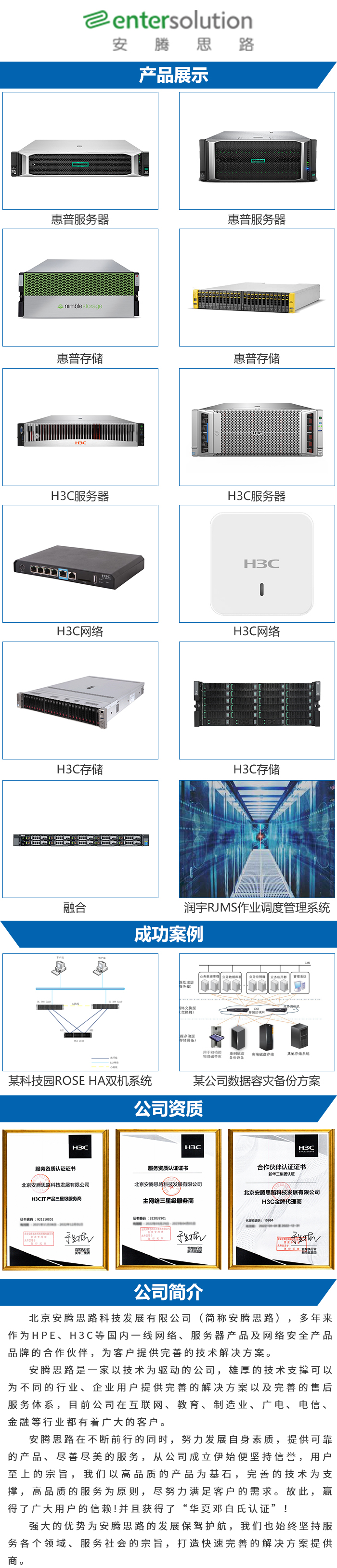
H3C Server
When increasing the density of racks in service areas, the operating organization needs to consider investing in data center infrastructure management and other system management tools to collect data from thermal sensors within the racks and generate reports. They can identify situations exceeding heat limits and take necessary actions, such as notifying technicians, automatically migrating workloads, or shutting down systems to prevent premature facility failure. When server racks are planned to generate hotspots, the IT team can reallocate hardware. Unlike filling a single rack, if space permits, purchase domestically-manufactured servers and move half or one to two racks to other racks, or shut down overheated systems. If space is insufficient for a redesign, add some portable, self-cooled cooling equipment that can be used within the data center. If compact inline or in-rack cooling units are used for the racks, setting temperature points can be more effective in achieving cooling than opening sealed units and adding cooling equipment.

H3C Server Basic Concepts
Servers, also known as servers, are devices that provide computing services. Since servers need to respond to service requests and process them, they generally should have the capacity to both offer and ensure the quality of service. The composition of servers includes processors, hard drives, memory, system buses, etc., similar to common computer architectures. How much is a domestically produced server? However, due to the need for high-reliability services, the price of domestically produced servers is higher. Therefore, they have higher requirements in terms of processing power, stability, reliability, security, scalability, and manageability. In a network environment, servers are categorized based on the type of service they provide, such as file servers, database servers, application servers, and web servers, among others.

H3C Server
Servers must possess a certain degree of "scalability," as a company's network is unlikely to remain static, especially in today's information age. Without adequate scalability, a server worth tens of thousands, or even hundreds of thousands, could become obsolete within a short time as user numbers increase. This is an expense that no business can afford. To maintain scalability, it is typically necessary to have sufficient expandable space and redundant components on the server (such as disk array rack spaces, PCI and memory slot availability, etc.). Scalability is specifically reflected in aspects like whether the hard drive can be expanded, whether the CPU can be upgraded or expanded, and whether the system supports various mainstream operating systems such as Windows NT, Linux, or UNIX. Only then can the initial investment be fully utilized in the long run.

Tianjin Domestic Servers - Domestic Server Prices - Beijing Anteng S思路 (Recommended Supplier) provided by Beijing Anteng S思路 Technology Development Co., Ltd. Beijing Anteng S思路 Technology Development Co., Ltd. boasts excellent service and products, consistently receiving recognition and trust from both new and old customers, as well as industry professionals. Our company is a member, so click on the icon on the page to directly communicate with our customer service staff. We hope for a pleasant collaboration in the future!




















