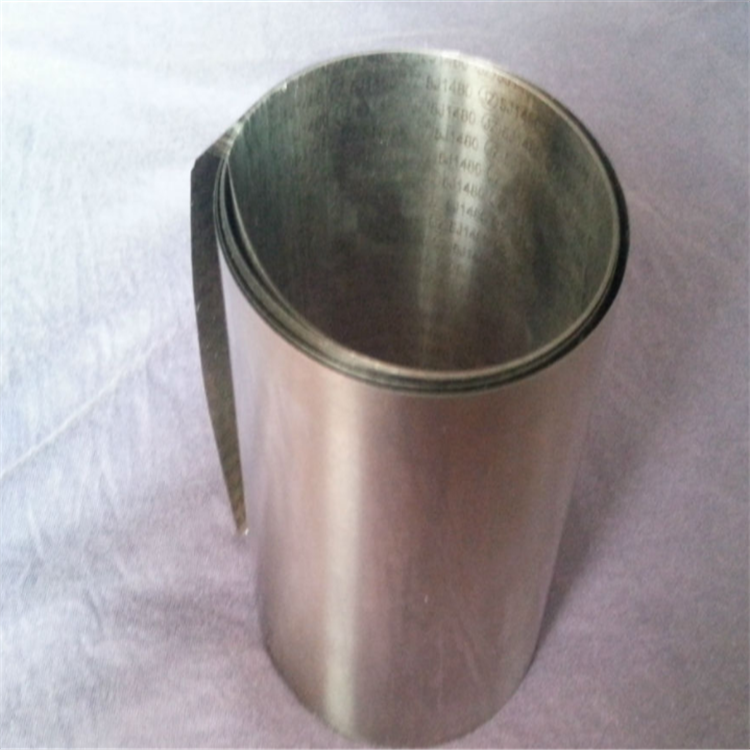









Hot bimetal is a composite functional material made by firmly bonding two or more metals or alloys with different expansion coefficients along the entire contact surface, which can change shape with temperature variations.
1. Thermal bimetallic active layer alloy(The Active Layer of Bimetal Alloy)The active layer alloy for bimetallic strips requires significant expansion, high melting point, stable structure, and a relatively low difference in elastic modulus compared to the passive layer alloy. There are many alloys that can be used as the active layer material, including nickel-chromium-iron, manganese-copper-nickel, copper-tin-zinc, copper-zinc alloys, and alloy steels. Common active layer alloys generally includeMn72Cu18Ni10、Ni22Cr3、Ni20Mn6、Ni18Cr11、Ni19Cr2AndNi25Cr8Equal expansion alloy.
2. Passive layer alloy for thermal bimetal(The Passive Layer of Bimetal Alloy)The passive layer alloys for thermocouple bimetallic strips are generally made of nickel-iron alloys with a lower coefficient of thermal expansion.1896Year scientistsGuillaumeInvented Invar alloy, which has an extremely low coefficient of expansion at room temperature, only about1.2×10-6/℃Laid the foundation for the development of bimetallics. Common passive layer alloys typically include:Ni36Fe、Ni39Fe、Ni40Fe、Ni42Fe、Ni45FeAndNi50FeAlloy with low or fixed expansion.
3. Intermediate layer alloy for thermal bimetal(The Middle Layer of Bimetal Alloy)As an adjuster for the resistivity of heat-resistant bimetallic materials“Diverting layer”These materials, typically including pure nickel, pure copper (red copper, oxygen-free copper), and zirconium copper, are positioned between the active and passive layers and primarily control the resistivity of the thermal bimetal.
Instructions for Use:
1. Design a bimetallic thermal element, considering the following factors:
a. Current rating of the component
b. Operating Temperature
c. The high temperature the components will withstand.
d. Requirements for displacement or force, or a combination of both.
e. Space constraints
f. Work conditions, etc.
2. Determination of the thermocouple alloy grade and specifications
a. Determine the type of thermal bimetallic temperature based on the operating temperature: Low-Temperature Type, Medium-Temperature Type, High-Temperature Type
b. Determine the grade, specification, and shape of bimetallic strips based on factors such as motion space, displacement, current level, and tripping force through calculations. High sensitivity model, Medium sensitivity model Low sensitivity
c. Confirm installation based on calculated results.
1) Select the type of bimetallic strip based on the operating temperature. The operating temperature is the temperature range at which the bimetallic strip operates. It is best for the operating temperature and the upper limit of the operating temperature to be within the linear temperature range of the bimetallic strip to ensure the linear operation of the bimetallic element. When the operating temperature exceeds the available (effective) temperature range of the bimetallic strip, the bimetallic element will experience residual deformation, causing a change in its working characteristics.
2) Based on factors such as motion space, displacement, current level, and trip force, through calculation
Confirm the grade, specification, and shape of the bimetallic strip.
High-sensitivity Low resistance (high amperage) Straight bar
Medium sensitivity Medium resistance (medium amperage) Helical
Low sensitivity High resistance (low amperage) Odd-shaped
Product Specifications:
1. By temperature characteristics of use:(Classified by Temperature)
1High-Temperature TypeHigh Temperature
As perFPA223-70、FPA206-70、FPA258-70、FPA206-9Wait
2Medium Temperature TypeMedium Temperature As per your instruction, there is no Chinese content provided for translation. Please provide the text you would like translated.FPA223-80、FPA206-78Wait
3Low-temperature typeLow Temperature As perFPA721-110、FPA721-140Pending
2. By thermal sensitivity characteristics:(Classified by Heat Reactive)
1Highly Sensitive(Temperature curve30×10-6/℃(above)
As follows:FPA721Series
2) Sensitive Type(Warm curvature15~30×10-6/℃Scope
As follows:FPA206SeriesFPA223Series etc.
3Low-sensitivity(Wavelength curvature15×10-6/℃Below)
As follows:FPA982-2、FPA258-60Please wait.
3. By resistive characteristics:(Classified by Resistance:)
Resistive Resistance
1Low Resistance Series,As perFPA7 2 1 - 5 、FPA9 8 2 - 2 、FPA2 0 6 - 3 、FPA982-4Await
2Medium Resistance Series,As perFPA223-25、FPA223-35、FPA721-20、FPA721-40Pending
3High Resistance Series,As per your request, there is no Chinese content provided for translation. If you provide the content, I will be able to translate it into American English.FPA721-140、FPA721-110、FPA23-93、FPA223-110Please wait
Thickness range Thickness:0.05- 3.0mm
Width Range Width:1 - 150mm
Inside Diameter (ID) Inradium:300mm, 350mm, 400mm
FPAExecute U.S.ASTM B388-06"Hot Double Metal Strip"