






OmniScan MX2
For over a decade, Olympus has been the recognized industry leader in developing modular NDT inspection platforms. The OmniScan MX, produced by them, is the most successful portable, modular phased array inspection instrument to date, with thousands of OmniScan MX units in use worldwide.
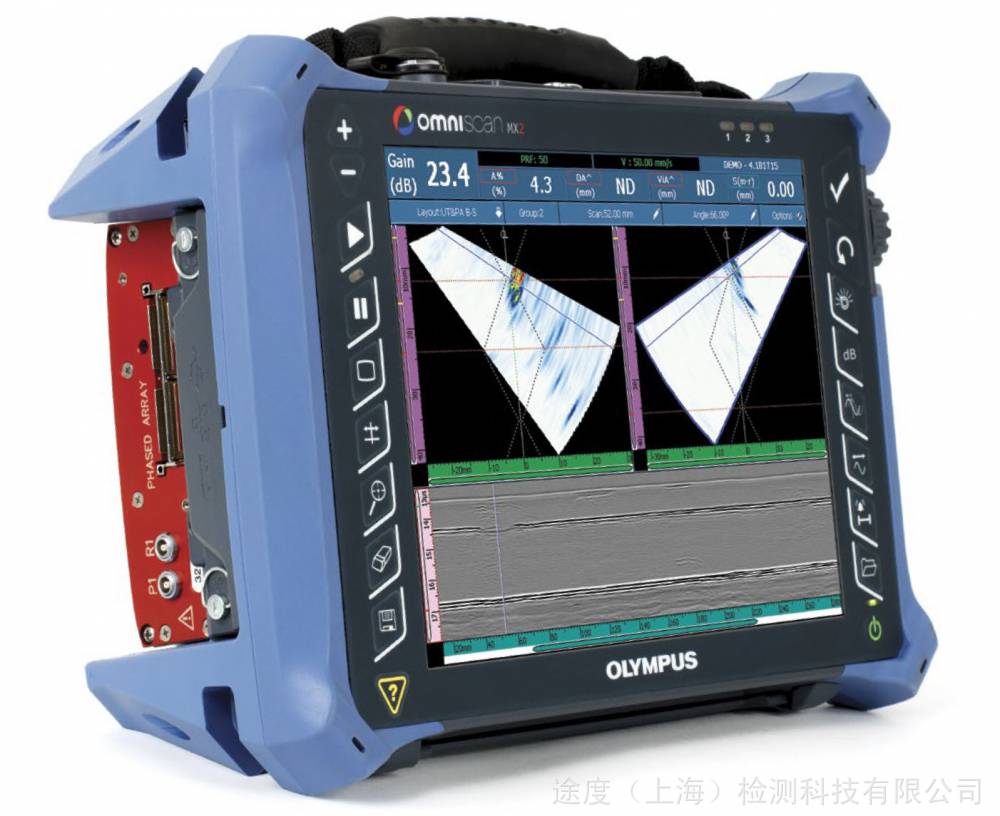
Now, Olympus has launched a new phased array module using TOFD technology, a new UT module, and new software programs (NDT SetupBuilder and the new OmniPC), which expand the performance of the already highly successful OmniScan MX2 platform and enhance the efficiency of the non-destructive testing workflow.
Solid foundation
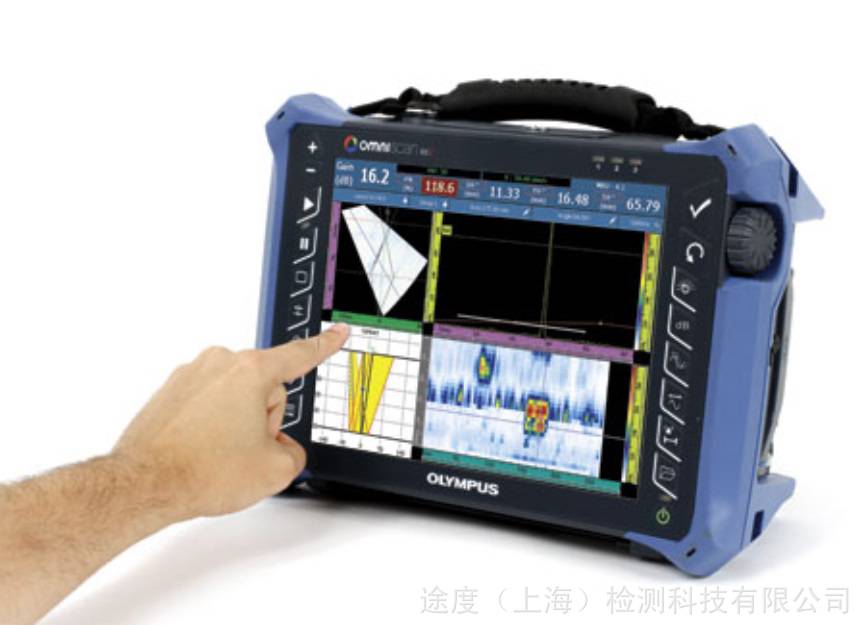
OmniScan MX2This second-generation instrument not only is compatible with over 10 phased-array and ultrasonic modules but also enhances detection efficiency: its quicker setup speed, shorter detection cycles, and faster report generation capabilities ensure advanced AUT applications at a high level. This premium, upgradeable detection platform, developed for NDT experts, enables truly next-generation NDT detection for the future.
OmniScan MX2This portable, modular instrument boasts high data collection rates and features a variety of new powerful software functions, enabling more efficient manual and automated inspections.
Faster and better!
Using the OmniScan MX2 instrument, your work will be more powerful! The OmniScan MX2's highly intuitive step-by-step guide simplifies and accelerates the setup process, allowing users to quickly start inspections. This MX2 instrument features a larger, brighter 10.4-inch (26.4 cm) screen with a modern, unique, and intuitive touchscreen function. Its industrial-standard phased array user interface is faster in both response and data transmission, enabling users to begin the next inspection even more rapidly.
Not just a standard instrument, but the core of the detection solution.
OmniScan MX2An essential part of the testing solution, when combined with other critical components, it forms a comprehensive testing system. Olympus offers a complete range of testing products, including phased array probes, scanners, analysis software, and various accessories. These products can be integrated and packaged according to specific application requirements, becoming quick-to-assemble solution kits for special applications, ensuring a rapid return on the investment made in purchasing the products. Additionally, Olympus provides high-quality calibration and repair services worldwide, with its expert team of phased array specialists guaranteeing immediate technical support when needed.
Weld Inspection for Pressure Vessels

Users can perform a comprehensive inspection of pressure vessel welds by using an OmniScan PA and a manual scanner like the HSMT series, or an electric scanner like the WeldROVER, with a single scan. Combining TOFD with PA during a single inspection significantly reduces the time compared to conventional grating scanning or radiographic imaging techniques. Moreover, users can receive immediate inspection results, allowing for the prompt detection and resolution of issues with welding equipment.
Composite Material Testing

Due to the varying shapes and thicknesses of parts made from laminated composite materials, inspecting these components can be quite a challenge.
OlympusComplete solutions for the inspection of carbon fiber reinforced polymer material structures are provided. These solutions are based on the OmniScan flaw detector, GLIDER™ scanner, and probes and wedges specifically designed for CFRP flat and curved surface inspections.
Weld seam inspection for small diameter pipe fittings

When used with the COBRA manual scanner, the OmniScan flaw detector can inspect pipe fittings with outer diameters ranging from 0.84 inches to 4.5 inches. This manual scanner is extremely slender, allowing for inspection in confined spaces. The distance between the pipe fitting being tested and surrounding objects, such as piping, brackets, or frames, can be as small as 12 millimeters (0.5 inches).
Manual and semi-automatic corrosion imaging

OmniScan PAThe purpose of using the system with the HydroFORM scanner is to detect wall thinning due to corrosion, erosion, or abrasion, and to provide detection solutions. Additionally, the system can identify internal wall damage such as hydrogen-induced blistering or delamination caused during manufacturing, and it can clearly differentiate these anomalies from wall thinning.
In this application, phased array ultrasonic technology boasts fast detection speed, appropriate data point density, and high detection levels.
Modular instrument
Demand updates continuously, the platform continually innovates.
Throughout the design of the OmniScan MX2 instrument, we have considered the return on investment of users' current and future investments in phased array technology, which allows the instrument to be equipped with over 10 different Olympus modules. The technical specifications of the instrument will continue to evolve and improve in line with user needs, through continuous software updates, ensuring a return on users' investments.
Industry-leading PA2 and UT2 modules


Dual Channel UT2 PA216:64
PA2 16:128
PA2 32:128
PA2 32:128PR
As a leading company in the phased array technology industry, Olympus has just launched a new module series compatible with the MX2 instrument.
PA2
The new series of phase array modules, represented by the innovative PA2 module, has improved performance in many aspects such as:
As of now, the quality of phased array and TOFD signals
l Better signal-to-noise ratio
l Pulse generator is more powerful
l 64Grey tone
Enhanced multiple performance groups
l The capability to utilize both PA and UT channels concurrently
Comprehensive general hardware specifications
l Operates at higher temperatures (up to 45°C)
l New OmniScan probe connector with quick-locking system
l Design meets IP66 environmental rating
l Battery runtime extended
UT2
The new UT2 standard ultrasonic module boasts the same technical performance as the PA2 module's UT channel, but its UT channel is twice as wide as the PA2 module's UT channel.
Primary Technical SpecificationsPlease note that files generated by previous software versions are compatible with the latest released version.
OmniScan MX2Technical Specifications of the Main Unit
Standard Specifications | |
Outer dimensions | (Width x Height x Depth) 325 mm x 235 mm x 130 mm (12.8 in. x 9.3 in. x 5.1 in.) |
Weight | 3.2Kilograms, without module, with one battery section. |
Data Storage | |
Storage Equipment | SDHCCard, most standard USB storage devices, or Fast Ethernet |
Data file size | 300 MB |
I/OPort | |
USBPort | 3An |
Audio Alarm | Is |
Video Output | Video Output (SVGA) |
Ethernet | 10/100 Mbps |
Input/Output Cables | |
Encoder | Dual-axis encoder wire (quadrature, up, down, or clock/direction) |
Digital Input | 4A digital TTL input, 5V |
Digital Output | 4A digital TTL output, 5V, 15mA |
Harvesting On/Off Device | Remote collection starts TTL, 5V |
Power output cable | 5 V500 mA power output cable (with short-circuit protection) |
Alarm | 3 TTL,5 V,15 mA |
Simulated Output | 2A simulated output (12 bits), ±5 V, 10 kΩ |
Step Speed Input | 5 V TTLStep Input |
Display | |
Screen size | 26.4 cm(10.4 Inches) (Diagonal) |
Resolution | 800 x 600Pixel |
Luminosity | 700 cd/m2 |
Color Quantities | 1Sixteen million |
Type | TFT Liquid Crystal Display (TFT LCD) |
Power Supply | |
Battery Type | Smart Lithium-ion Battery |
Battery Quantity | 12 or 4 batteries (the battery compartment can accommodate two hot-swappable batteries) |
Battery-powered runtime | Operates with two batteries, minimum 7 hours |
Environmental Indicators | |
Operating Temperature Range | -10 °C~45 °C(14 ºF~113 ºF) |
Storage temperature range | -20 °C - 60 °C (-4 °F - 140 °F), with battery -20 °C - 70 °C, without battery |
Relative Humidity | 45 At 70% relative humidity, no condensation occurs under 0°C conditions. |
Intrusion Protection Rating | Design meets IP66 rating |
Impact Resistance Rating | Passed the MIL-STD-810G 516.6 drop test |
OmniScan MX2Meets or exceeds the minimum requirements for instruments and software as specified in ASME, AWS, API, and EN standards.