









EPOCH 650 Ultrasonic Flaw Detector —— Portable, Durable, Ergonomically Designed
Appearance characteristics
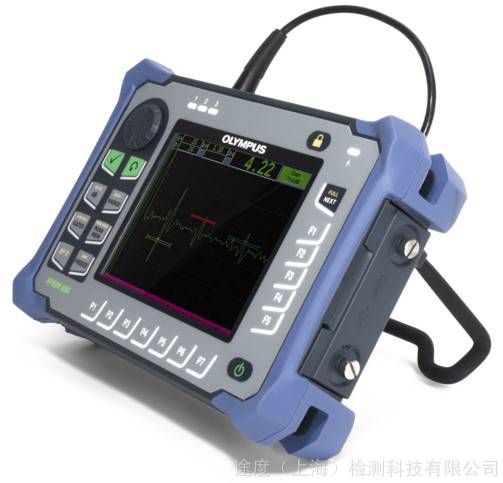
The EPOCH 650 instrument is a lightweight, portable flaw detector, with its sturdy and flexible features making it suitable for nearly all detection environments. Some of the main appearance characteristics of this instrument include:
Wide-screen, full VGA resolution, and transreflective display, ensuring bright and clear images in both indoor lighting and direct sunlight.
The corners of the instrument are equipped with rubber overmold protective sleeves, serving as shockproof and wear-resistant features.
4 connection points for the chest strap.
Battery compartment and side I/O cover that can be opened without tools.
A sturdy bracket for continuously securing instruments, featuring a right-angle bend hook, allowing the upright angle to be adjusted from 0 to 180 degrees.
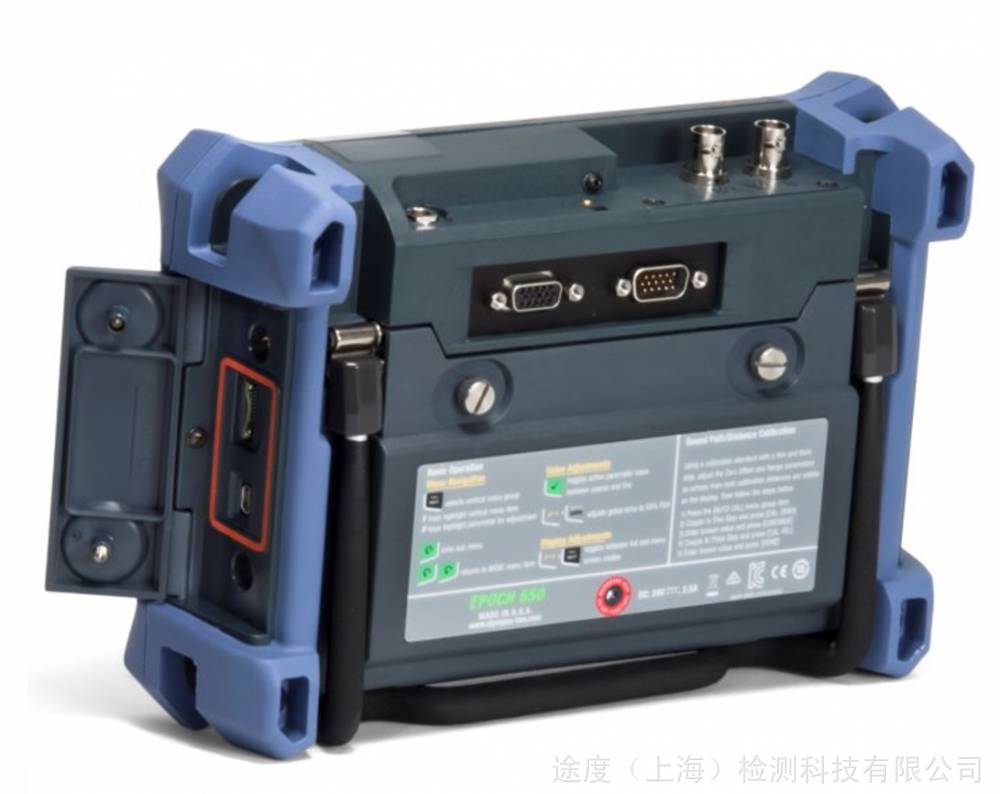
The USB OTG port on the side of the instrument and the removable storage card interface are equipped with a sealed lid.
Standard built-in lithium-ion battery.
Extremely lightweight with ergonomic design, enhancing the portability and ease of use of the instrument.
Compact model, guaranteed quality
When used with the fully VGA reflective wide-screen display and the patented digital high dynamic range receiver, the instrument screen can display stable and clear A-scan images under any lighting conditions. The EPOCH 650 model meets the requirements of EN12668-1 standards and comes with a comprehensive range of standard and optional flaw detection features. Multiple on-board report generation tools and a highly integrated data filling system allow users to easily collect and report high-quality test data. This instrument is rugged and durable, designed for ergonomic use, making it nearly suitable for any testing environment; plus, it's equipped with a flexible PerfectSquare pulse generator and the most number of digital filter settings in its class, making it nearly adaptable to any testing application.
The EPOCH 650 digital ultrasonic flaw detector combines Olympus' industry-leading conventional flaw detection capabilities with the compact, portable design and intuitive operation of the instrument. This flaw detector features efficient menu functions and quick key access, providing a high-quality, easy-to-operate defect detection platform for inspectors.
Model design is suitable for all detection environments

The EPOCH 650 instrument is suitable for nearly all detection environments, including testing operations on laboratory benches and extreme, hazardous outdoor detection applications. The EPOCH 650's梭旋钮 hardware meets the IP66 intrusion protection rating, while the browse key area hardware complies with the IP67 rating. Additionally, the instrument has passed stringent environmental and reliability standards testing. Operators can be confident in the instrument's operational performance and durability in any detection environment.
Key Features
Design complies with EN12668-1 requirements
PerfectSquare Adjustable Square Wave Pulse Generator
Full-screen A scanning mode
Digital High Dynamic Range Receiver
30 digital filters for enhancing signal-to-noise ratio
2 kHz PRF, for rapid scanning
Sailor button or navigation keypad area for adjusting settings
Sun-readable wide screen with full VGA display
Operates for over 15 hours on battery power
Standard Dynamic DAC/TCG and Onboard DGS/AVG
Multiple Aircraft Report Formats
microSD memory card, for data transfer
Optional corrosion module software with B-code scanning feature
USB (OTG) port for communication with PCs
Alarm and VGA Output
Optional simulated output
Simple operation, easy to use
The primary design objective of the EPOCH 650 instrument is to provide an extremely high level of flaw detection performance through a simple basic setup. The EPOCH 650 instrument is ergonomically designed, simple and intuitive, and practical to use. Whether experienced or new to the field of ultrasonic testing, users can easily master and utilize this flaw detector.
Simple and intuitive user interface
The user interface of the EPOCH 650 instrument is based on the industry-leading EPOCH 600 flaw detector. The EPOCH 650 instrument utilizes a simple menu structure for instrument setup, calibration, and software feature adjustments, featuring the EPOCH brand's signature shortcut keys.
Access key testing features, such as gain, gate adjustment, screen freeze, and file save. The intuitive user interface of the EPOCH 650 model offers multiple language versions for use by operators of any skill level.

EPOCH 650 DGS/AVG Features - Standard Screen Mode
Bright VGA display in full-screen mode
The EPOCH 650 instrument features a display with full VGA resolution (640 x 480 pixels). Its horizontally wide and vertically narrow panel design optimizes the size and clarity of A-scan images on high-quality screens. This instrument employs transreflective technology, utilizing strong backlighting in dimly lit indoor environments and ambient light as a pseudo-backlight under direct sunlight. Regardless of the lighting conditions, the instrument's VGA screen displays images with exceptional clarity.
The instrument's full-screen mode further enhances the screen's sharp and clear display features, providing A-scan for all EPOCH series flaw detectors!

EPOCH 650 DGS/AVG Features - Full-Screen Mode
Options for a user-friendly browsing interface
To cater to the varying needs and preferences of our users, the EPOCH 650 model instrument comes with two hardware configurations for selection:

Sewing Shuttle Knob
The EPOCH 650 instrument's shuttle knob, used in conjunction with the confirm and exit keys, allows for coarse or fine adjustment of parameter values. During the detection process, operators can lock the shuttle knob to prevent accidental modification of parameter values. This hardware setup enables quick switching of parameter values, meeting the needs of users who prefer adjusting parameters with the shuttle knob. The design of the shuttle knob configuration complies with IP66 requirements.

Browsing Keypad Area
The EPOCH 650 instrument's navigation keypad is a hallmark feature of the EPOCH flaw detector. The up and down arrow keys are used for coarse adjustment of parameters, while the left and right arrow keys are for fine adjustment. The keypad also includes several other functions and commonly used parameters, such as: gain, save, confirm, and exit keys. The design of the keypad configuration meets IP67 requirements.
Exterior Features (rear panel)

A - USB (OTG) Port
B - microSD card
C - DC Power Interface
D - VGA Port
E - Digital I/O Port
F - Probe Interface (2 pcs)
G – Battery Compartment Cover
H - Tubular Bracket
Key Technical Parameters
Instrument Input/Output | |
USB port | USB (On-The-Go) Port |
RS-232 port | Available |
Video Output | Standard VGA Output |
Simulated Output | 1 simulated output (optional), optional 1 V/10 V full scale, 4 mA |
Alarm Output | 3 alarm outputs, 5V TTL, 10 mA |
Trigger I/O | Trigger input is 5V TTL; trigger output is 5V TTL, 10 mA |
Encoder Input | Single-axis encoder cable (orthogonal, for corrosion module mode only) |
Environmental Rating | |
IP Rating | In compliance with IEC 60529-2004 (Degree of Protection Provided by Enclosures – IP Code) standard, the hardware design of the navigation key area meets the IP67 intrusion protection rating, while the hardware design of the梭旋钮 meets the IP66 intrusion protection rating. Before the newly developed product is officially put into production, Olympus will conduct an internal inspection of the product design. This instrument has been tested and proven to meetIPRating Criteria. |
Explosive atmosphere | Passed testing per MIL-STD-810F Method 511.4 Procedure I, safe to operate in explosive atmospheres as defined in NFPA 70 Section 500, Division 2, Group D. |
Impact Resistance Test | Passed the testing as per MIL-STD-810F Method 516.5 Procedure I, with each shaft undergoing 6 cycles at 15 g, 11 ms half-sine wave. |
Vibration Resistance Test | Passed the testing in Appendix C, Figure 6 of MIL-STD-810F Method 514.5 Program I, general exposure: 1 hour per axis. |
Operating Temperature | –10°C~50°C |
Battery Storage Temperature | 0°C~50°C |
Standard Specifications | |
Dimensions (Width x Height x Depth) | 236 mm x 167 mm x 70 mm |
Weight | 6 lbs, including lithium-ion battery |
Keypad area | English, International Symbols, Japanese, Chinese |
Language | English, Spanish, French, German, Japanese, Chinese, Portuguese, and Russian |
Probe Interface | BNC interface or No.1 LEMO interface |
Data Storage | Aboard with 100,000 ID codes, with a removable 2 GB microSD card (standard) |
Battery Type | Single lithium-ion battery, rechargeable, standard type |
Battery-powered runtime | 15 to 16 hours (Lithium-ion) |
Power Requirements | AC Main Power: 100 VAC ~ 120 VAC, 200 VAC ~ 240 VAC, 50 Hz ~ 60 Hz |
Monitor Type | Full VGA (640 x 480 pixels) transflective color LCD, 60 Hz refresh rate |
Screen Size (Width x Height, Diagonal) | 117 mm x 89 mm, 146 mm |
Pulse Generator | |
Pulse Generator | Adjustable Square Wave |
PRF | 10 Hz to 2000 Hz, in increments of 10 Hz. |
Energy Settings | 100V, 200V, 300V, or 400V |
Pulse Width | Adjustable from 25 ns to 5000 ns (0.1 MHz) using PerfectSquare technology |
Damping | 50、100、200、400 Ω |
Receiver | |
Amplification | 0 dB ~ 110 dB |
Input Signal | 20 V P-P |
Receiver Input Impedance | 400 Ω ± 5% |
Receiver Bandwidth | 0.2 MHz ~ 26.5 MHz,–3 dB |
Digital Filter Settings | 30 Standard Digital Filters Settings 7A piece that meetsEN12668-1:2010Standard Filter Settings0.2-10 MHz、2.0-21.5 MHz、8.0-26.5 MHz、0.5-4 MHz、0.2-1.2 MHz、1.5-8.5 MHzAnd5-15 MHz) |
Detector | Full Wave, Positive Half Wave, Negative Half Wave, RF Wave |
System Linear | Level: ±0.5% FSW |
Resolution | 0.25% FSH, Amplifier accuracy ±1 dB |
Inhibit | 0% to 80% full screen height, with visible warnings |
Amplitude Measurement | 0% to 110% full screen height, resolution of 0.25% |
Measurement Rate | In all modes, equivalent to PRF |
Calibrate | |
Automatic Calibration | Sound velocity, zero offset, vertical beam (first bottom echo, or echo to echo), angle beam (sound path or depth) |
Test Mode | Pulse Echo, Dual Crystal, or Penetration |
Unit | Millimeters, inches, or microseconds |
Scope | 3.36 mm to 13388 mm,5,900 m/s |
Sound Velocity | 635 m/s to 15240 m/s |
Zero Offset | 0 µs ~ 750 µs |
Display Lag | -59 mm to 13,401 mm, longitudinal wave velocity in steel |
Refraction Angle | 0° to 90°, with an increment of 0.1°. |
Gate | |
Measurement Gate | 2 fully independent gates for amplitude and transit time (TOF) measurements. |
Gate Starting Point | Variable throughout the entire display range |
Gate Width | The area between the gate starting point and the end of the display range is variable. |
Gate height | Variable within a full-screen height range of 2% to 95%. |
Alarm | Positive and negative thresholds, minimum depth (Gates 1 and 2) |
Measurement | |
Measurement indicates position | 5 positions (manual or automatic selection) |
Gates (1 and 2) | Thickness, Sound Path, Projection, Depth, Amplitude, Transit Time, Minimum/Depth, Minimum/Amplitude |
Echo to Echo | Standard gate 2 to gate 1, optional interface gate tracking |
Other Measurements | DGS/AVG's surge value (dB), DGS/AVG's equivalent reflector size (ERS), AWS D1.1/D1.5 A, B, C, and D ratings, suppression values, echo to reference dB level. |
DAC/TCG Standards | |
DAC Point | Up to 50 points, 110 dB dynamic range |
Special DAC Mode | Custom DAC (up to 6 curves), 20% to 80% view |
Curvature Correction | Standard outer diameter or rod stock calibration for angle beam measurement. |
Corrosion (optional) | Cross-zero measurement algorithm, V-path correction, single echo, echo-to-echo, or coded B-scan |