










Duplex Stainless SteelDuplex Stainless Steel, abbreviated as DSSFerriticWithAusteniticApproximately each50%, typically the content of less than 30% stainless steel is required. In cases with a lower carbon content,CCarbon content ranges from 18% to 28%, with Nickel content between 3% and 10%. Some steels also include alloying elements such as Mo, Cu, Nb, Ti, and N.
This type of steel combines Austenitic andFerritic stainless steelFeatures: Compared to ferritic, it exhibits higher plasticity and toughness, no room temperature brittleness, and significantly improved resistance to intergranular corrosion and welding properties, while still maintaining the characteristics of ferritic stainless steel.High brittleness at 475°C and high thermal conductivity, featuring superplasticity and other characteristics.Austenitic stainless steelCompared, there is a significant improvement in strength, as well as resistance to intergranular corrosion and chloride stress corrosion. Duplex stainless steel boasts excellent pitting resistance and is also a nickel-saving stainless steel.
Duplex stainless steel, due to its austeniticFerritic-bainitic microstructure, with the two phases having approximately equal amounts, hence exhibiting both characteristics.Austenitic stainless steelAnd the characteristics of ferritic stainless steel. Yield strength can reach400MPa to 550MPa, which is twice that of common austenitic stainless steel. Compared to ferritic stainless steel, duplex stainless steel boasts higher toughness, lower brittleness transition temperature, and significantly improved resistance to intergranular corrosion and welding properties; while still retaining some characteristics of ferritic stainless steel, such as 475°C brittleness, high thermal conductivity, low coefficient of linear expansion, superplasticity, and magnetism. In comparison to austenitic stainless steel, duplex stainless steel has higher strength, particularly with a significant increase in yield strength, and also shows marked improvements in resistance to pitting corrosion, stress corrosion, and corrosion fatigue.
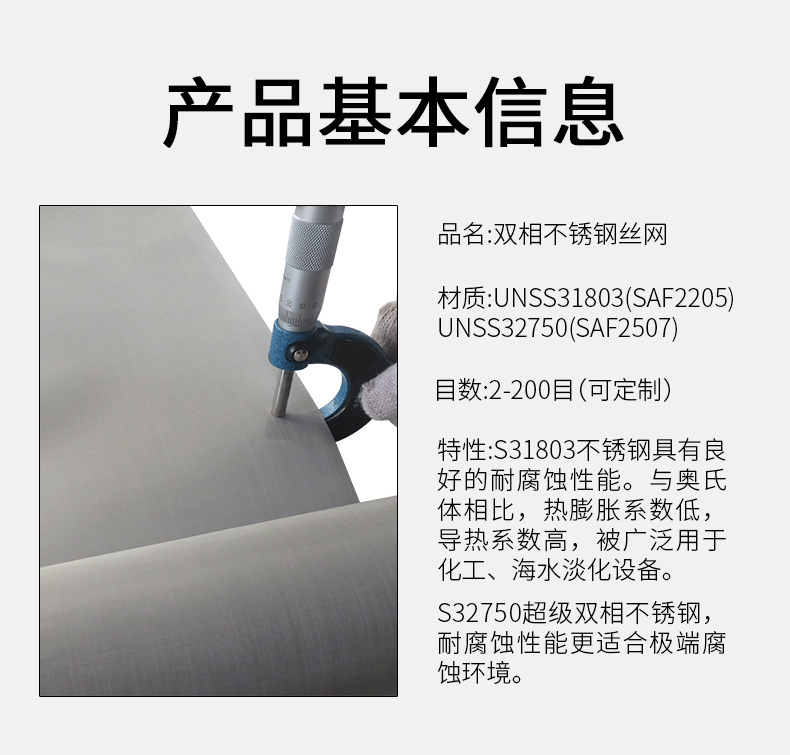
Duplex stainless steel is categorized by its chemical composition, and can be divided intoCr18, Cr23 (without Mo), Cr22, and Cr25 types. The Cr25 dual-phase stainless steel is further divided into standard and super dual-phase grades, with Cr22 and Cr25 types being more widely used. In China, Swedish-made dual-phase stainless steel is predominantly used, with specific grades including: 3RE60 (Cr18), SAF2304 (Cr23), SAF2205 (Cr22), and SAF2507 (Cr25).