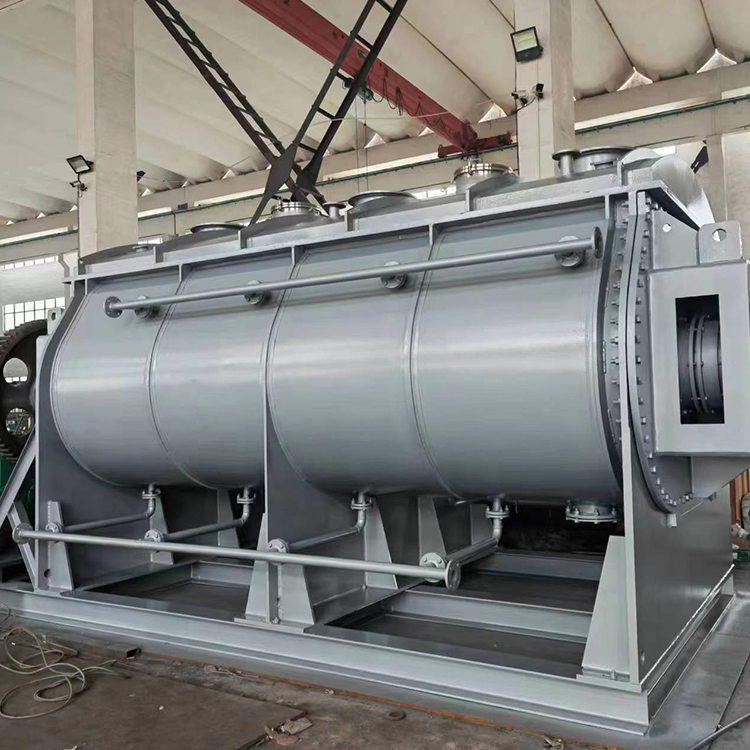
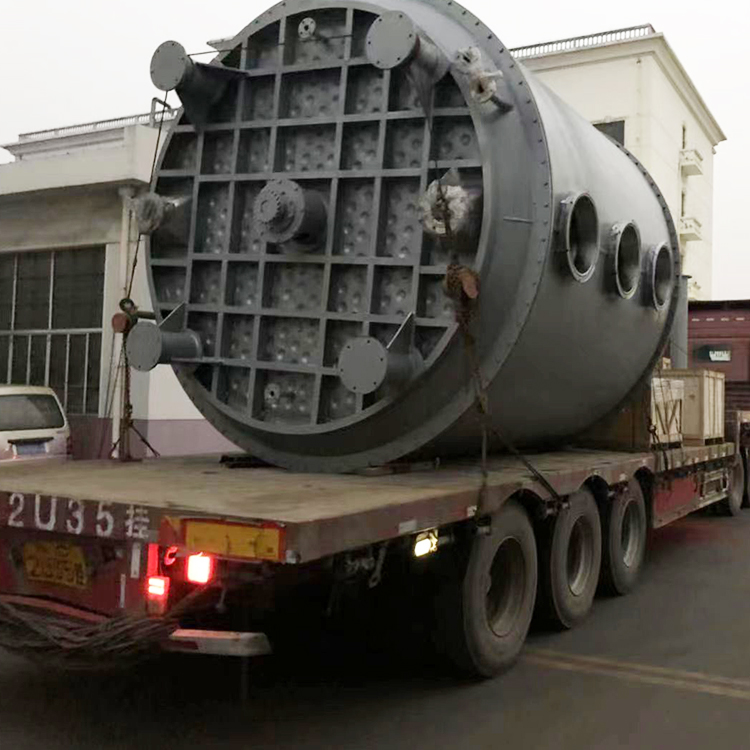
Manufacturer of drying equipment, granulation equipment, ...


Product Recommendation
Process Conditions
Material: Organic Solid Granules Melting Point: 145℃
2. Initial Moisture Content: 10% (wet basis)
3. Moisture Content: 0.1% (Wet Basis)
4. Solvent: Water
5. Wet Product Output: 600 Kg/h
6. Product Particle Size: 100 mesh
7. Bulk Density: 04 g/cm³
8. Drying cavity mixing temperature: 80-90℃
9. Material Temperature: 50℃
Heating Method: Steam, 110-120℃
11. Recycling: Host Machine
Material: Contact areas are made of 304 stainless steel, with the rest being A3.
Installation: Indoor
Power: 380V 50Hz Explosion-proof
15. Environment: 20℃ 760mmHg Relative Humidity φ=80%
16. Refrigerant: 7℃ Cold Water
II. Process Calculation:
1. Wet Treatment Volume: G_wet = 600 kg/h
2. Solvent Evaporation Rate: W = 60 kg/h
3. Dried Product Output: G_dry = 540 kg/h
4. The necessary heat for the evaporating solvent:
Q1=35700kcal/h
Heat from material warming
Q1=10800kcal/h
Solvent Heating Energy:
Q1=3000kcal/h
Total Caloric Intake: Q = 49,500 kcal/h
Equipment heat loss is set at 15%.
The total heat is: Q=56925 kcal/h
Steam Consumption: GSteam = 114-130 kg/h
Q = KA△Tm △Tm = 40 K = 15 Solve for A = 95 square
Based on experience, 1 unit of ZPLG3000-18 (cooling for the bottom disk and discharge base at the lowest level)
III. Working Principle:
The wet material of the vacuum disc dryer is continuously added to the first layer of drying tray at the top of the dryer through a feeder. The scraper arm with rake blades performs a rotational motion, continuously flipping the material. The material flows over the surface of the drying tray along an exponential spiral line. The material on the small drying tray moves to the outer edge and falls onto the outer edge of the large drying tray below. The material on the large drying tray moves inward and falls into the middle, dropping into the next layer of small drying tray. The large and small drying trays are alternately arranged vertically, allowing the material to continuously flow through the entire dryer. A heating medium is introduced into the hollow drying trays, entering at one end and exiting at the other. The dried material falls from the last layer of drying tray onto the cooling bottom of the shell, and is finally moved by the scraper blades to the discharge port. Moisture evaporates and vaporizes from the material, condenses into solvents, and is then extracted by the vacuum pump at the end, exhausting the last stage of waste gas.
Our vacuum disc dryer has been patented, Patent No.: 201420254725.9. The company boasts extensive experience in technology and customer cases for the manufacturing and design of vacuum disc dryers. These dryers are suitable for drying solvent materials, featuring solvent condenser recovery, and choosing Purnell Dryers gives you peace of mind.


b2b.china9.net © Zhongshang 114 Hebei Network Technology Co., Ltd.Address: Room 6009, Oriental New World Center, No.118 East Zhongshan Road, Qiaoxi District, Shijiazhuang City, Hebei ProvincePlatform Service Hotline: 4006299930