


- AllProduct Category
-
Light curtain target
Technical Articles
Industry News
News & Information
Light-Gas Gun System
Impact Tester
Security Management Platform
Impact/Overshoot Dynamic Checker
Ultra-Dynamic Testing Equipment
Ultra-Dynamic Signal Conditioning/Data Acquisition
Impulse Fire Device
Self-Organizing Network
FlexiBots Industrial Software
Automated Production Line
FlexiBots Assembly Robots
FlexiBots Inspection Robots
Flexible Hazardous Area Electrical Equipment
FlexiBots Industrial Robots



详情描述
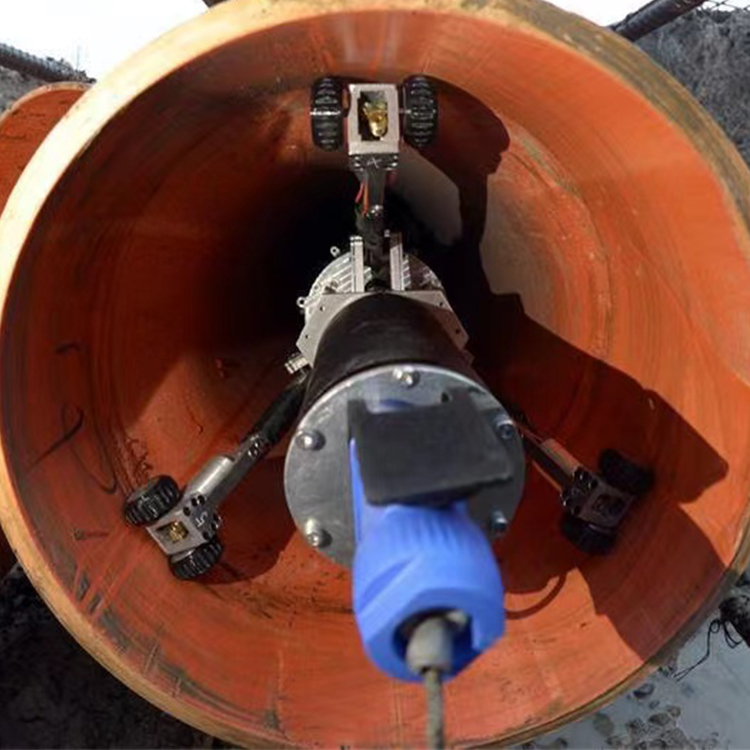
Pipe Cleaning Robots are specialized automated devices designed for cleaning and wiping the inner walls of pipelines. They are primarily used in industrial settings, particularly for large-scale pipeline systems that require regular cleaning, such as in the chemical, oil, and food processing industries. These robots can access the interiors of pipelines with larger diameters to perform efficient and thorough cleaning.
I. Application Scenarios
Power generation plant
In power plants and nuclear power stations, condensers, heat exchangers, and boiler pipes require regular cleaning to maintain efficient operation. Tube cleaning robots can perform cleaning without complete shutdown, effectively enhancing equipment operation efficiency and lifespan.
2. Petroleum and Natural Gas Industry
Pipelines in the oil and natural gas industry, which transport high-viscosity fluids, tend to accumulate impurities and sediments. Cleaning robots can navigate through narrow pipelines to ensure they remain clear and maintain operational safety.
3. Chemical Plants & Pharmaceutical Factories
- Production equipment in such factories largely relies on pipelines to transport various chemicals. Deposits and blockages within the pipeline walls can affect product purity and production efficiency. Utilizing pipeline cleaning robots can achieve efficient and pollution-free cleaning.
4. Food and Beverage Industry
The food and beverage industry demands stringent hygiene standards. Tube cleaning robots can thoroughly clean pipelines, preventing contamination and bacterial growth, thus ensuring product quality meets standards.
5. Air Conditioning and Refrigeration Systems
Condensers and evaporator pipes in large air conditioners and refrigeration systems are prone to accumulating dust and microorganisms, affecting system efficiency. Tube cleaning robots can be used to clean these pipes, enhancing system energy efficiency and extending its lifespan.
6. Shipbuilding and Marine Engineering
The cooling system and balancing water pipes of ship engines require regular cleaning to prevent corrosion and blockages. Tube cleaning robots can perform effective cleaning in harsh and confined environments, ensuring the normal operation of the vessel.
7. Municipal Water Supply and Sewerage Systems
Municipal water and wastewater system pipelines have a wide coverage and are prone to sedimentation and clogging. Pipe cleaning robots can be used for routine maintenance of these pipelines, enhancing system operation efficiency and reliability.
8. HVAC (Heating, Ventilation, and Air Conditioning) System
Heating, ventilation, and air conditioning (HVAC) systems in commercial buildings, public structures, and industrial facilities require clean piping to maintain air quality and system efficiency. Pipe cleaning robots effectively clean ventilation ducts, preventing the accumulation of bacteria and pollutants.
9. Heat Exchanger Cleaning
Heat exchangers are widely used across various industries, and scaling and corrosion can reduce their heat transfer efficiency. Tube cleaning robots can penetrate deep inside for a thorough cleaning, restoring their optimal performance.
10. Other Industrial Sectors
Any industrial equipment requiring internal pipeline cleanliness, such as the pulp and paper, textile industries, can utilize pipeline cleaning robots to enhance equipment efficiency and reduce maintenance costs.
Section II: Main Features
1. Auto-Clean Feature
- The pipe cleaning robot is equipped with various cleaning tools such as brushes, high-pressure nozzles, and scrapers, capable of effectively removing dirt, sediments, and corrosion from the interior of pipes. Some high-end models can also automatically adjust the cleaning intensity and tools based on the type and amount of dirt inside the pipes.
2. High-definition camera and detection features
- Many tube cleaning robots are equipped with high-definition cameras and sensors, enabling real-time monitoring of the interior wall condition during cleaning. This not only aids in adjusting cleaning strategies promptly but also allows for the recording of before-and-after images for subsequent analysis and reporting.
3. Automatic Navigation and Positioning Function
- Equipped with an integrated navigation system (such as GPS, LiDAR, or an Inertial Navigation System), the pipeline cleaning robot can autonomously navigate complex pipeline systems, avoid obstacles, and accurately locate the areas requiring cleaning.
4. Remote Control and Monitoring Features
- Operators can remotely monitor and control the tube cleaning robot's working status via wireless communication technology. This greatly enhances efficiency and safety, especially in high-risk environments such as nuclear power plants or underwater pipelines.
5. Data Collection and Analysis Features
- The pipe cleaning robot can collect various data during operation, such as the condition of the pipe inner wall, temperature, and pressure. This data can be transmitted to the central data system for analysis, providing strong support for the health assessment and preventive maintenance of the pipeline system.
6. High-pressure water jet cleaning
- Certain pipe cleaning robots are equipped with a high-pressure water jet system, effectively removing stubborn deposits and contaminants through high-pressure water flow, particularly suitable for dirt on the inner wall of pipes that is hard to remove.
7. Robot Arm or Telescopic Arm Features
- Some pipe cleaning robots are equipped with mechanical arms or telescopic arms, designed for cleaning complex structures or hard-to-reach areas. This makes the cleaning process more flexible and comprehensive.
8. Filth Collection and Removal
- Advanced pipe cleaning robots feature dirt collection and expulsion capabilities, enabling the centralized collection of dirt and waste fluids during the cleaning process to prevent secondary contamination and expel them from the pipes at the appropriate time.
9. Electric and Pneumatic Dual Mode
- To accommodate various work environments and cleaning requirements, tube cleaning robots typically support both electric and pneumatic dual-mode operation. Electric mode is commonly used for routine cleaning, while pneumatic mode is suitable for explosive or high-risk environments.
10. Emergency Stop and Safety Protection Features
- To ensure safety, pipe cleaning robots are typically equipped with an emergency stop button and various safety features, such as collision sensors and overheat protection, which can quickly halt operation in case of emergencies to prevent accidents.
11. Multi-functional Modular Design
- Many tube cleaning robots feature modular designs, allowing for the replacement or upgrade of different functional modules such as cutting, polishing, and repairing, to achieve multi-functional capabilities based on various cleaning tasks and pipe structures.
III. Structural Composition
1. Aircraft body
- The body is the core structure of the wiping robot, typically made of high-strength, lightweight materials such as aluminum alloy or engineering plastics. The body houses most of the critical components, including the battery, processor, and motor.
2. Drive System
- The drive system is responsible for the robot's movement and typically includes the following components:
- Wheels or Tracks: Used for the movement of robots inside pipelines, selection depends on specific application. For instance, tracks are suitable for complex and uneven pipelines.
- Motors: Provide driving force, which may be an electric motor or a pneumatic motor, depending on the application environment (e.g., explosive environments).
3. Cleaning Tools
Cleaning tools are crucial for tube cleaning robots to perform their tasks, commonly including:
- Brushes: Used for physical wiping and cleaning.
- High-pressure water nozzle: Used for high-pressure water jet cleaning.
- Scraper: Used for removing stubborn deposits.
- Vacuum Device: Used for collecting dirt and impurities generated during cleaning.
4. Control System
- The control system includes the following components:
- Central Processing Unit (CPU): Responsible for processing data from various sensors and executing instructions for cleaning tasks.
Interface Module: Used for communication and control with operators, typically including wireless communication modules (Wi-Fi, Bluetooth, etc.).
Sensor
- Sensors are used for monitoring and feedback of working conditions, including:
- Temperature Sensor: Monitors the temperature inside the pipeline.
- Pressure Sensor: Monitors pressure changes within pipelines.
- High-definition camera: Used for visual inspection and recording.
- Laser radar or sonar: Used for navigation and positioning.
6. Navigation and Positioning System
- Navigation and positioning systems ensure that the robot can move autonomously or semi-autonomously within pipelines and accurately reach the target location, with commonly used technologies including:
Inertial Navigation System (INS)
- Global Positioning System (GPS) (suitable for outdoor environments).
- Odometers and encoders (for recording distance traveled).
7. Power System
- The power system provides the energy for the robot, typically including:
Battery Pack: Commonly, lithium-ion batteries are used, offering high capacity and long-lasting performance.
- Charging Interface: For quick charging convenience.
- Backup Power Supply: For emergency use.
8. Soil Collection and Treatment System
- Used for collecting dirt and waste liquids during the cleaning process, usually including:
- Grease trap: Collects and removes dirt.
- Filtration System: Separates liquid and solid impurities.
9. Communication and Remote Control Systems
- Achieve remote monitoring and operation, mainly including:
- Wireless Communication Modules (such as Wi-Fi, Bluetooth, 4G/5G, etc.): Used for data transmission with control centers or operator devices.
- User Interface (UI): Typically a graphical interface, facilitating real-time monitoring and control of robots.
10. Emergency Shutdown and Safety Systems
- Includes an emergency stop button and various safety sensors to prevent sudden accidents. May also include:
- Collision avoidance sensor: Prevents robots from colliding inside pipelines.
- Overload Protection System: Prevents motor overheating and overloading.
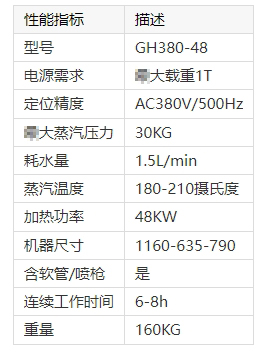
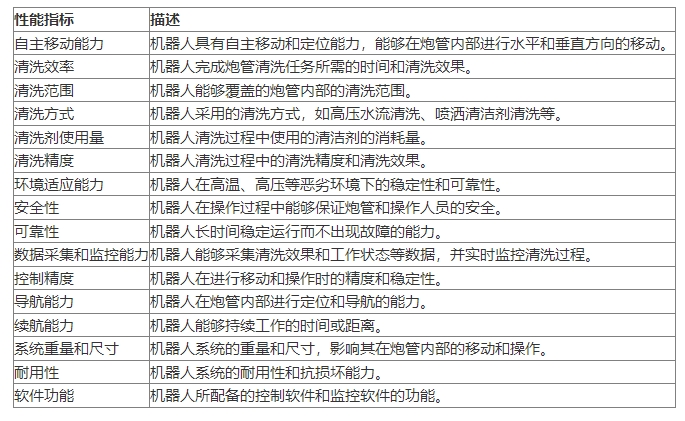
The following will describe some performance indicators of the tube cleaning robot: