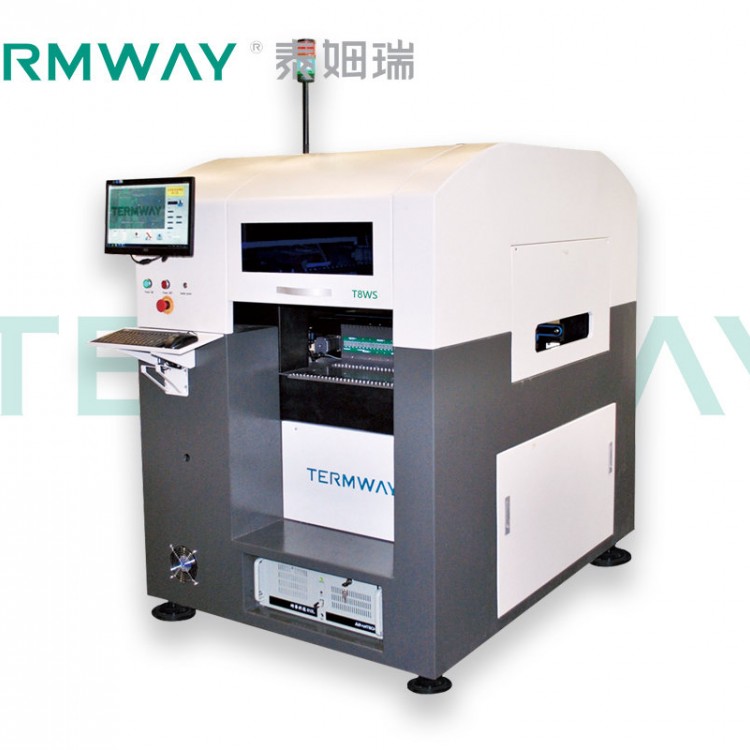
Research, development, production, and sales of SMT equipment and consumables. Always leading the technology and trends of domestic SMT equipment.
13701314315
"Benchmarking" phenomena often occur during the reflow soldering process of CHIP components (such as surface mount capacitors and resistors), with smaller components being more prone to it. Especially in the production of 1005 or smaller 0603 surface mount components, it is difficult to eliminate the "benchmarking" phenomenon. During the reflow soldering process of surface mount technology, the surface mount components can experience defects due to warping, leading to soldering failures, which people vividly refer to as the "benchmarking" phenomenon (i.e., the Manhattan phenomenon).
The cause is due to an imbalance in surface tension at the two welding ends of the component during the reflow melting of the solder paste on the pads at both ends of the component. A detailed analysis reveals the following seven primary reasons:
Inconsistent heating, uneven temperature distribution within the reflux furnace, and uneven temperature distribution on the plate surface.
2. Component issues include significant variations in the shape and size of the welding terminals, considerable differences in the weldability of the terminals, and excessively light component weight.
3. Substrate material and thickness; poor thermal conductivity of the substrate material; poor uniformity in substrate thickness.
4. Pad shapes and solderability vary significantly, as do the thermal capacities of pads, with considerable differences in solderability.
5. Solder Paste – Poor solder paste flux homogeneity or activity; significant difference in solder paste thickness between two pads; excessive solder paste; poor printing accuracy; severe misalignment.
6. Preheat Temperature, too low preheat temperature
7. Poor assembly accuracy, with significant component offset.
The "marking" phenomenon occurs due to the uneven surface tension at the two ends of the component pads when the solder paste melts during reflow. The end with greater tension pulls the component along its bottom, causing it to rotate. There are many factors that can lead to this uneven tension, and the following will briefly analyze some of the main factors.
1. Pre-warm-up period
Table 1 presents the statistical results of the vertical column phenomenon in infrared heating and gas phase heating reflow soldering. The test utilized 1608 and 2125 surface mount capacitors, comparing infrared and hot air reflow soldering with unpreheated gas phase heating reflow soldering. The table clearly illustrates the occurrence rate of the vertical column phenomenon, which is significantly higher in the latter due to the lack of a preheating zone in gas phase heating, resulting in rapid temperature rise. This increases the likelihood of the solder paste on both ends of the component not melting simultaneously. When the preheating temperature is set too low and the preheating time is too short, the probability of uneven melting of the solder paste at both ends is greatly increased, leading to unbalanced tension and the formation of "vertical columns." Therefore, it is crucial to correctly set the preheating process parameters. Based on our experience, the preheating temperature is generally around 150+10°C, with a duration of approximately 60-90 seconds.
Pad size
For small, SMD components, designing varying pad sizes at one end or connecting one end of the pad to a ground plane can also lead to component standing up. The use of differently sized pads may result in uneven pad heating and solder paste reflow times. During reflow, components can almost float on the liquid solder, reaching their final position when the solder solidifies. Different wettability forces on the pads may cause a lack of adhesion and component rotation. In some cases, extending the time above the liquidus temperature can reduce component standing. When designing pad patterns for SMD resistors and capacitors, strict symmetry should be maintained, meaning the pad shape and size should be identical to ensure that the resultant force on the component pad is zero during solder paste melting, facilitating ideal solder joints. Design is the first step in the manufacturing process, and poor pad design can be a primary cause of component standing. Specific pad design standards can be found in IPC-782, "Surface Mount Design and Pad Placement Standards." In fact, pads that are too large for the components may allow them to slide during solder wettability, potentially pulling the component out of the pad end.
3. Solder Paste Offset
通常, during the reflow process, component misalignment during assembly is automatically corrected due to the surface tension pulling the components as the solder paste melts, which we call "self-adaptive." However, severe misalignment can lead to components standing up, creating a "monument" effect. This is because: (1) The soldering end of the component, which comes into more contact, has more heat capacity and thus melts first. (2) The adhesion between the component ends and the solder paste varies. Therefore, it is essential to adjust the component placement accuracy to avoid significant placement deviations.
4. Solder Paste Thickness
When the solder paste thickness is reduced, the tombstoning effect is significantly diminished. This is due to: (1) The thinner solder paste has a reduced surface tension during melting. (2) As the solder paste becomes thinner, the overall thermal capacity of the pad decreases, greatly increasing the probability of simultaneous melting of the solder paste on both pads.
5. Component Weight
Due to the tension generated by solder paste melting, which is generally around 1g to 3g, the occurrence rate of "monument" phenomena in lighter components is higher, and the probability of occurrence is also greater; this is because uneven tension can easily pull the components. Therefore, when selecting components, it is advisable to prioritize larger-sized and heavier components if possible.
Welding defects are numerous, and there are many measures to address them, but often these methods are mutually restrictive. For instance, increasing the preheat temperature can effectively eliminate warping, but it may also result in a large number of solder balls due to faster heating speeds. Therefore, when tackling these issues, it is crucial to consider multiple aspects and opt for a compromise solution.
Contact us

Service Hotline
13701314315
Company Telephone
13701314315

Address
Beijing Tongzhou District Jinqiao Science and Technology Industrial Park, Jiangsu Taixing High-tech Industrial Development Zone, No. 18 Kechuang Road
b2b.china9.net © Zhongshang 114 Hebei Network Technology Co., Ltd.Address: Room 6009, Oriental New World Center, No.118 East Zhongshan Road, Qiaoxi District, Shijiazhuang City, Hebei ProvincePlatform Service Hotline: 4006299930