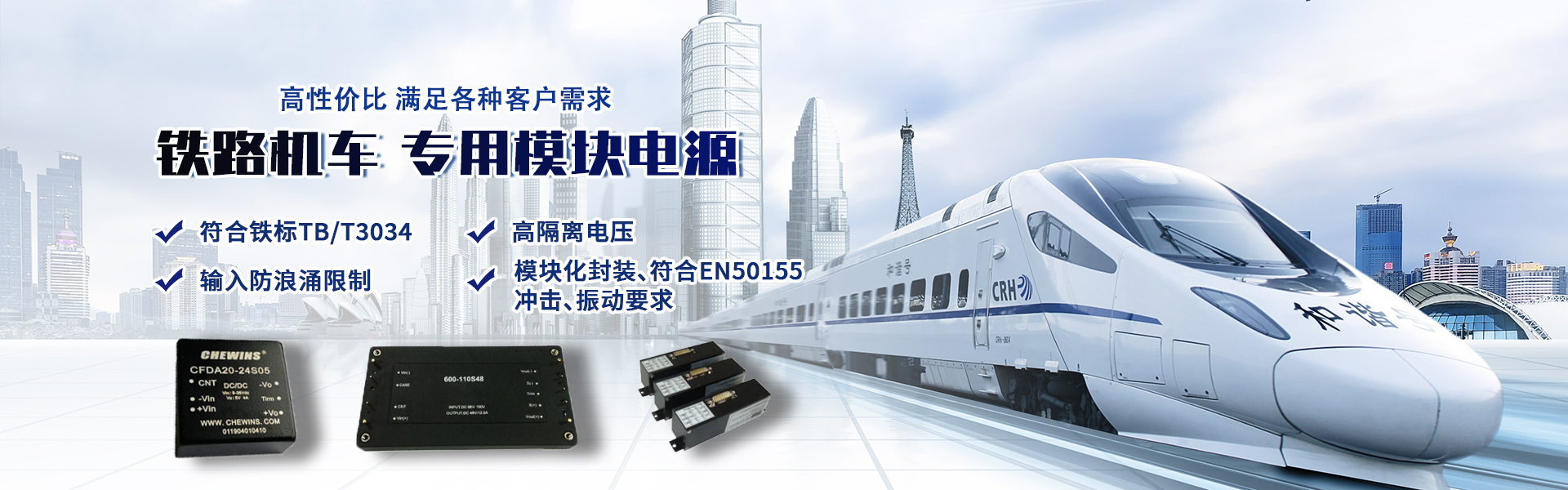
We specialize in the research, manufacturing, and sales of domestic module power supplies, railway power supplies, AC/DC, DC/DC, and DC/AC high-frequency switching power supplies.
15600309099
As industrial intelligence continues to evolve, embedded systems demand higher power supply capabilities with wider input voltage ranges and increasingly precise output current requirements. How can one maintain stable power supply with wide voltage input?
The growing processing capabilities of embedded systems are increasingly demanding for module power supplies, as wide voltage inputs can lead to a change in supply current with the input voltage. Therefore, to ensure the uniformity of module power supply start-up capabilities across the full voltage input range, an additional constant current circuit is introduced to power the control chip. In reality, constant current circuits differ from ideal constant current sources, and appropriate constant current source circuits must be selected based on practical applications. Below is an introduction to common power constant current circuits.
Circuit 1: Composed of two transistors of the same type, this circuit takes advantage of the relatively stable Vbe voltage of the transistors and the characteristic of the base current being smaller than the collector current to form a constant current source with relatively stable current Io = Vbe/R1. This constant current source does not require any special components and is made up of two transistors and two resistors, making it cost-effective and adjustable for Io. The drawback is that the Vbe value varies with changes in current and temperature; higher current leads to a larger Vbe, and lower temperature also results in a larger Vbe. Therefore, it is not suitable for applications that require high precision.
Circuit 2: This constant current circuit primarily utilizes the stable voltage characteristic of the zener diode and the stability of the transistor's Vbe, forming a constant current circuit with Io = (Vd - Vbe) / R3. Its benefits include low cost and adjustable current, but its drawbacks are the poor temperature characteristics and low stability in search engine optimization rankings, making it suitable for applications with low precision requirements.
Circuit 3: A three-terminal voltage regulator provides a constant voltage Vout, forming a constant current source, Io = Vout/R1.
The aforementioned are some common and simple constant current sources, all sharing the characteristic of low voltage regulation accuracy and a relatively small output current Io. Other similar constant current sources are also typically composed based on a constant voltage source, which we will not list individually. During application, if a high-precision, high-current constant current source is required, an operational amplifier can be used to form a high-precision, high-current constant current source.
Circuit 4: A constant current source using operational amplifiers, Io = Vref/R1.
In modular power supplies, low-power sources typically do not have an externally connected short-circuit protection circuit. The characteristic of this module is its low power, small size, and low cost, making it suitable for today's highly competitive market. However, they have a critical flaw: there is a conflict between the short-circuit protection function and the starting capability. A stronger starting capability leads to weaker short-circuit protection, and vice versa. Particularly under the requirement of a wide voltage range input, the compatibility between starting capability and short-circuit protection is poor.
Circuit 5: For instance, a module power supply with an 18-72VDC input and 15W output. If an RC start-up circuit is composed of resistors and capacitors, the current through resistor R1 will vary with the input voltage. During low and high voltage short circuits, the snort cycle will differ significantly, and the short-circuit power will be higher under high voltage input. After adjusting the low-voltage start-up capability and short-circuit protection, the high-voltage short-circuit protection will degrade. A strong start-up capability will result in poor high-voltage start-up and short-circuit protection. Conversely, if the high-voltage start-up and short-circuit protection are adjusted well, the low-voltage short-circuit protection will be good, but the start-up capability will be poor, leading to poor start-up symptoms. To resolve these contradictions, replace the start-up circuit with one using a constant current circuit, where the input current will not significantly change with the input voltage. Under both high and low voltage inputs, the short-circuit cycle of the module power supply output during short-circuit is closer.
Circuit 6: Employing a constant current circuit, the short-circuit waveform diagram shows that replacing the resistor with a constant current circuit resolves the conflict between startup and short-circuit issues. As illustrated below:
The implementation of a constant current source can be achieved by processing the output current or by processing the input current to ensure a constant output current. For the former, the key role is to maintain a stable output current, which can be done through devices like transistors and three-terminal regulators, offering lower cost and simpler circuitry. However, the group results are not very ideal. For the latter, the input current generally does not change with the variation of input voltage, thereby enabling the output to achieve a constant current.
Contact us

Service Hotline
15901068673
Company Telephone
15600309099

Address
25 South Torch Street, Zhoushuizi Economic Development Zone, Baoding City, Hebei Province
b2b.china9.net © Zhongshang 114 Hebei Network Technology Co., Ltd.Address: Room 6009, Oriental New World Center, No.118 East Zhongshan Road, Qiaoxi District, Shijiazhuang City, Hebei ProvincePlatform Service Hotline: 4006299930