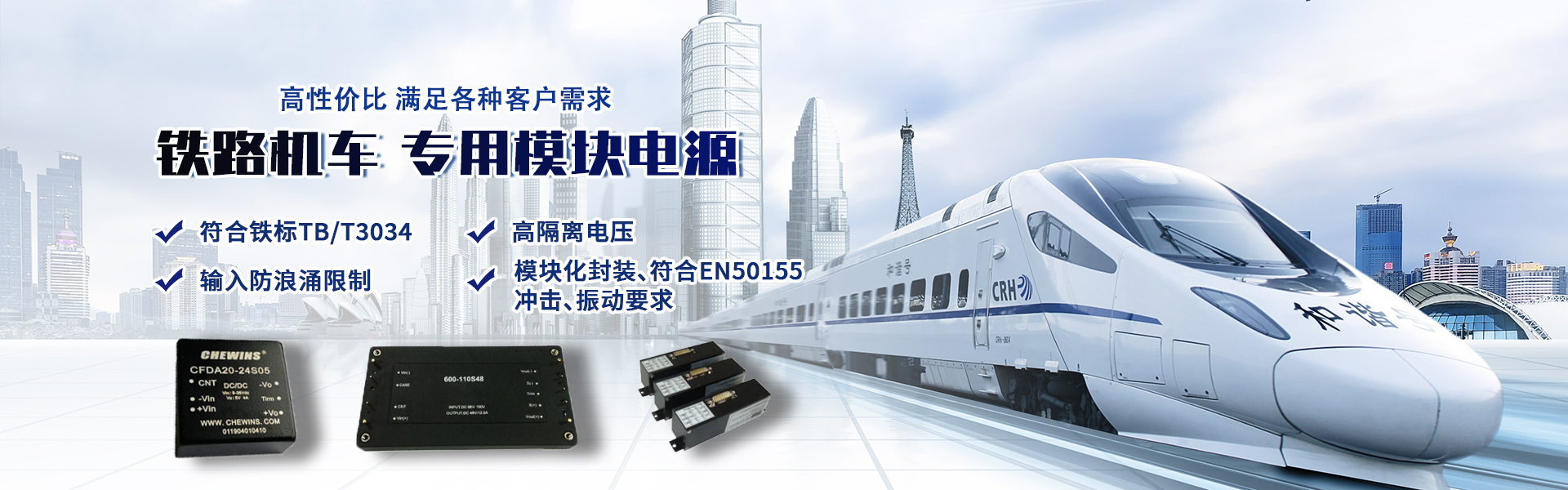
We specialize in the research, manufacturing, and sales of domestic module power supplies, railway power supplies, AC/DC, DC/DC, and DC/AC high-frequency switching power supplies.
15600309099
The impact of heat on power supplies is significant, affecting aspects such as conversion efficiency, circuit board layout, and heat dissipation methods. In module power supplies or electronic systems, wind cooling is commonly used as a heat dissipation method, thus making heat sinks and axial flow fans widely applicable.
Axial fans operate by using an electric motor to drive the blades connected to it, causing the blades to rotate at a speed specified by the motor. This rotation creates a positive pressure difference between the front and back of the blades, propelling the air around the blades in a fixed direction along the motor shaft. Consequently, axial fans feature low pressure head and high flow rate.
When selecting axial fans, people often only consider the aforementioned characteristics, overlooking the series of effects caused by the rotation of the fan blades on the forced air flow. In reality, the fluid through the axial fan does not move strictly in a single direction along the motor shaft; there is also a velocity component on the fan blade cross-section perpendicular to the motor shaft. Therefore, the fluid driven by the axial fan actually rotates and moves forward around the motor shaft as an axis.
In reality, the fluid at the outlet of an axial fan flows forward along the axis in a swirling motion. How does the actual rotation direction of the fan affect the cooled area within the power source?
Under the modular power supply model, we recalculated the two models by adjusting the rotation direction of the axial flow fan without altering the grid division of the model. After the calculation converged, we analyzed the impact of the different fan rotation directions on the entire power supply's heat dissipation by comparing the internal flow field transformation and the cross-sectional distribution of the temperature field in these two scenarios.
Comparing the effects of two analyses, we find that in the analysis process of this model, the rotation direction of the fan has a particularly significant impact on the internal flow field and temperature field distribution of the module power supply. From the perspective of the flow field, due to the relatively low size of the rectifier bridge section and the relatively high size of the PFC heat sink section in the model, the rotation direction of the fan has a very obvious effect on the flow field. When the fan rotates clockwise, the whirlpools around the rectifier bridge heat sink are small, resulting in a more open flow field, which is beneficial to the heat dissipation of the rectifier bridge heat sink. Conversely, when the fan rotates counterclockwise, there are many whirlpools around the rectifier bridge heat sink, which is unfavorable for the heat dissipation of the rectifier bridge heat sink. These differences are also further proven by the distribution of the temperature field in the cross-section of the module power supply.
Carefully observing the flow field animation of the fan in different rotation directions, we can see that the influence of the fan's rotation direction on the subsequent flow field distribution lies in the fact that the rotation direction of the fan determines the spiral direction of the fluid in a spiral flow at the fan's outlet. Therefore, in the process of practical application, we should fully utilize this phenomenon, and strive to avoid layouts that are unfavorable for the heat dissipation of key power components or high-power loss components within the module power supply, ensuring the rationality and reliability of thermal design.
The analysis above applies only to situations where axial fans are used for forced air cooling. In cases of exhaust cooling, as the fan outlet flow field change has no effect on the intake, the rotation direction of the fan has no impact on the internal heat dissipation of the module power supply.
Contact us

Service Hotline
15901068673
Company Telephone
15600309099

Address
25 South Torch Street, Zhoushuizi Economic Development Zone, Baoding City, Hebei Province
b2b.china9.net © Zhongshang 114 Hebei Network Technology Co., Ltd.Address: Room 6009, Oriental New World Center, No.118 East Zhongshan Road, Qiaoxi District, Shijiazhuang City, Hebei ProvincePlatform Service Hotline: 4006299930