



Liquid Heater IEC60335-2-15 Testing Introduction
The safety of household and similar electrical appliances is the primary indicator of their product quality. For most home appliances, the safety requirements not only need to meet the general safety requirements of IEC60335-1 but also fulfill specific additional safety standards depending on the product type. The IEC60335-2-15 standard is an additional safety standard for liquid heaters, applicable to appliances such as coffee makers, egg boilers, milk warmers, slow cookers, steamers, boiling cleaners, yogurt makers, electric kettles, pressure cookers with a rated steam pressure not exceeding 140kPa and a rated capacity not exceeding 10L, as well as other water heaters that produce boiling water with a rated capacity not exceeding 10L. Appliances that are not typically used in households but may pose a hazard to the public, such as those used by non-professionals in stores, light industry, and farms, are also included in the scope of this standard.
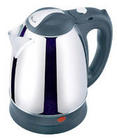
Here, we take the electric kettle as an example to provide a brief introduction to the safety tests and requirements according to the IEC60335-2-15 standard.
Prior to testing, it's essential to identify what constitutes the normal operating state of the product. For an electric kettle, conducting the input test in Chapter 10 is done at the rated voltage. First, fill the kettle with the rated volume of water and then cover it with the lid. In this case, we consider testing at the rated power to be a normal operation.
Next is determining the working voltage during the testing of appliances; for items like kettles, we typically establish the working voltage as 1.15 times or 0.85 times the rated power.
Input Power Test:
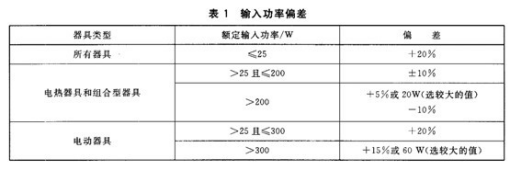
The kettle operates normally under rated voltage; test its input power, which needs to be calculated. For electric kettles and other electric heating appliances, we measure the input power after they have been working for a while, allowing the input power to stabilize. Then, the input power can be directly read from a power meter. Subsequently, we can determine if it meets the standards. The input power is listed in the table below:
Warming-up Test:
In safety testing, the temperature rise test is crucial. The normal temperature rise test for a kettle is conducted at 1.15 times the rated power. Centrifugal juicers have two different temperature rise test requirements: one for electric kettles with a thermostat, where we should reset or react as soon as possible after the thermostat activates, and the test ends after the limiter is engaged a second time, measuring the temperature rise. The other is for electric kettles with a temperature controller; the test should end after the water temperature reaches 95℃ and remains there for 15 minutes, testing the temperature rise. For other electric kettle tests, the temperature rise should be measured after the water inside the kettle reaches 95℃ and remains there for 5 minutes.
Pressure and Contact Current Test:
Generally, electric kettles are categorized as Class II appliances. Let's take a common electric kettle with a dedicated base connector available on the market as an example. The electric kettles sold on the market are typically made of metal with plastic handles, lids, and bases, which are of reinforced insulation type, while the metal外壳 is of basic insulation. The limit for contact current in basic insulation is 0.75 mA, and in reinforced insulation, it is 0.25 mA. For the L and N connections, it is functional insulation with a contact current limit of 0.75 mA. As for the electrical insulation of electric ovens, functional insulation and basic insulation are 1000V, while reinforced insulation is 3000V. This test is conducted while the appliance is in operation and its internal components are heated. Before the test, the appliance should be operated until the temperature stabilizes, and then the withstand voltage and contact current tests should be performed.
Overflow Test:
Based on the type of electric kettle, there are three methods for overflow testing. Depending on the electric kettle, a different testing method can be chosen. For kettles that can be filled through the spout, the spout should be facing up and placed on an inclined plane at a 20° angle to the horizontal for the test. If the water level mark at the filling position is clearly visible, pour a 1% sodium chloride solution to the *highest water level mark; if there is no mark, fill to the overflow position in the kettle and then quickly inject a 15% sodium chloride solution of the rated capacity. Second, the test for cordless electric kettles is conducted on a horizontal surface, with testing performed on both the base and when the kettle is removed from the base. If the kettle can still be filled through the spout, the test should only be conducted with the kettle removed from the base; then place it on the base for an electrical strength test of 16.3. Other electric kettles are tested for overflow with the position deviating from normal use by no more than 5°. After the overflow test, fill the electric kettle to the rated volume. Place it on a plane at a 20° angle to the horizontal, with the spout aligned at the top of the inclined plane. Water should not overflow from the kettle. The structure of the base for cordless electric kettles should ensure that: the connector is not affected by water. This is verified by the following test: place the base on a horizontal surface and pour 30ml of a 1% sodium chloride solution through a tube with an inner diameter of 8mm and a lower end 200mm above the connector within 2 seconds, then the base withstands an electrical strength test of 16.3 with an enhanced insulation voltage of 2500V.
Abnormal Condition Testing:
The abnormal test of the electric kettle includes the tests of 19.3, 19.4, 19.101, and 19.102. 19.3 is the waterless test, where the electric kettle undergoes a waterless test at 1.15 times the rated power. The kettle must also be tested repeatedly with water covering the heating element, and if the heating element is outside the container, 10mm of water is poured into the kettle and the lid is either closed or placed in the most unfavorable position during testing. 19.4 is the thermostat failure test, involving testing the thermostat that operates at 11.8 until the self-resetting thermal circuit breaker activates under normal conditions. 19.101 places the electric kettle on a plywood of approximately 20mm thickness, with the thermal circuit breaker set to non-operational and the kettle operating under no-load conditions. The test is conducted at either 0.85 or 1.15 times the strict rated power, and after the test, any flame must be contained within the kettle, and the supporting surface must not be ignited. For 19.102, the test for kettles with two self-resetting thermal circuit breakers involves short-circuiting one and testing under the conditions of 19.101. Water at (15±5)°C is poured into the kettle within 2 seconds of the other thermal circuit breaker operating, and after one minute, the water in the kettle is drained, with the test being conducted 100 times. For kettles with circuit boards and standby functions, we must also conduct the 19.11 test, including the failure of components in the fault test and the interference resistance test in 19.11.4. During the tests in Chapter 19, the appliance must not expel flames, molten metal, dangerous amounts of toxic gases, or flammable liquids, and its temperature rise must not exceed the specifications of 19.13.
Mechanical Testing:
The kettle's stability and mechanical strength are tested by placing it on a test board inclined at 15° to the horizontal plane with the kettle positioned *in an unfavorable direction* with the lid open or closed, and the kettle should not tip over. A 0.5J impact is applied to the kettle's control panel and switch. The kettle should not be damaged, and it should not come into contact with live parts.
Structural specifications:
The drain hole in the electric kettle must be at least a circular hole with a diameter of 5mm or a slot with a width of at least 3mm, with an area of 20 square millimeters.
2. The kettle structure should ensure that the lid does not fall off when pouring water.
3. The kettle structure should ensure that it does not suddenly expel steam or hot water, potentially causing harm to the user, when used normally.
4. The structure of the cordless kettle base with contact points should ensure that any electrical and mechanical damage incurred during normal use does not pose a hazard. This is achieved by connecting the two conductive pins of the kettle together and串联ing an external resistive load with the power source. When the appliance is supplied with the rated voltage, the external load should produce a current in the power circuit that is 1.1 times the rated current to determine if a hazard will occur. The kettle is placed on and removed from the base at a rate of approximately 10 times per minute for 10,000 cycles. An additional 10,000 cycles are performed without power.
5. For electric kettles and portable boiling water devices with a rated capacity over 3L, the structure must be designed to limit the water leakage rate. To determine compliance, the following test should be conducted: attach the appliance's soft wire, fill the devices with water up to the rated capacity, and close the lid as instructed in the manual.
