

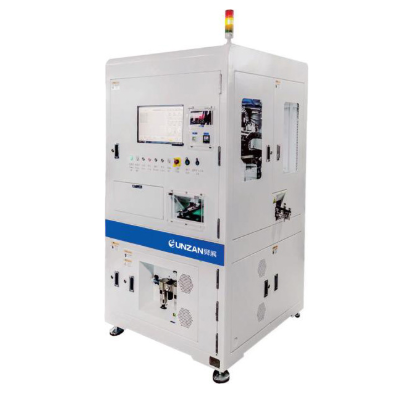





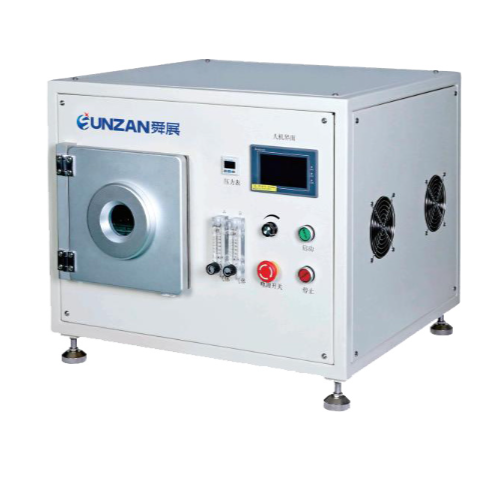
Surface Cleaning: Removes organic contaminants from the product's surface, primarily by eliminating weak bonds (typical)
Organic pollutants, primarily represented by the -CH key, etc.
Surface Activation: Formation of polar groups on the material surface, primarily in the form of carbonyl groups
(Carbonyl), carboxyl, hydroxyl, and other organic groups
Sir, these polar groups have a positive effect on hydrophilicity, used to replace weakly rigid, mainly applied for
Pre-treatment for bonding and coating.
Surface Etching: Utilizing typical gas mixtures to form highly etching plasmas
The sub-body reacts chemically with the organic matrix on the material surface, producing CO, CO2, and H2O vapor.
Gas such as argon is used to achieve the purpose of surface etching.
Surface Coating: Simultaneously introduce two or more process gases into the plasma coating equipment.
Enter the reaction chamber, where the gas is cracked in an ionic environment and then re-aggregated to produce new substances.
This application is much stricter than that required for activation and cleaning. Typical applications include protective coatings.
Formed, applicable to fuel containers, scratch-resistant surfaces, and materials similar to polytetrafluoroethylene (PTFE)
Plating, waterproof coatings, etc.