















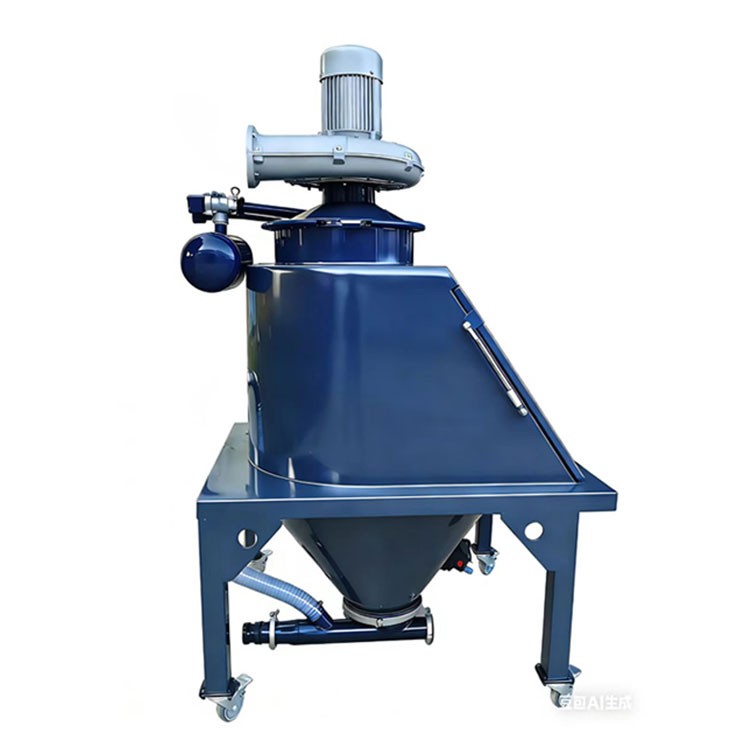


Y-Type Double Helix Conical Blender
The Y-type double helix conical mixer is widely used in various industries such as chemicals, metallurgy, food, pharmaceuticals, fertilizers, coatings, pigments, dyes, pesticides, rubber feed, additives, refractory materials, fine chemicals, new materials, electronic plastics, ceramics, mining, and building materials for the combination of solid with solid (i.e., powders with powders), liquid with liquid, and powder with liquid. The machine is highly adaptable to mixed materials. It does not overheat heat-sensitive materials, does not crush granular materials, and does not cause stratification and separation in mixing materials with vastly different specific gravities and particle sizes. It also has good adaptability to mixing coarse, fine, and ultra-fine particles, as well as fibers or sheet-like materials.
Working Principle
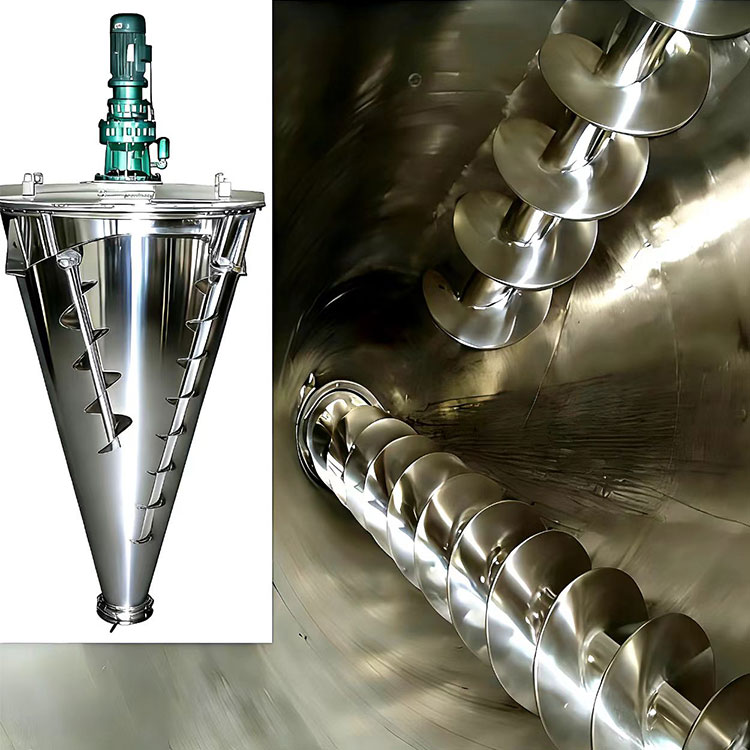
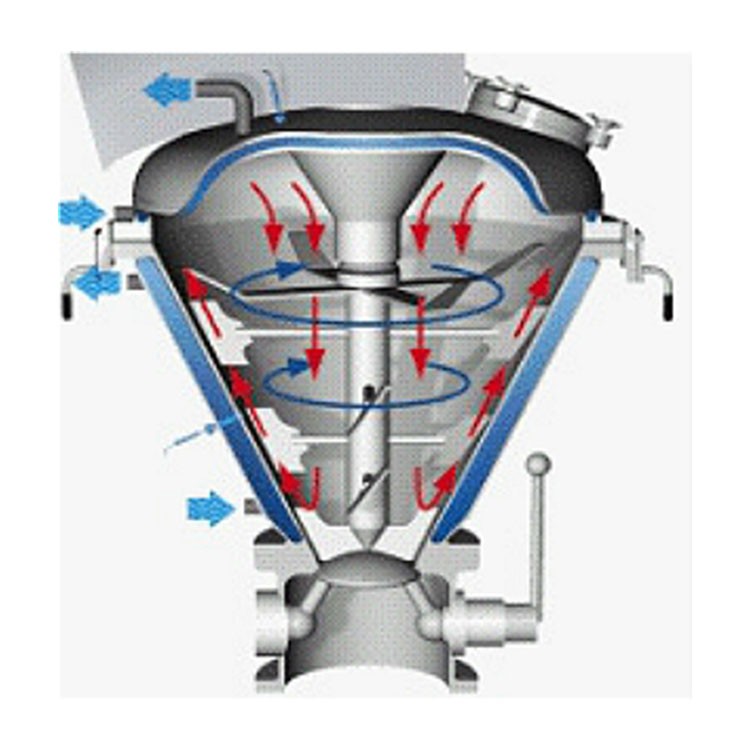
The rapid self-rotation of the two asymmetric screws within the mixed extruder raises the material upward, forming two asymmetric screw-shaped material flows along the cylinder wall from bottom to top. The circular motion of the spiral driven by the rotating arm causes materials outside the spiral to enter the enveloping line of the screw to varying degrees, with some material being lifted out of place and others ejected from the screw. This results in a continuous updating and spreading of the material around the circular circumference. The two streams of material raised to the top then converge into the central depression, creating a downward flow that fills the bottom cavity, thus forming a convection cycle. Due to the composite movement, the material achieves a uniform mixture in a short time with high mixing precision.
Structural Features
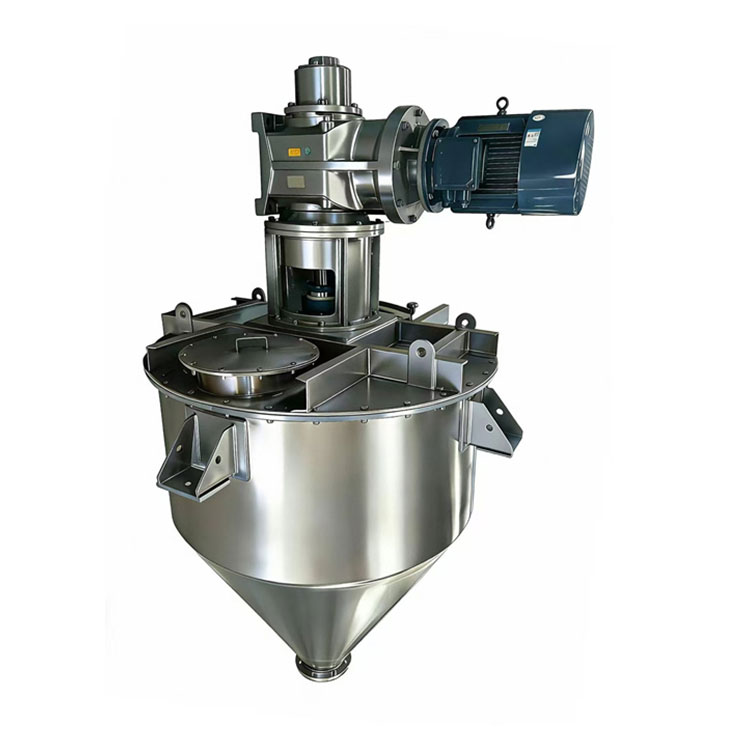
The Y1 type double helix conical mixer consists of a spray atomization device, transmission part, cylinder cover, spiral, cylinder body, discharge valve, etc.
1. Spray Nozzle Assembly: The spray nozzle assembly consists of a rotating connector and a spray nozzle component. The spray nozzle component is fixed to the bottom cover of the distribution box using a flange. The rotating connector and spray nozzle component are a movable connection, allowing the rotating connector to be fixed onto the pipeline.
2. Transmission Section: The motion from the self-rotating motor and the rotating motor is adjusted to a reasonable speed through worm gears and gears, and then transmitted to the screw to achieve both self-rotating and rotating movements.
3. Drum Cap Section: The drum cap supports the entire transmission part, which is secured to the drum cap using a spiral. The drum cap is equipped with a feeding port, observation port, cleaning port, and maintenance hole.
4. Spiral Section: As the two asymmetrically arranged spirals within the cylinder perform a planetary motion of self and reciprocal rotation, they effectively flip the material over a wide range, achieving rapid and even mixing.
5. Cylinder Section: The cylinder is in a conical structure, used for conveying materials, ensuring rapid, clean discharge without material accumulation and no dead corners in the discharge process.
6. Discharge Valve: The discharge valve is installed at the bottom of the cylinder, used for controlling the discharge of materials. This valve is available in three structural types: manual, pneumatic, and electric. Liquid discharge valves (slurry valves) can be added according to customer requirements.
Work Data


















