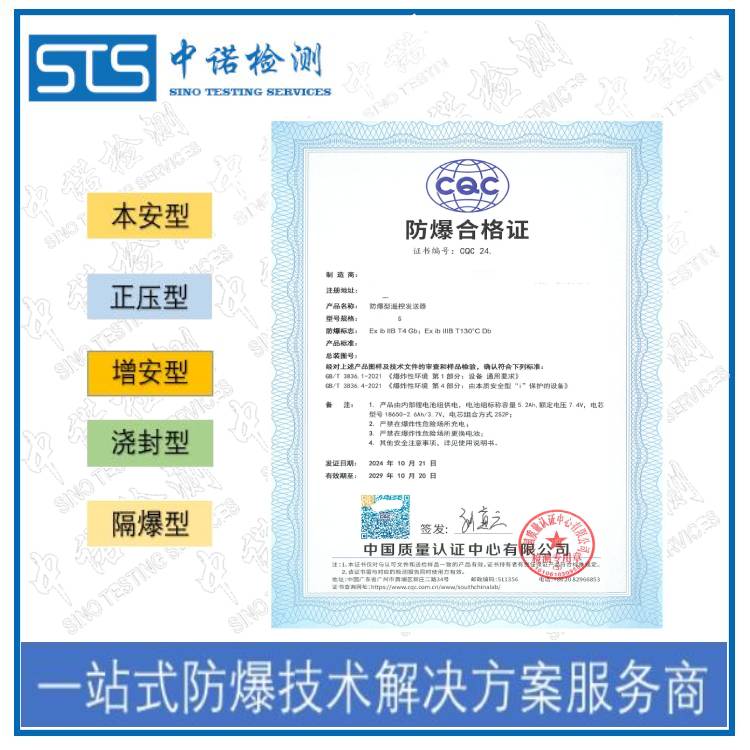

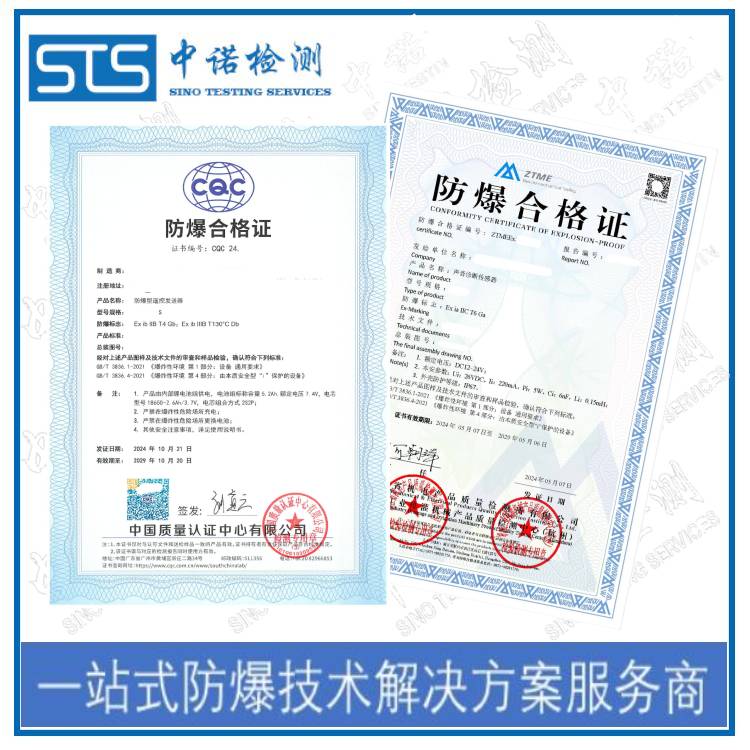
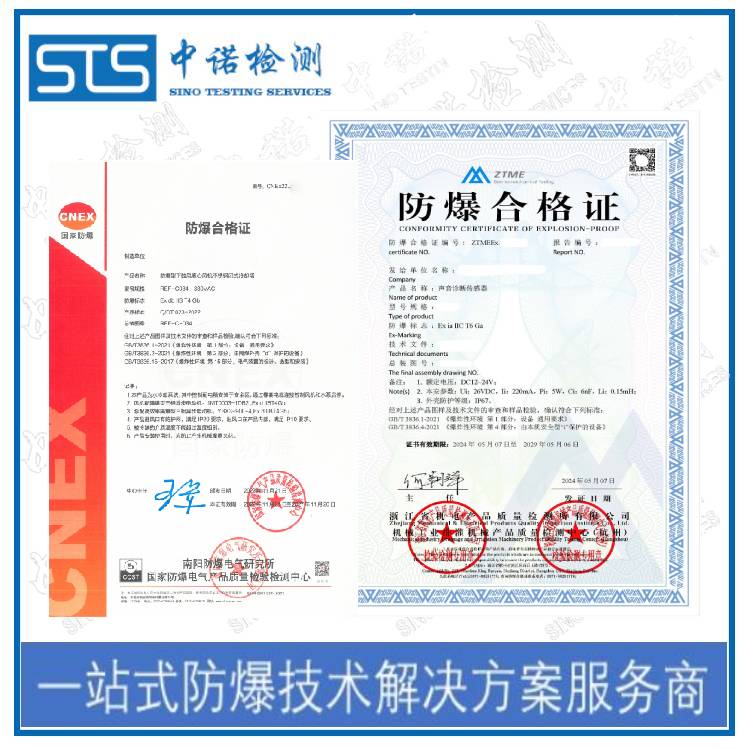










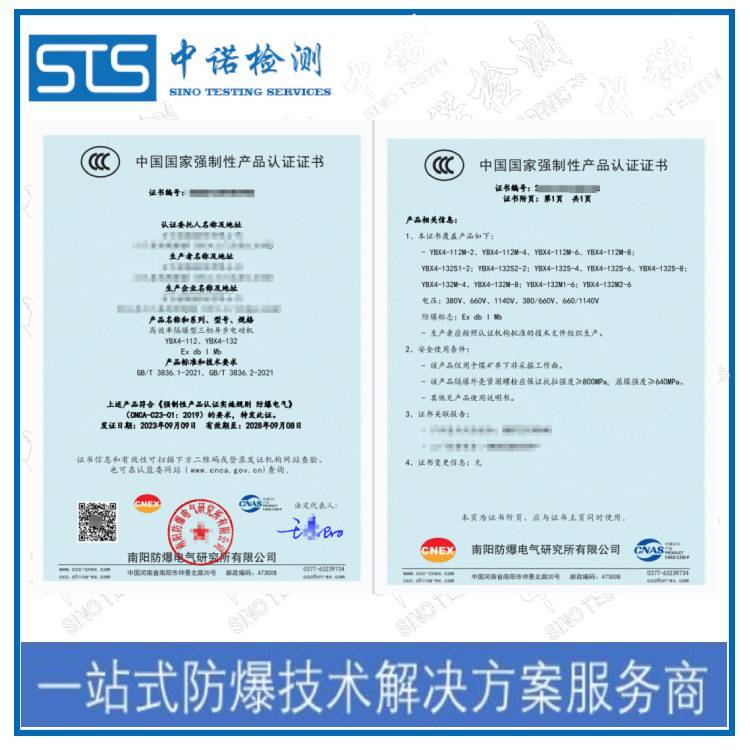
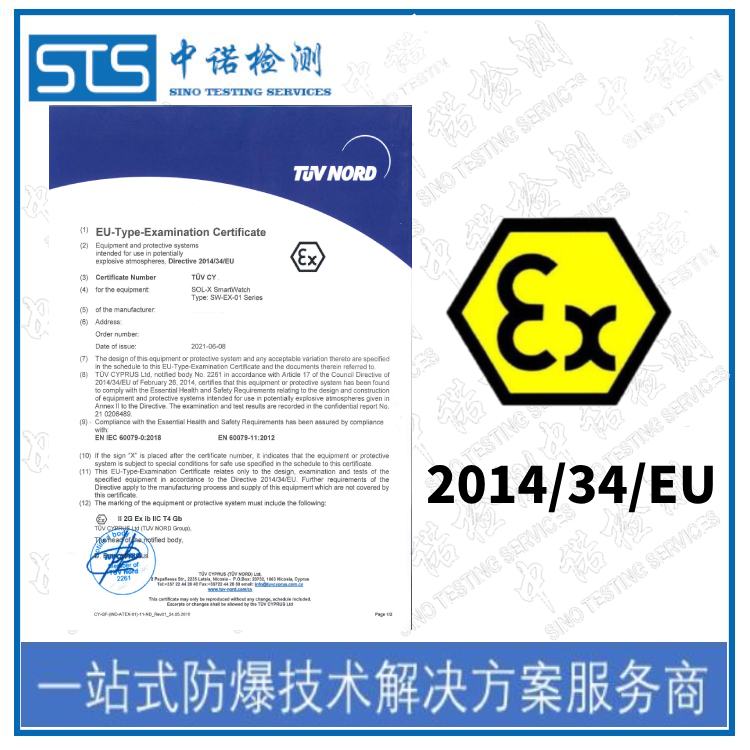
Shenzhen Zhongnuo Testing Technology Co., Ltd. is based in South China and specializes in explosion-proof certification and coal safety certification application consulting services, offering a one-stop explosion-proof technology consulting service.
What does the explosion-proof marking Ex db ib IIC T4 Gb mean?
The explosion-proof marking signifies a device's explosion-proof characteristics, allowing for the identification of the specific explosion-proof type employed.
Applicable to explosive areas and explosion-proof zones, etc.
What is an explosion-proof mark? What does the explosion-proof mark signify? How do you interpret the explosion-proof mark on explosion-proof equipment?
In response to these issues, ZhongNuo Inspection provides a detailed explanation for your reference.
For example, explosion-proof marking Ex db ib IIC T4 Gb.
This is a composite explosion-proof marking.
Ex indicates explosion-proof, all explosion-proof equipment must be marked with the Ex symbol.
DB-IB refers to the explosion-proof protection type of the equipment, meaning it is both explosion-proof and intrinsically safe.
IIC refers to equipment suitable for explosive gas environments of IIC category gases (representative gas is and).
T4 refers to the temperature category, indicating that the surface temperature of the equipment does not exceed 135°C.
Gb refers to the equipment protection level, applicable to Zones 1 and 2.
Above is an example of a common explosion-proof marking used for equipment in an explosive gas environment.
If the equipment is used underground in coal mines or in environments with combustible dust, the explosion-proof markings are different.
If it's an ATEX explosion-proof certification mark, it becomes even more complex.
Business clients, if you need more information on explosion-proof certifications and markings, feel free to message us anytime!
What are the requirements for applying for coal safety certification and mine safety certification?
Coal Safety Certification and Mine Safety Certification are mandatory certifications for mining products and equipment.
Coal safety certification is for equipment used in coal mines, while mine safety certification is for non-coal mine equipment.
Certificates are all applied for, reviewed, and issued at the ANSI Center.
Certificates are valid for 5 years and must undergo annual supervision and review.
To obtain both Coal Safety Certification and Mine Safety Certification, both product testing and factory audits are required.
Applicants must possess design and development capabilities, provide complete product design drawings, and have their own manufacturing facility.
Some products can also apply for coal safety and mine safety certifications through the OEM method.
If dealers or end-users do not meet these criteria, they are unable to apply for the Coal Mine Safety and Coal Safety Certification.
Shenzhen ZhongNuo Inspection, as a coal safety and mine safety certification body, is well-versed in the standards and requirements.
A team of engineers and factory audit service professionals.
We offer services including online application, product design and modification, drawing and documentation revision, and factory inspections.
Facilitate companies in obtaining coal safety and mine safety certifications smoothly.
Our successful case studies include lightboxes, remote controls, fiber optic temperature sensors, sensors, air compressors, smartphones, thermal imaging cameras, and patrol robots.
If you have a need for this, feel free to send a private message to Shenzhen ZhongNuo Testing Technology Co., Ltd. for further communication at any time!
How to apply for an explosion-proof certification for modular equipment?
There is an increasing number of modular equipment used in explosion-proof environments, enabling more complex functions. In response to the technical requirements for explosion-proof certification of such equipment, ZN Testing has summarized years of industry experience, mainly including the following points:
(1) Explosion-proof performance is only considered for the electrical components, including their installation and connection, grounding, etc., without considering the steel structure part.
(2) Electrical components must be purchased and installed with explosion-proof certification or a Class 3C explosion-proof certificate. If suitable explosion-proof electrical components cannot be obtained, consider using explosion-proof/breathable pressure methods for installation.
(3) The explosion-proof marking of the selected explosion-proof electrical components must not be lower than the explosion-proof marking grade of the entire machine.
(4) Installation of explosion-proof electrical components, electrical connections, grounding, etc., must comply with standard requirements.
In the field of explosion-proof equipment certification, ZHONGNUO Testing boasts a technical team and industry experience capable of providing guidance on explosion-proof designs such as positive pressure and flame arrester systems.
Guide customers in selecting electrical equipment, installation, and preparation of technical drawings and documents.
Engineers can be dispatched for on-site inspections to reduce customers' cost and time for evidence collection.
Successful certification cases include robots, AGV vehicles, industrial ovens, high and low-temperature chambers, filling machines, refueling machines, portable fueling units, chemical storage cabinets, dust removal equipment, etc.
Seeking this kind of need? Feel free to DM us for further discussion!
An explosion-proof type is a type of explosion prevention for electrical equipment.
The housing is designed to withstand the entry of flammable and explosive mixtures through the housing joint surfaces or structural gaps without damage in the event of an internal accident.
And causes ignition of flammable and explosive gas atmospheres formed by one or more gases or vapors.
The explosion-proof housing must possess both explosion-proof and anti-explosion capabilities.
Explosion-proof product enclosures are typically heavy-duty, designed for fixed installations and equipment use.
Explosion-proof joint width, gap, and roughness are the three key elements of explosion-proof housing design.
Design requirements for explosion-proof elements vary depending on the different flammable and explosive gas environments used in Class I mining, non-mining Class IIA, IIB, and IIC.
Refer to the design standards of GB/T3836.1 and GB/T3836.2 for specifics.
ZhongNuo Inspection has long specialized in explosion-proof product design, testing, and certification services. Our team in the explosion-proof field is well-versed in standard requirements and offers services such as explosion-proof housing design, drafting, modification guidance, and certification agency assistance.
If you have similar needs, feel free to DM Shenzhen ZhongNuo Inspection Technology Co., Ltd. anytime!
Explosion Proof Certification Application Consulting Service - Shenzhen Zhongnuo Testing Technology Co., Ltd.
WeChat Official Account

Scan to follow Official Account