







Product Introduction
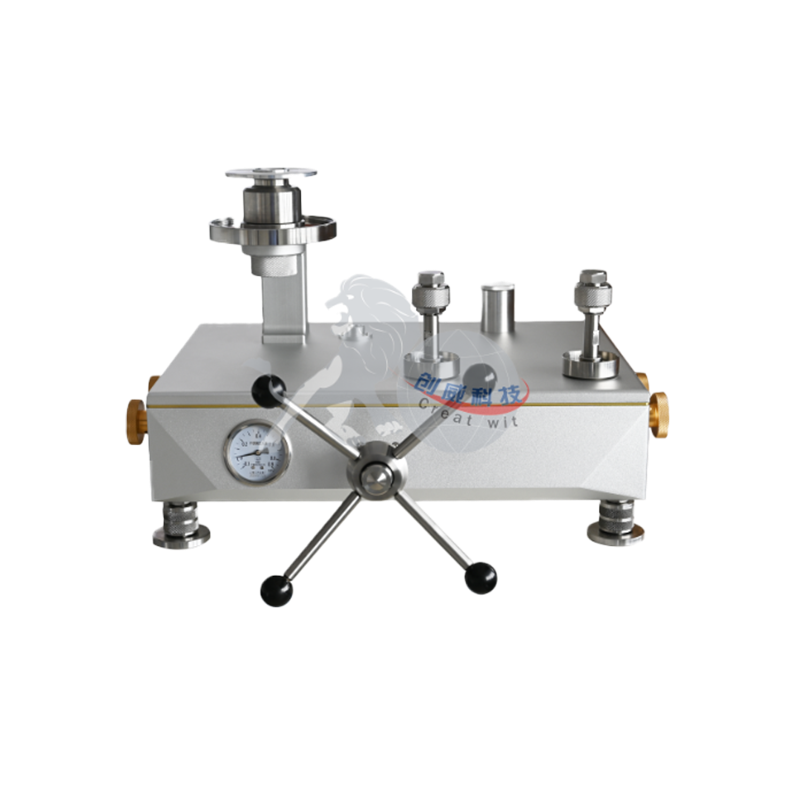
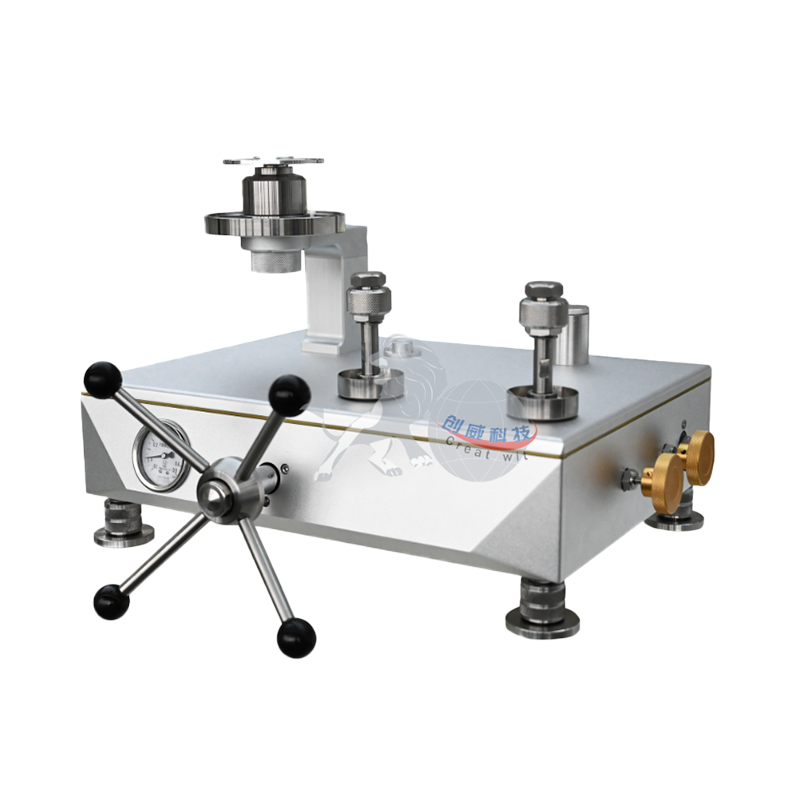
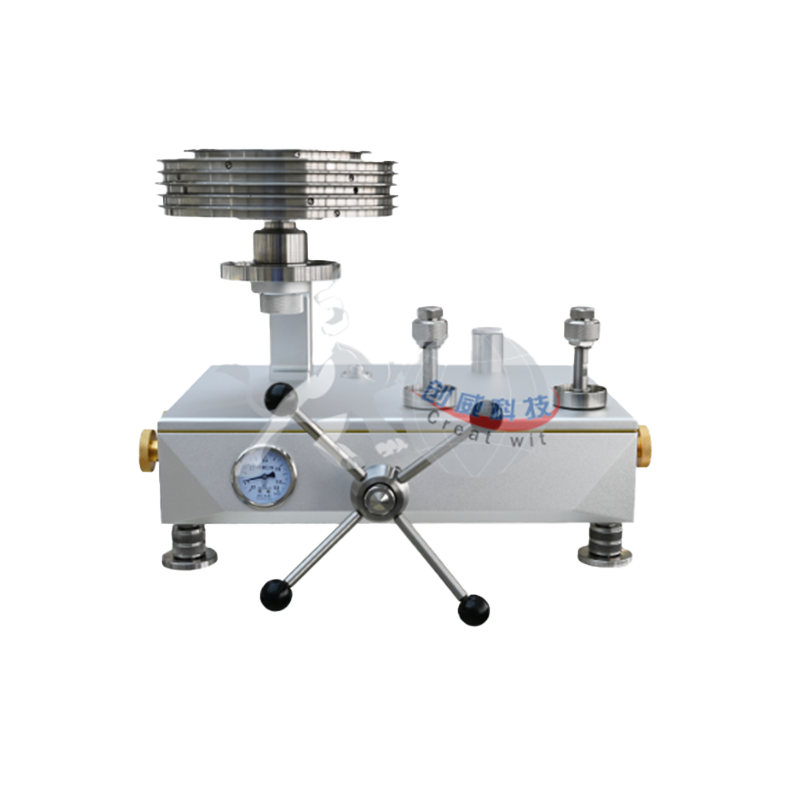
Gauge pressure meters, utilizing the principle of hydrostatic equilibrium (i.e., the fluid pressure acting on the effective area of the piston balances the gravitational force it supports), are instruments for pressure measurement. Typically, they consist of a piston system, special weights, and a pressure calibrator. Additionally, they require a corresponding gas source, vacuum pump (for measuring negative pressure), and vacuum chamber (for absolute pressure measurement). Gas piston pressure gauges are high-accuracy pressure standards, using gas as the working medium to measure and calibrate gauge pressure, absolute pressure, and vacuum pressure (negative pressure). The piston rod and cylinder of the piston gauge are made of tungsten carbide, ensuring the piston's features of being rust-proof, wear-resistant, and having a long stable service life. Compared to liquid piston pressure gauges, gas piston pressure gauges offer extended service life, higher sensitivity, and better repeatability, resulting in accurate and reliable measurement data.
Technical Specifications
△Model: QTZ-1.0, QTZ-2.5, QTZ-4, QTZ-6, QTZ-10.
△Measurement Range: (-100-100) kPa, (-100-250) kPa, (-100-400) kPa, (-100-600) kPa, (-100-1000) kPa
△Accuracy Grade: 0.005, 0.01, 0.02, 0.05
△Function: Can be used as a volumetric piston pressure gauge, calibration of digital pressure gauges, precision pressure gauges, pressure transmitters, etc.
△ Weights Material: Non-magnetic Metal
△Working Medium: High-purity nitrogen; transporting nitrogen cylinders is inconvenient, recommend purchasing locally.
△Dimensions: Length x Width x Height (690 x 420 x 460mm)
Product Performance
Calibrate any pressure gauge within the measuring range.
The pressure occurrence system and pressure testing system can be used together. The independently operated weight loading and pressure application systems minimize various measurement errors, resulting in more stable, reliable, and accurate detection data.
Mirror finish weights are highly resistant to friction and dust contamination, easy to clean, and can maintain precise and consistent weight over long periods.
◆ Piston structure, stable and reliable performance. With a break-prevention device added, users can now operate with peace of mind, no longer worrying about piston rod breakage during normal use, which could cause significant losses. However, we are not responsible for rod breakage caused by misuse or rough handling.
A set of main unit and two piston systems, capable of switching between positive and negative pressure ranges. The range change can be easily achieved by simply rotating the switching valve.
Meets metrological inspection regulations.
The gas piston pressure gauge uses high-purity nitrogen as the medium, eliminating the viscosity caused by lubricating oil, significantly enhancing sensitivity and accuracy. Its sensitivity can reach 10 milligrams.
The measurement area features a new structure, allowing for a more convenient and quick operation during positive and negative pressure measurements. No need to flip the measurement system back and forth; simply switch the pressure/vacuum cover directional valve.
The unit is equipped with multi-level filtration to prevent fine dust from entering the piston and affecting measurement accuracy.
Add vacuum and positive pressure conversion valves, allowing simultaneous connection of vacuum pumps and gas cylinders, eliminating the need for frequent disassembly of connecting pipes for user convenience.
The micro-adjustment section features a new structure for reliable sealing, ensuring that the screw does not protrude during pressure adjustment, thereby saving space.
Technical Features
1. Pistons and piston sleeves are precision ground, resulting in minimal roundness error and clearance. This increases the piston's rotation duration, correspondingly reducing the piston's descent speed and enhancing its discrimination ability.
2. The design features two piston stop valves for vacuum and positive pressure. The positive pressure valve is closed during vacuum measurement, and the negative pressure valve is closed during positive pressure measurement. Both stop valves can be used as a pressure source when closed simultaneously.
3. Weights have been corrected for pressure deformation coefficient and local gravity acceleration.
4. Measurement Range: Nominal measurement range is consistent with actual measurement range.
5. The piston system can be easily removed for inspection (without the need to carry the heavy main unit).
6. Suitable for transmitting use as a piston-type pressure gauge; also for high-precision testing. Compatible with kg weights and MPa weights.
7. Advanced pressurization system, lightweight, durable, and quick in stabilizing pressure.
8. Simultaneously inspect two test gauges, using quick-pressure fittings with no air leakage.
9. Enhanced expansion interfaces for convenient and quick multi-station calibration operations.