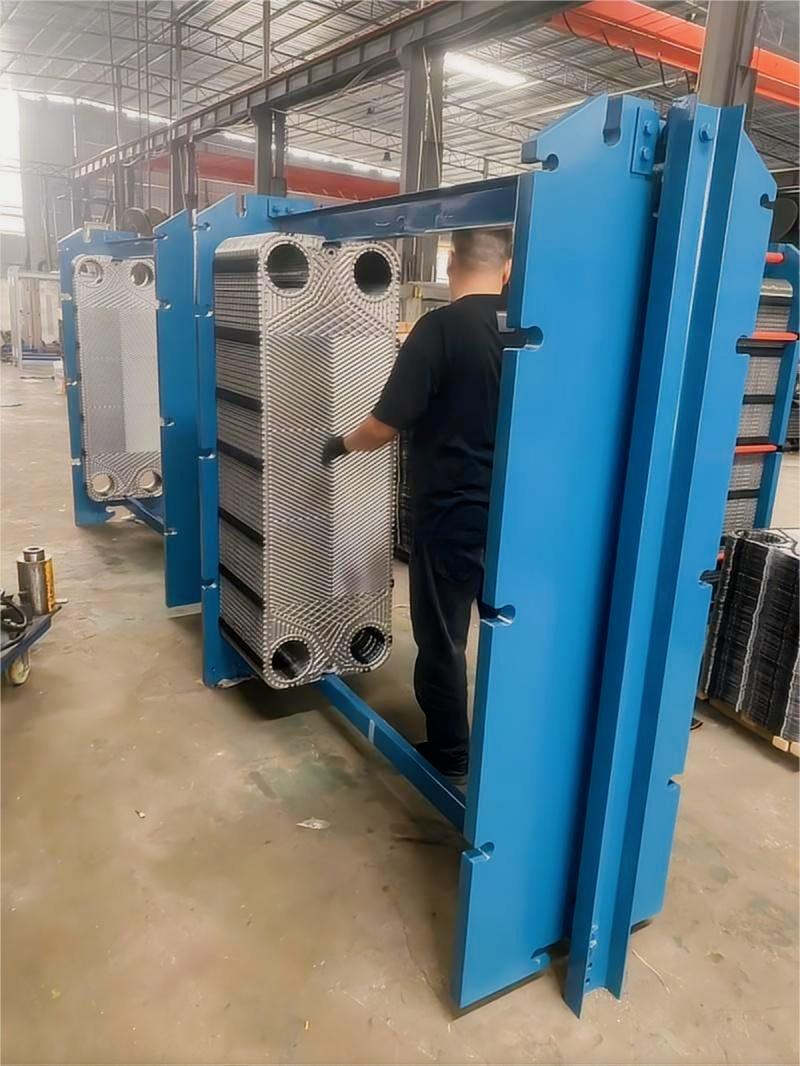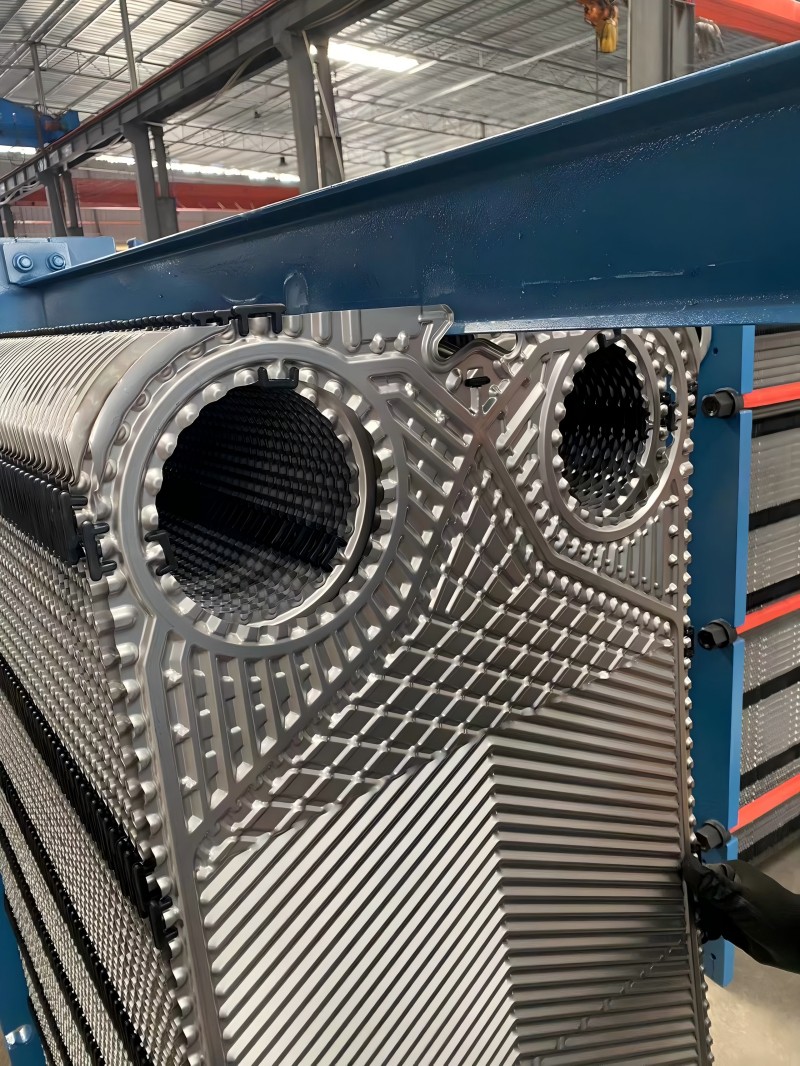









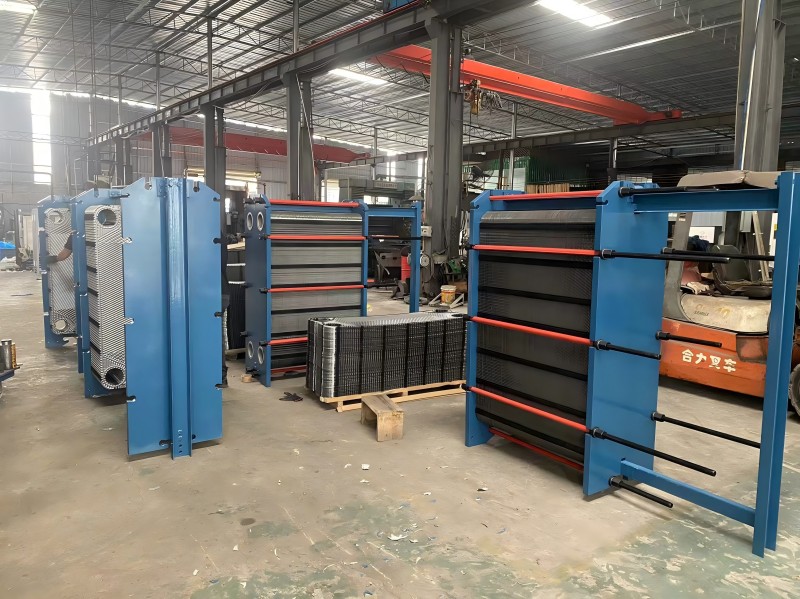
New Energy Plate Heat Exchangers Feature the Following Characteristics: 1. High Heat Transfer Efficiency - The corrugated shape of the plates creates complex flow paths, allowing for strong turbulence at lower flow rates, significantly enhancing the heat transfer coefficient. Compared to traditional tube-and-shell heat exchangers, it has a higher heat transfer coefficient, requiring less surface area for the same heat exchange task, typically just 1/3 to 1/4 of the tube-and-shell type. 2. Compact Structure and Small Footprint - Constructed from a series of thin metal plates, it boasts a large heat exchange area per unit volume, up to 250 square meters, several times that of tube-and-shell heat exchangers. The compact overall structure offers a clear advantage in space-limited environments, such as new energy vehicles and distributed energy stations, with a footprint usually just 1/5 to 1/10 of the tube-and-shell type. 3. Large Logarithmic Mean Temperature Difference - Fluids in new energy plate heat exchangers often flow in parallel or counter-current patterns, with a high correction coefficient for the logarithmic mean temperature difference, reaching about 0.95, allowing for more efficient heat utilization and energy utilization. Cold and hot fluids flow parallel to the heat exchange surface without bypass, resulting in small end temperature differences, less than 1°C in water-to-water heat exchange, suitable for high-temperature control requirements in new energy applications. 4. High Flexibility - Easy to adjust the heat exchange area by simply adding or removing plates to meet different operating conditions. It can also be conveniently modified to adapt to new heat exchange conditions by changing the arrangement of plates or replacing a few plates. 5. Low Cost - Primarily made of metal sheets, with relatively low raw material costs and simple processing techniques, high production efficiency keeps the overall manufacturing cost lower than that of some other types of heat exchangers. 6. Non-Fouling - The fast and turbulent flow inside reduces scaling on the plate surface. Additionally, the small dead zones between plates and smooth heat exchange surfaces further minimize fouling. Cleaning is straightforward, requiring only the loosening of clamping bolts and removal of plates. 7. Suitable for Multiple Media - Through the use of intermediate baffles, it can achieve heat exchange for three or more media, meeting the heat exchange needs between various media in the new energy field. 8. Good Sealing - The plates are sealed with gaskets, ensuring good sealing performance and preventing fluid leakage, guaranteeing the safety and reliability of the heat exchange process.