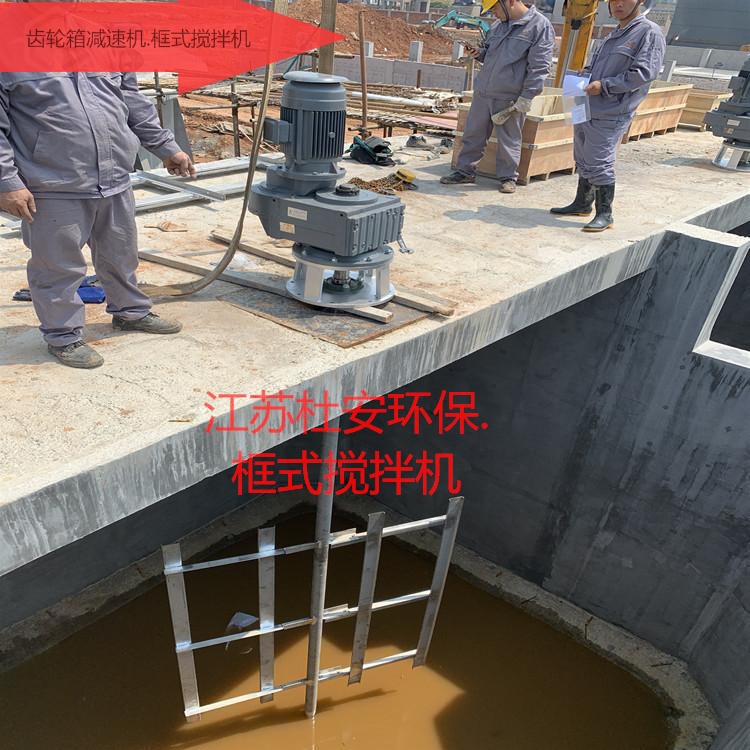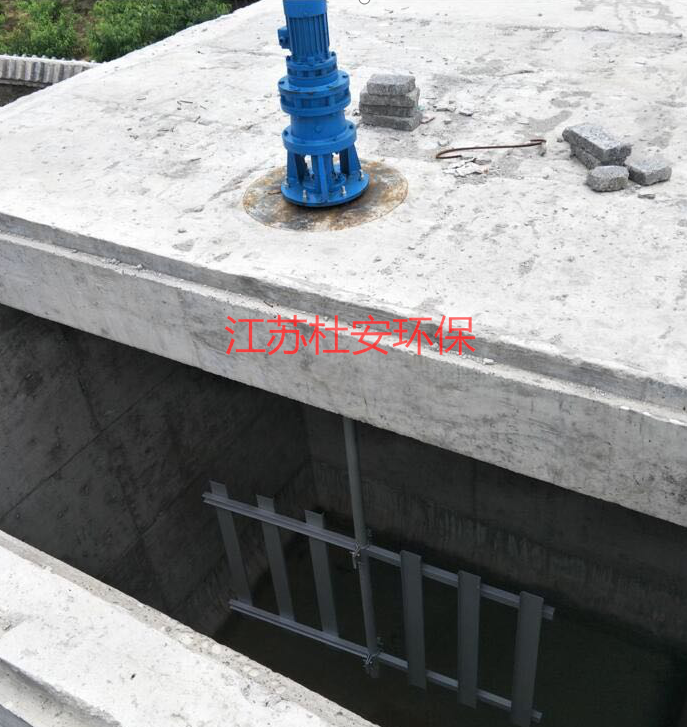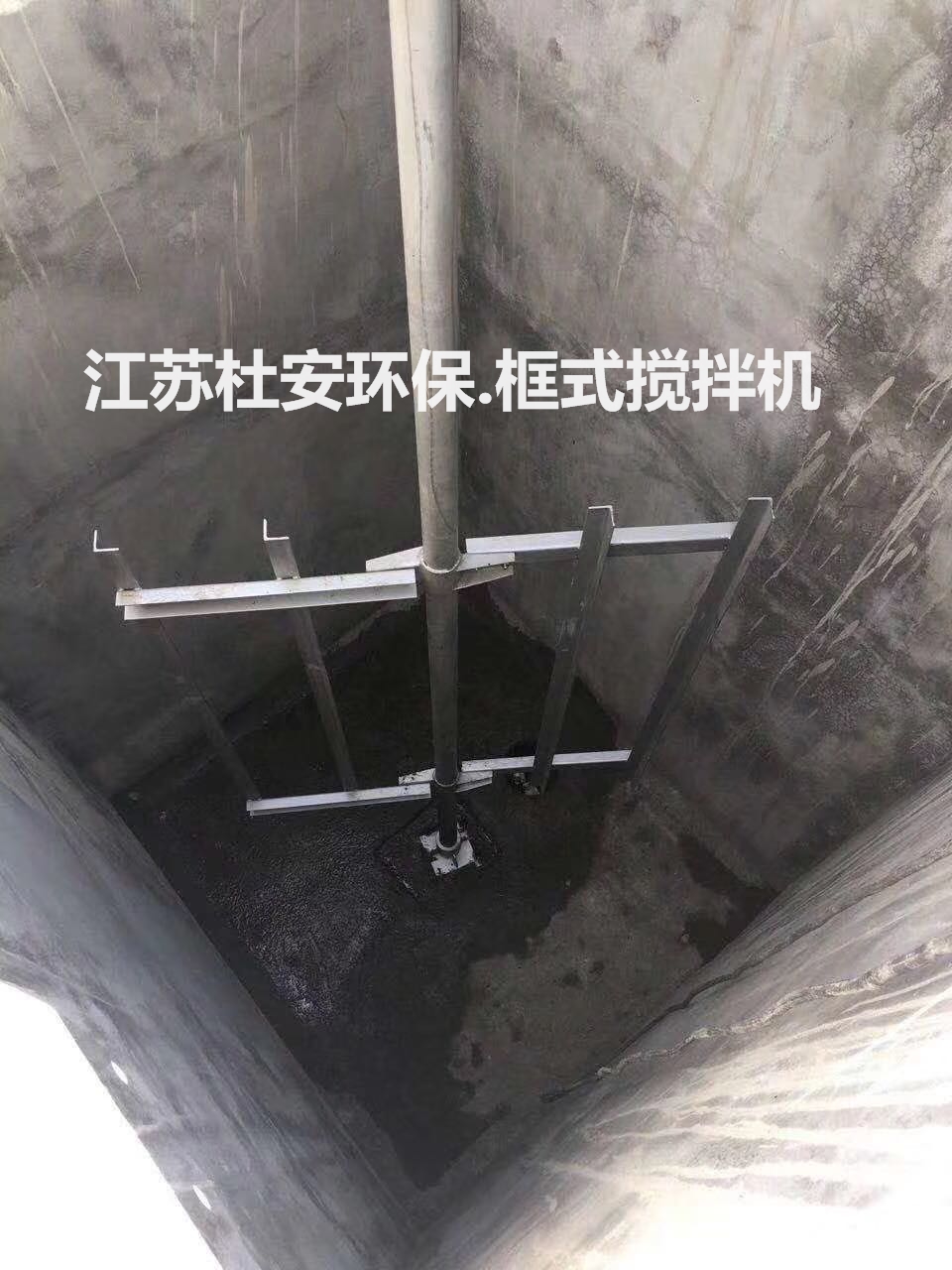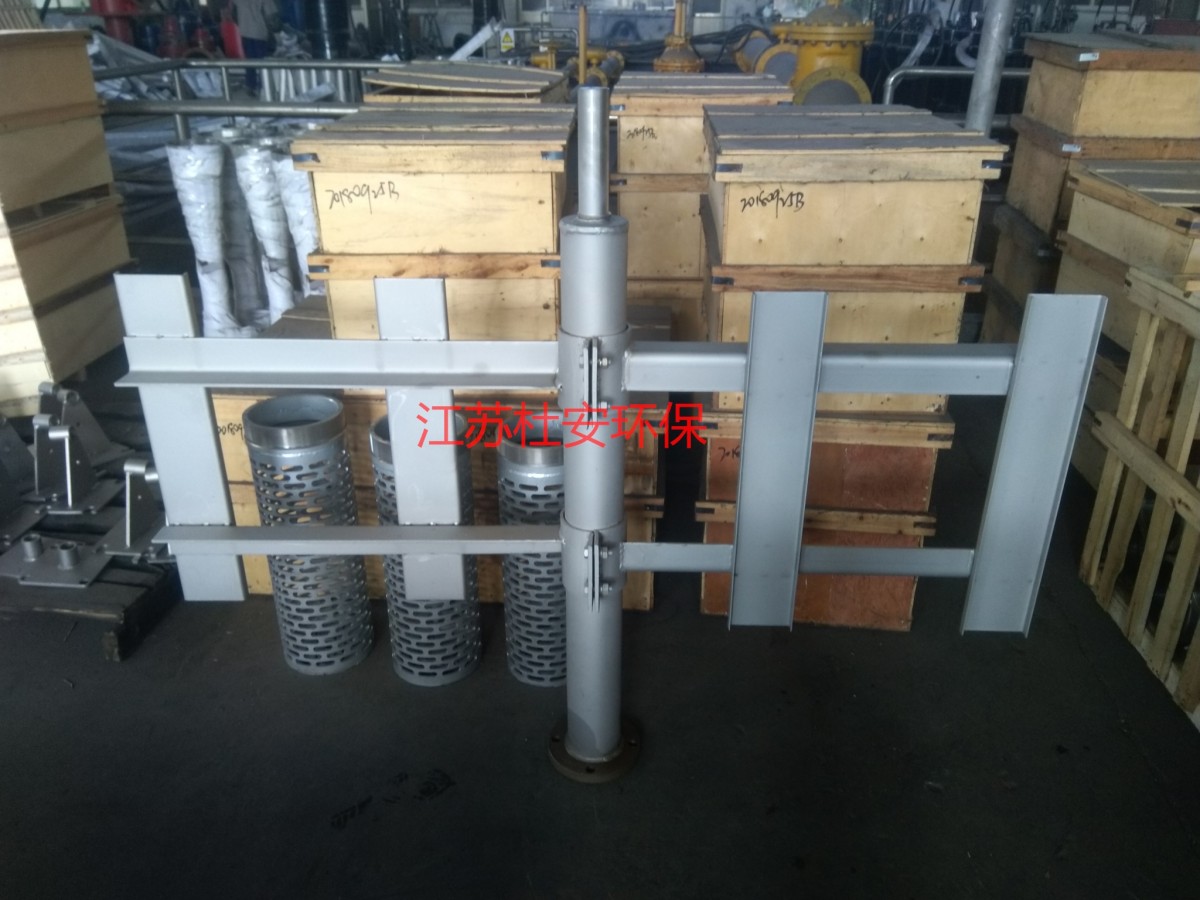








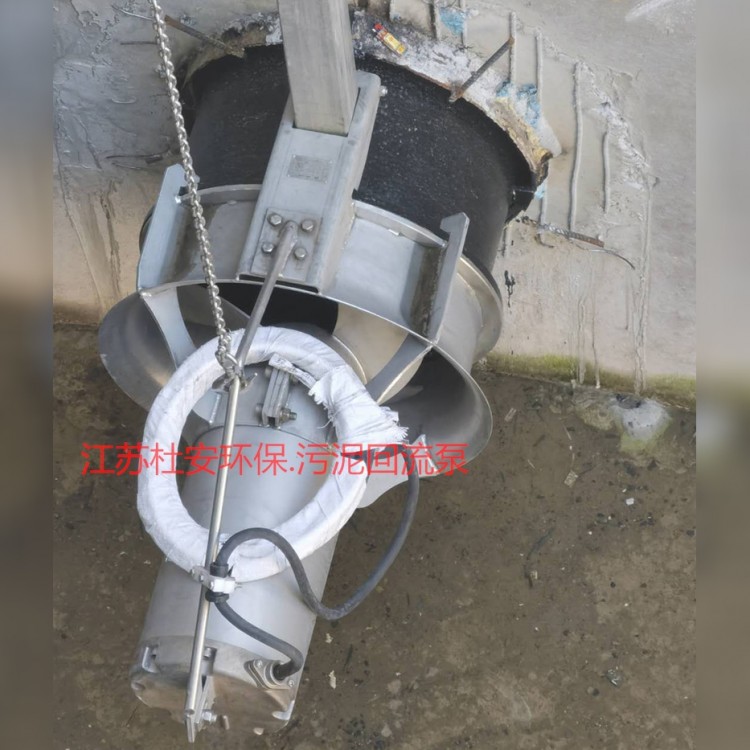
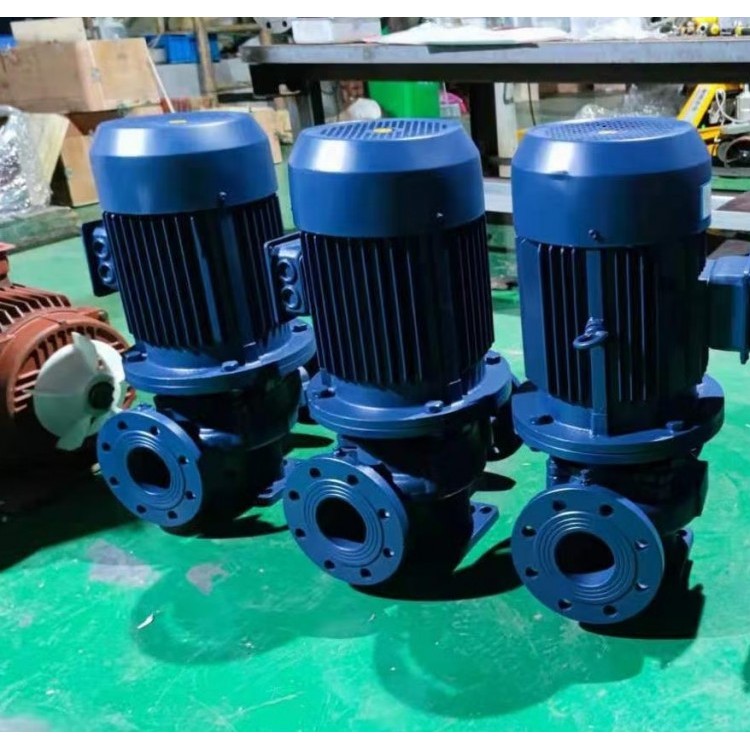
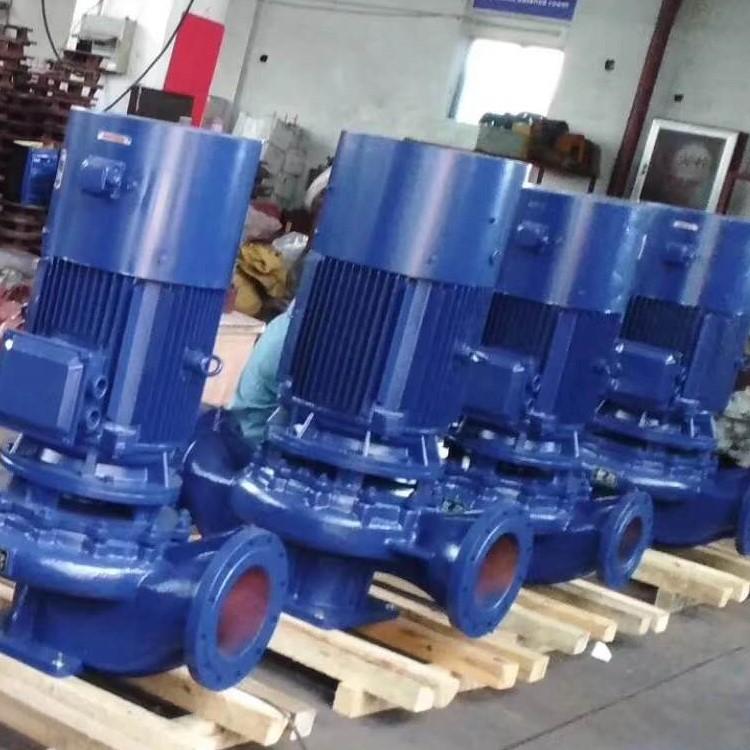
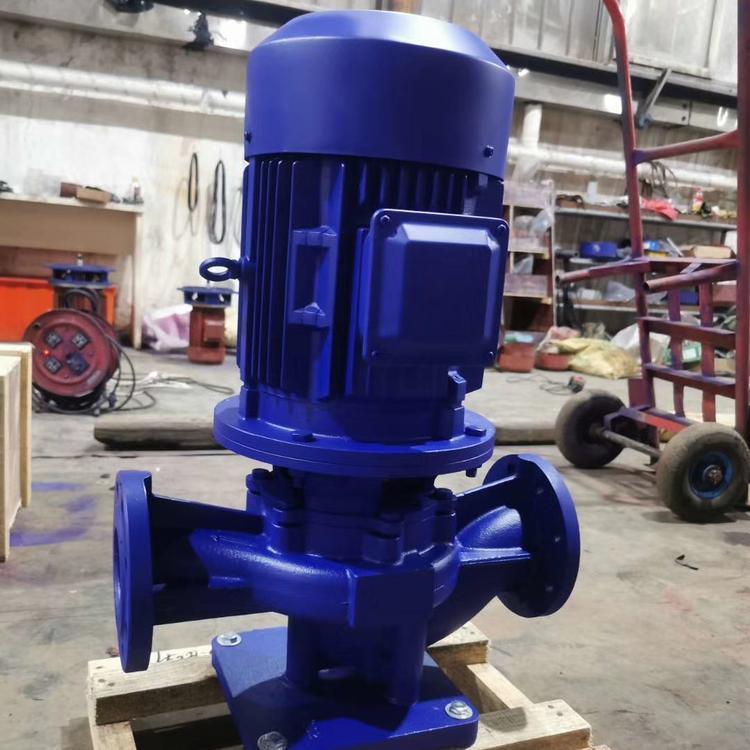
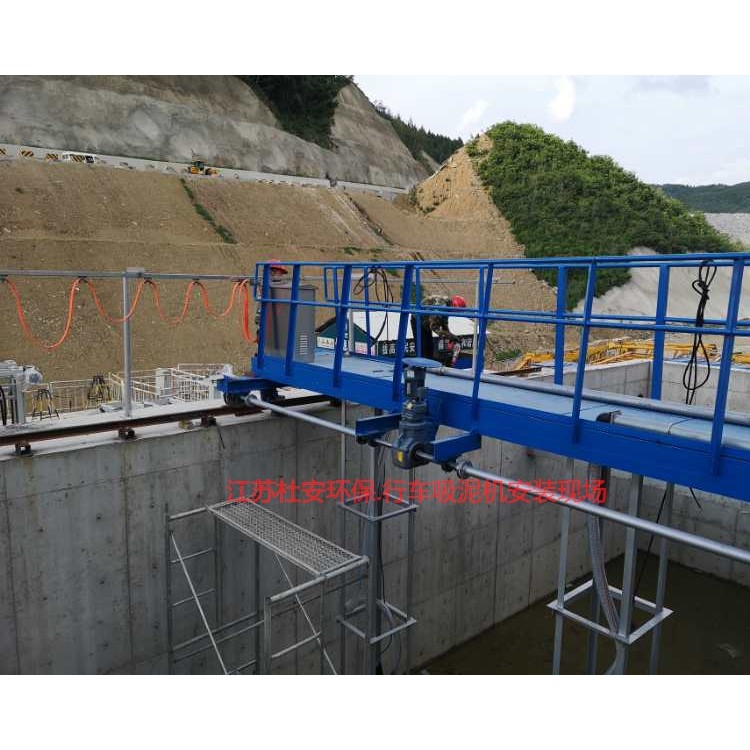
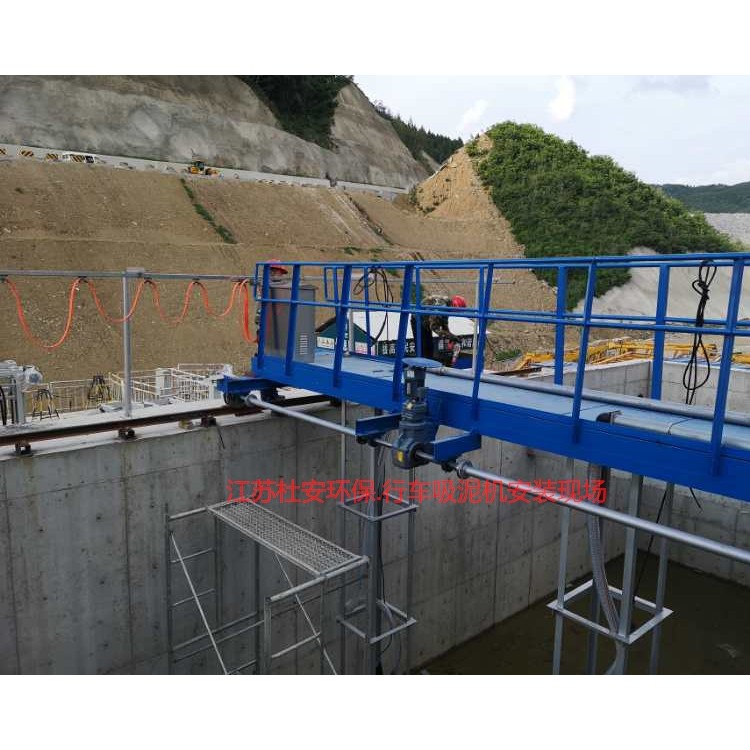
Flocculation Blender JBK-1500
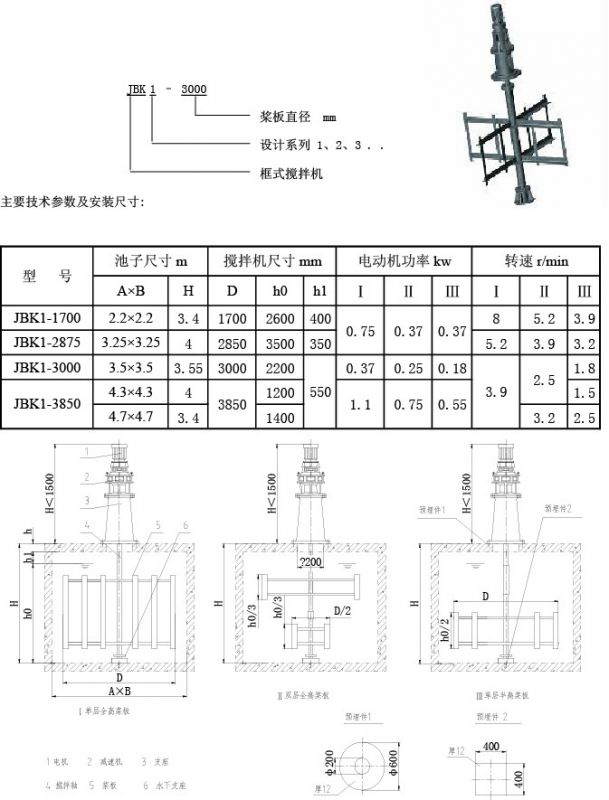
Vertical Blender CAD Installation Drawing
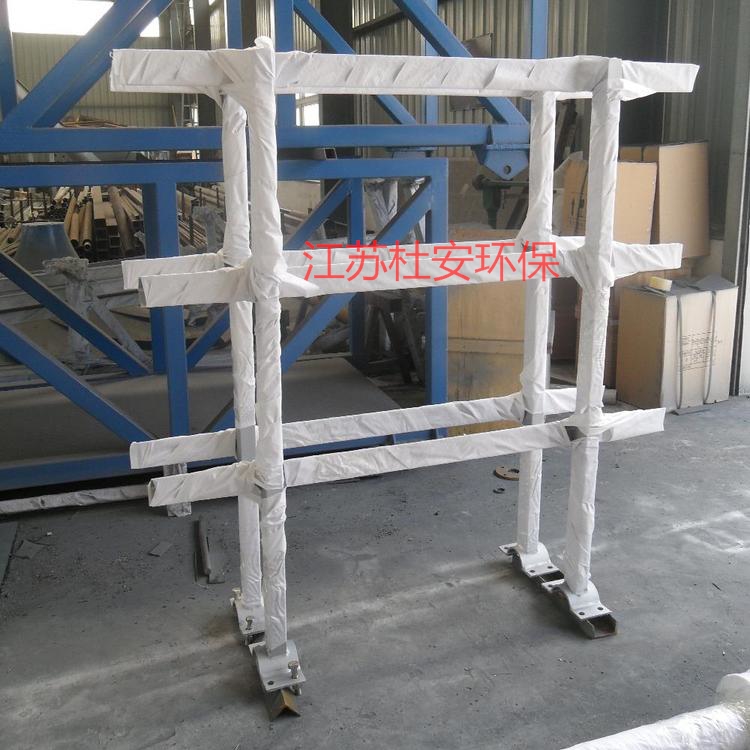
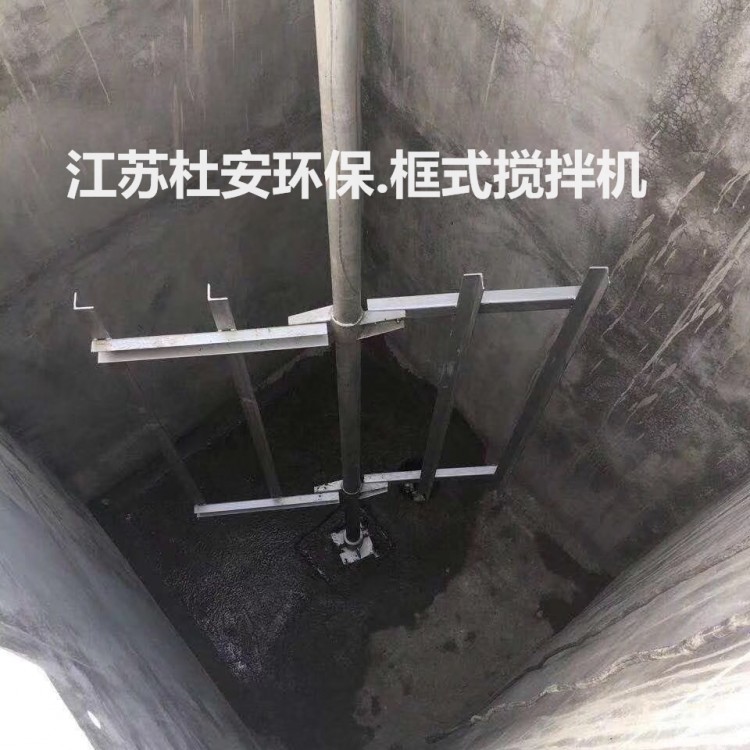
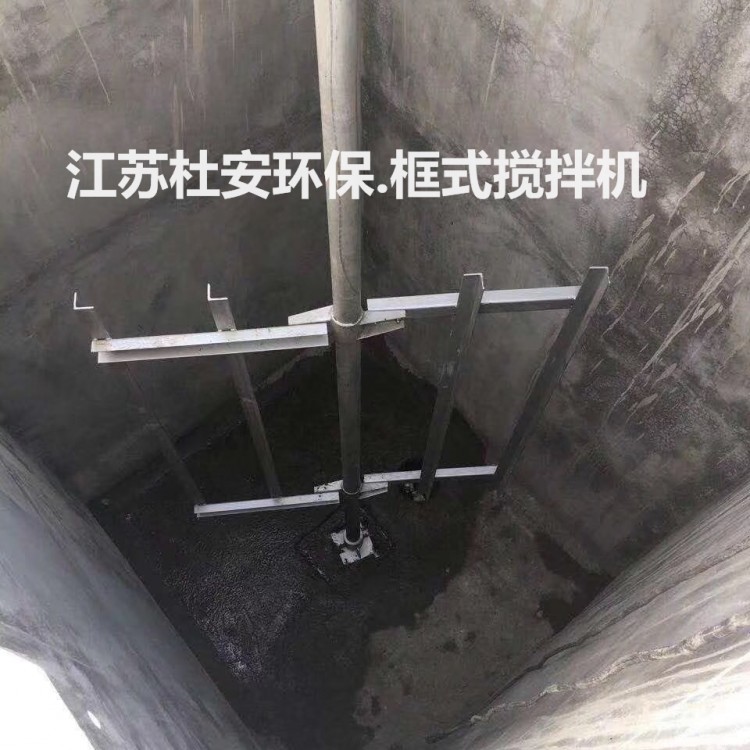
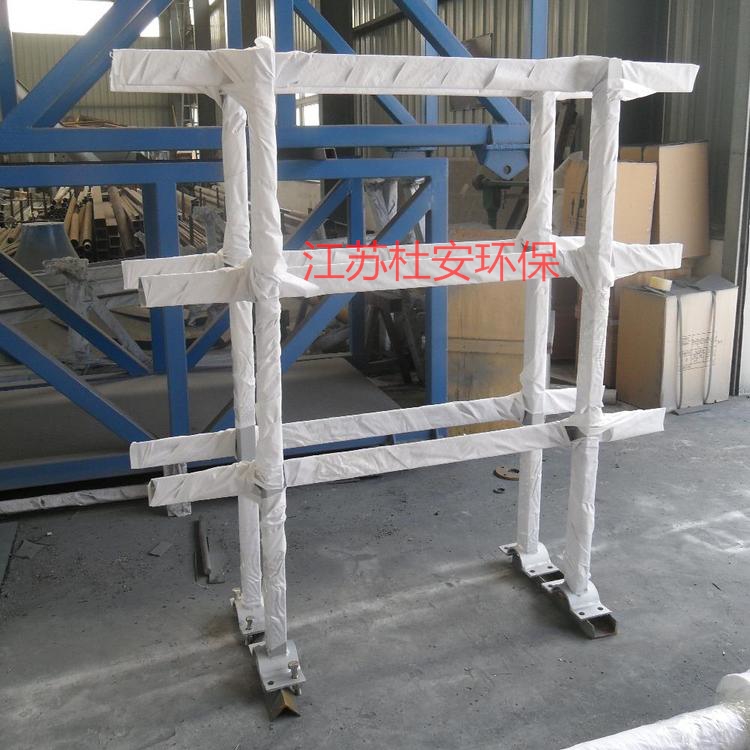
Box-blade mixer
Vertical Variable Frequency Blender Manufacturer
Duwan Environmental Frame-Type Blender Technical Description:
One, Frame-type mixer
Frame mixers are selected based on the physical properties, capacity, and mixing purpose of different media, playing a significant role in accelerating the rate of chemical reactions and improving production efficiency. Frame mixers are generally used for mixing paste-like materials.
The box-type agitator can be considered a variation of the paddle agitator, featuring a more robust structure and the ability to handle larger volumes of material. When the bottom shape of such an agitator resembles the bottom shape of a reaction kettle, it is typically referred to as an anchor agitator. The box-type agitator has a larger diameter, usually taken as a multiple of the internal diameter of the reactor.2/3 to 9/10, 50 to 70 r/min. For low-viscosity liquids, the impeller diameter to tank diameter ratio of the anchor impeller is 0.7 to 0.9, while for high-viscosity liquids, it is 0.8 to 0.95, with a typical speed range of 10 to 50 r/min. Frame-type mixers have a smaller gap with the reactor wall, which is beneficial for the heat transfer process. At high speeds, the liquid moved by the blades of the mixer breaks down the stationary layer from the reactor wall; at low speeds, mixers with scrapers can achieve good heat conduction. These mixers are commonly used for heat transfer, crystallization operations, and stirring of high-viscosity liquids, high-concentration sludges, and sedimenting sludges.
Anchor and frame mixers belong to the same category, collectively known as anchor-frame mixers. To increase the mixing range and remove residue or liquid layers from the tank wall, the outer contour of the anchor-frame mixer must be close to the inner wall of the mixing tank. The bottom shape, adapted to the tank's base contour, can be elliptical, conical, and so on. To expand the mixing range for high-viscosity materials and enhance the rigidity of the impeller, additional vertical blades and crossbeams are often added to the anchor and frame mixers, resulting in a variety of structural shapes for the anchor-frame mixers.
Two, paddle types can be roughly categorized by their shapes:
Anchor, Ellipse, Conical Base, Square, and Anchor Frame Styles 。
Section 3: Applicable Viscosity
ApplicableStandardViscosity200~300Pa·s。
Section 4: Application Fields
Anchor frame mixers typically operate at low speeds and do not generate significant shear forces while mixing low-viscosity liquids, thus they are not suitable for liquids-Liquid and gas-liquid dispersion. On the other hand, this type of impeller has a high flow rate within the tank, with horizontal recirculation currents dominating, resulting in poor mixing uniformity. However, the flow velocity near the tank wall is higher than that of other impellers, achieving a larger heat transfer film coefficient, thus commonly used for heat transfer and crystallization operations. Additionally, due to its larger paddle diameter and close proximity to the tank bottom, it is often used to stir high-concentration slurry and sedimentary slurry. It is also commonly used for stirring high-viscosity fluids.
V. Flowing State
Horizontal circumferential flow at different heights.
Section 6: Structure
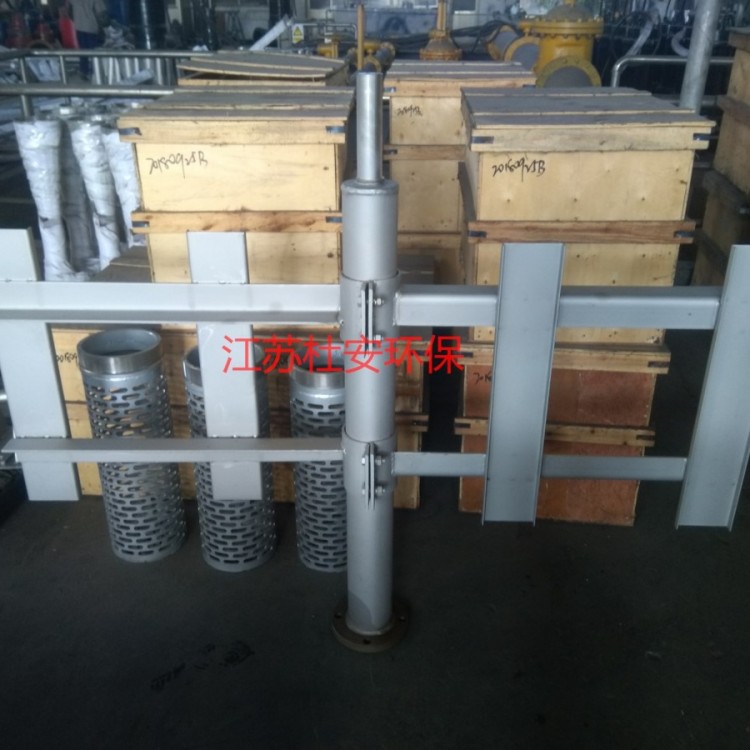
The anchor-type agitator is connected to the agitator shaft in a manner similar to that of a paddle type, where the end of the impeller connected to the shaft is shaped into a semicircular shaft ring. Then, the two semicircular rings of the two blades are clamped on the shaft using bolts, while the blade and shaft are secured with through-bolts. Due to the large outline dimensions of the impeller, most blades are connected by bolts for easy assembly and disassembly; only small-sized impellers are cast or welded. The impeller is mostly made of flat steel or angle iron, and reinforced steel plates can also be used to enhance the strength of the impeller.
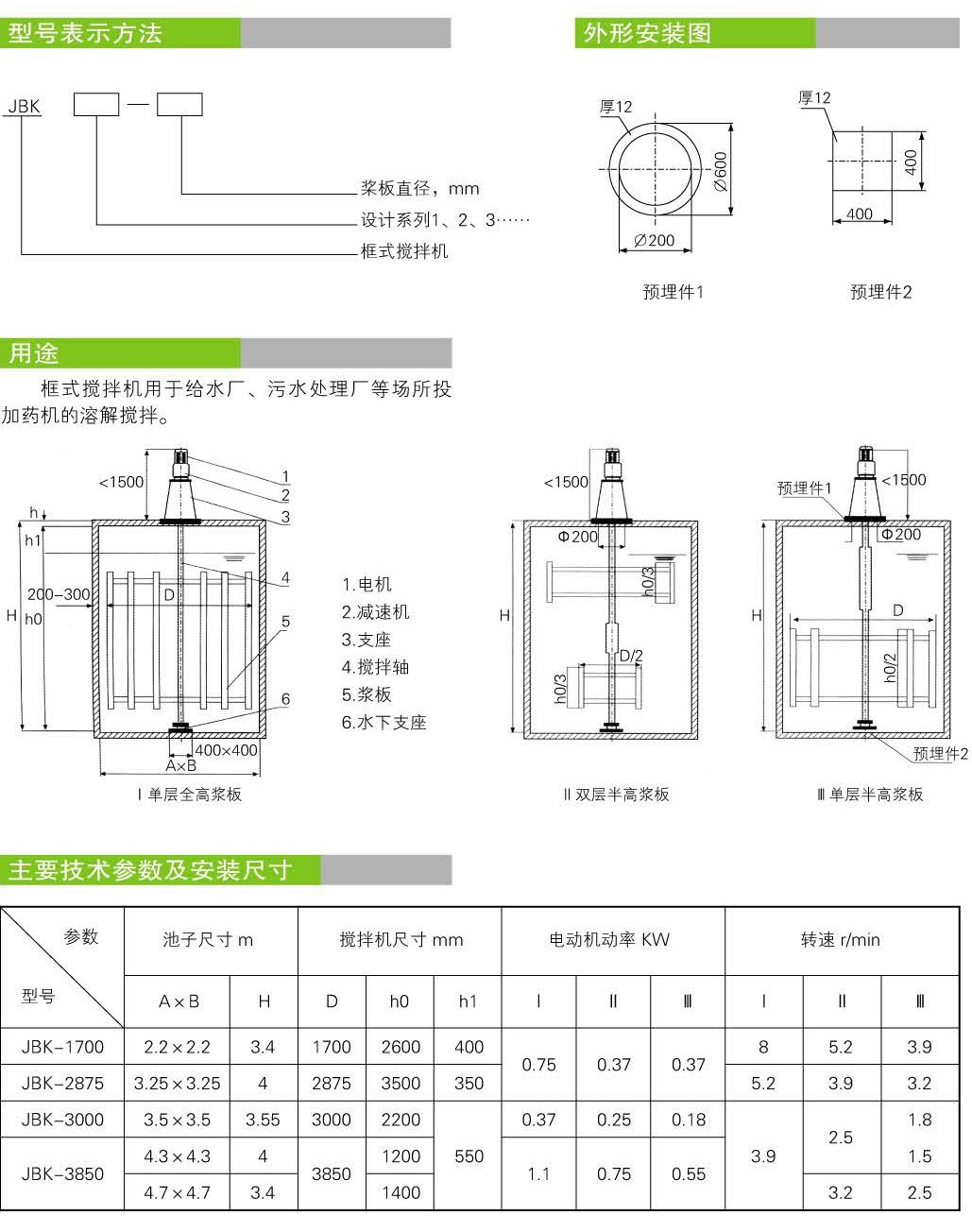
Model Specifications | Pond dimensionsm | Mixing Machine Dimensionsmm | Motor EfficiencyKW | RPMr/min | |||||||
A×B | H | D | h0 | h1 | Ⅰ | Ⅱ | Ⅲ | Ⅰ | Ⅱ | Ⅲ | |
JBK-1700 | 2.2×2.2 | 3.4 | 1700 | 2600 | 400 | 0.75 | 0.37 | 0.37 | 8 | 5.2 | 3.9 |
JBK-2875 | 3.25×3.25 | 4 | 2875 | 3500 | 350 | 5.2 | 3.9 | 3.2 | |||
JBK-3000 | 3.5×3.5 | 3.55 | 3000 | 2200 | 550 | 0.37 | 0.25 | 0.18 | 3.9 | 2.5 | 1.8 |
JBK-3580 | 4.3×4.3 | 4 | 3580 | 1200 | 1.1 | 0.75 | 0.55 | 1.5 | |||
4.7×4.7 | 3.4 | 1400 | 3.2 | 2.5 | |||||||
Section 7: Selection Considerations:
During stirring high-viscosity fluids, as the fluid viscosity increases, the flow within the tank decreases, and the energy transmitted from the drive unit acts as friction between the impeller and the fluid.(The shear) The proportion consumed increases. From the mixing effect, there is liquid exchange near the blades, but there is a part near the shaft that almost does not mix. Using a modified box-type impeller (adding diagonal crossbars or vertical blades to the box) can improve the situation as needed, but it still does not solve the problem entirely. To ensure complete flow of high-viscosity fluids, a propeller with a spiral blade, which forces the liquid to extrude and flow, is necessary. However, compared to spiral blades, anchor-type impellers are cheaper. At the same blade diameter and speed, an anchor-type mixer is only two-thirds the price of a spiral, so anchor-type impellers are often chosen for applications that do not emphasize mixing effects.
In special occasions, to overcome the drawbacks of the anchor impeller's insufficient shearing force and the presence of a mixed dead zone near the shaft, a coaxial double-turbulent mixer can be formed by combining a box impeller with a multi-layer turbine impeller. Additionally, to take advantage of the benefit of the blades being close to the tank bottom and walls for enhanced heat transfer, scraper blades can be installed on the anchor impeller blades to continuously scrape off the liquid that tends to adhere to the tank walls.
EightBoxed mixer installation diagram
Box-type mixer dosing reaction equipmentJiangsu Du'an Environmental Protection
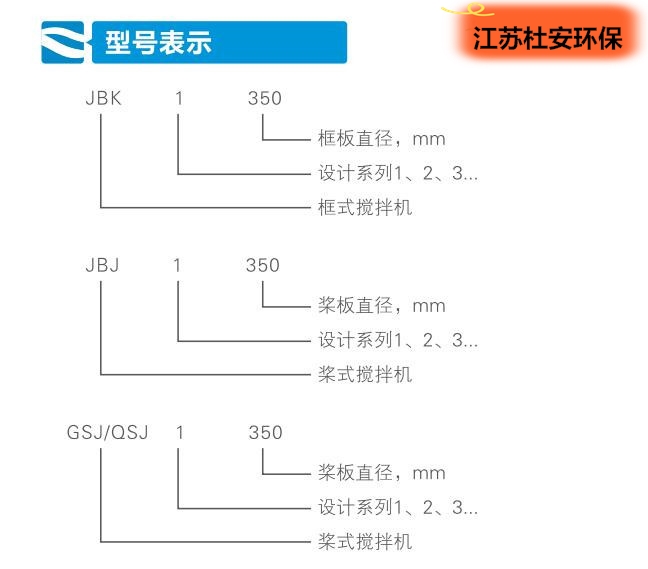
Structure and Operating Process:
JBK TypeFloculationThe mixer is composed of an electric motor, vertical reducer, frame, coupling, shaft, paddle, and underwater bearing. Once the electric motor is powered on, it is reduced in speed by the reducer, and the torque is then transmitted to the mixer's main shaft through the coupling, which drives the paddle to rotate, thereby stirring the liquid.
Equipment Installation and Commissioning Requirements:
Check the foundation dimensions before hoisting and installation to ensure they match the equipment's installation size.
Check the installation height of the top and bottom of the pool (tank) for accuracy, with permissible tolerance.±20mm, steel plates can be used to adjust under the frame or bottom support if the requirements are not met.
After aligning the equipment, spot-weld the bottom plate under the frame and base support to the pre-bolted components. Manually push the equipment to rotate it should be even and without any jamming, and securely weld the shims to the pre-bolted iron.;
The reducer is lubricated with oil, and the frame bearings are lubricated with grease. The procedures for oil filling or replenishment are detailed in the reducer's user manual.
Base shaft sleeve filled with lead-based lubricant, sealed with asbestosis packing.
After normal operation on no-load after connecting power, then start operation with loadThe rotation direction is clockwise from above.
On-siteElectrical Control Box Operating Procedure:
Inspection: Before power-on, check the control cabinet's insulation resistance, grounding protection, and electrical connections for reliability. After power-on, inspect if the three-phase voltage is normal.
2. Operation Procedure: Power on: Close the power switch QF, and the red power indicator HR will light up.
a. Manual Mode: Set the selector switch SA to the "Manual" position (left-hand rotation by 45°).
△ Power On: Press the start button ST, the mixer running indicator green light HG illuminates.
△ Shutdown: Press the Stop button SP according to process requirements, the running indicator green light HG will turn off.
b. Automatic Mode: Set the selector switch SA to the "Automatic" position (rotated 45° clockwise). The PLC workstation sends commands to control the start and stop of the mixer according to process requirements.
3. Accident Alarm:
When a phase loss, short circuit, or overloading of the blender occurs, the blender shuts down with a light indicator.
Boxed mixer selection guidelines:
Parameters required for selection: type of pool, length of the poolWidth x Height
Please provide the following details when inquiring: motor power, impeller diameter, and whether the installation system is required.