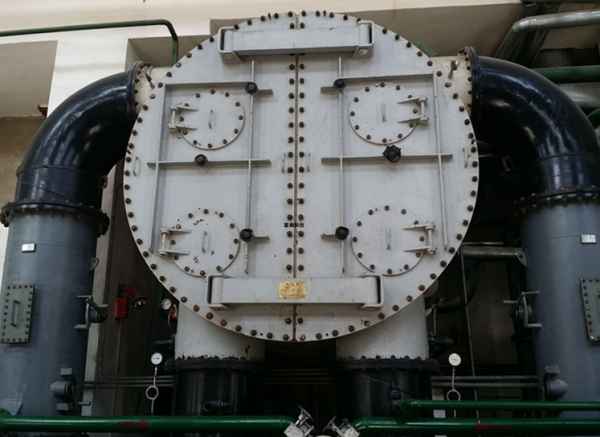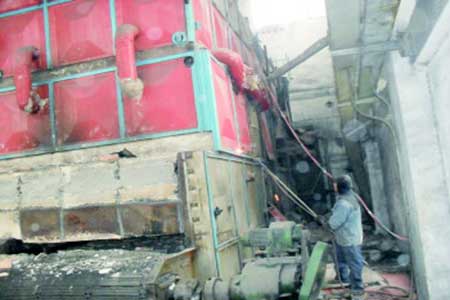

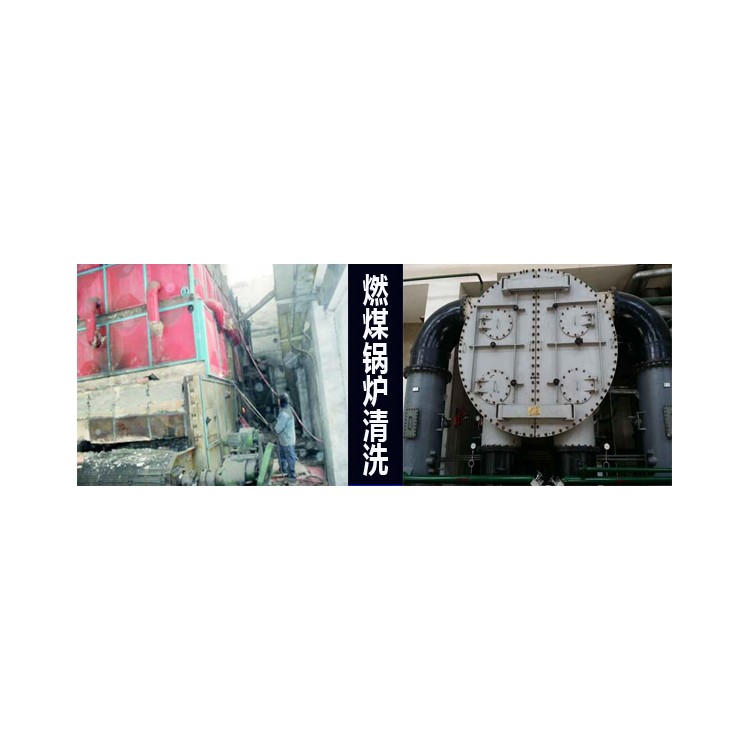

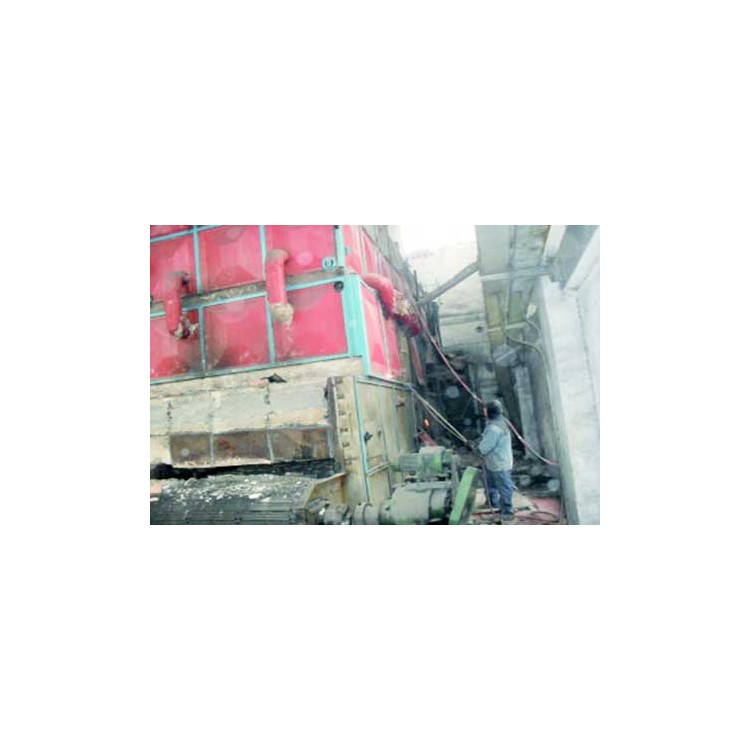











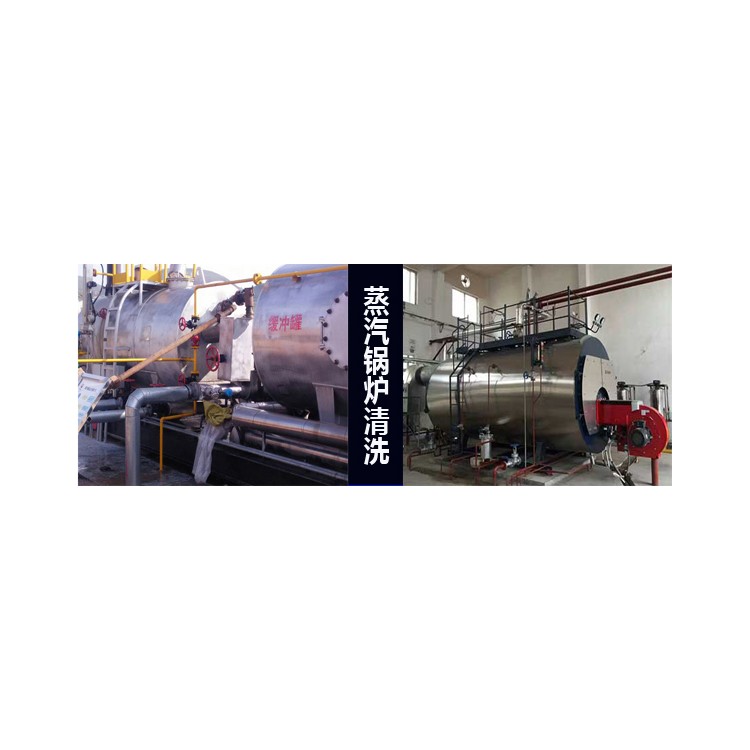
Coal-fired boilers refer to boilers that burn coal as fuel. After the coal's heat is converted, it produces steam or hot water. However, not all heat is effectively converted, with some being wasted. This leads to efficiency issues. Larger boilers generally have higher efficiency, typically between 60% to 80%.
The necessity of coal-fired boiler cleaning
1. Easy to cause damage to equipment.
Lime scale buildup in coal-fired steam boilers reduces the efficiency of heat transfer across the heating surface. To maintain the boiler's output, the fire side temperature must be increased. The thicker the scale, the slower the heat transfer within the boiler, and the more heat that needs to be supplemented on the fire side. Normally, the fire side temperature of a boiler is around 900°C, while the water side is about 190°C. Without scale, the steel plate temperature is around 230°C, but with 1mm of scale, the temperature rises by about 140°C compared to a scale-free condition. When the steel plate temperature reaches 315°C, various metal properties begin to decline. At 450°C, the metal can deform due to overheating. Therefore, scale buildup can easily lead to the destruction of the metal materials in coal-fired steam boilers.
2. prone to fuel waste.
After scale forms on the heating surface inside a boiler, it hinders heat transfer due to its extremely low thermal conductivity, which is only a fraction of that of steel. This scale leads to heat loss, necessitating an increase in fuel to raise the fire side temperature to maintain the boiler's working pressure and evaporation rate. With scale present, more fuel is wasted to produce the same amount of heat. Moreover, the type and thickness of scale formed in coal-fired steam boilers at different working pressures vary, as does the amount of fuel wasted. Engineers have determined, based on tests and calculations, that there is a proportional relationship between the thickness of the scale and the amount of fuel wasted:
When scale thickness is ≥1mm, fuel waste is 5-13%.
≥2mm when fuel waste is 13-18%.
≥3mm, fuel waste of 18-26%.
3. Easy to increase maintenance costs and reduce service life
Lime scale buildup in coal-fired steam boilers not only leads to heat loss, fuel waste, and equipment damage, but also poses significant safety hazards. The likelihood of accidents increases greatly after scaling, with statistics showing that 33% of coal-fired steam boiler accidents are caused by scale, and this trend is on the rise. Not only does it reduce the boiler's lifespan, but it also endangers human life.
Mechanism of Scale Removal by Dry Heat Method
Scale has a much lower linear expansion coefficient than metal. The linear expansion coefficient of carbon steel is α=0.0125mm/m℃ between 20~600℃. The more compact and harder the scale, the lower its expansion coefficient. The linear expansion coefficient of common daily-use ceramics is 0.0025~0.0045mm/m℃ between 20~800℃. The composition of scale is similar to that of common daily-use ceramics, both formed under high-temperature conditions, with their linear expansion coefficients being similar, approximately 3~4 times that of carbon steel. A 1-meter long steel plate expands 1.25m for every 100℃ increase in temperature. Heating from room temperature to 600℃ results in an expansion of about 7.5m, while the scale expands slightly over 1.5m. The difference in surface expansion between scale and metal is even greater. When both metal and scale are heated, due to their significantly different linear expansion coefficients, a tangential stress is generated at the bonding surface. As the temperature drops, a reverse shearing force is produced, and since the tensile and flexural strength of scale are much lower than that of carbon steel, this repeated stress can cause the scale to crack and fall off the metal surface.
实例 & Operation Process Analysis of Dry Heat Descaling
(1) Open the drain valve to remove all water from the boiler; open the manhole and inspection holes to allow steam inside the boiler to evaporate when heated. Heat the boiler slowly and carefully with wood to dry it out. Coal should not be used as the fire is too intense and difficult to control. The scale in the boiler expands more when wet than when dry, with a uniform inner surface. Upon heating, the scale expands slightly and is malleable. Therefore, during normal boiler operation, as the boiler temperature increases, the scale, which forms gradually over the long-term operation of the boiler, adheres closely to the heating surface. As the boiler steel expands with heat, the scale expands in sync, preventing cracking on the scale's surface.
(2) After the surface scale and the internal boiler are completely dried, heat slowly and carefully, allowing the steel to expand freely to prevent internal stress. Heat to approximately 600 degrees Celsius, which takes about 2 hours. We know that steel is a good conductor of heat, and the bottom of the boiler is heated, quickly transferring radiant and convective heat from the wood smoke to the boiler body. As long as the wood's flame is controlled during heating, the local temperature at the bottom will not be too high. Due to the temperature rise, the scale has a much lower linear expansion coefficient than the steel, resulting in a shearing force at the interface between the scale and the steel. The steel used in boilers is typically 20g, with a carbon content of less than 0.22%. In the heat treatment process of steel, if the steel is heated below the critical temperature of 723°C without causing phase change, this is a theoretical value. Due to the composition of the steel and the degree of supercooling and superheating during heating, the actual application temperature is lower, around 660°C. Low-temperature stress-relieving annealing (high-temperature tempering) involves heating the steel to below A1, usually between 500~650°C.
(3) Remove the wood to extinguish the fire and allow the boiler to cool naturally. During the cooling process, due to the significant difference in linear expansion coefficients between scale and metal, a reverse shearing force is produced, causing most of the scale to crack and fall off. Gently tap the metal wall with wooden or bamboo rakes to remove the fallen scale through the manhole, vent hole, and inspection hole.
(4) Alkali Boiling. Add 8 kg of sodium carbonate per cubic meter of boiler water (it is even better if an additional 1.4 kg of trisodium phosphate is added per ton of boiler water), ignite and increase pressure to 1 kg (not less than 24 hours), then reduce pressure. After the alkali boiling is stopped, when the boiler water temperature drops to 70°C, drain the boiler water, open the manhole, handhole, and inspection hole, and flush off the detached scale with pressurized tap water (especially the scale inside the pipes). For a 0.4-ton boiler, the removed scale is in a flaky form, with a thickness of about 4 meters, and approximately 200 jin of scale is removed; dry heat causes the scale to crack, breaking the bond between the scale and the metal, with most of the scale falling off or peeling off. The alkali boiling softens the remaining scale, making it easier to remove, and also forms a protective layer on the metal surface (mainly ferric oxide, Fe3O4). The descaling efficiency is very high with a clean boiler interior, low labor intensity, and excellent results; Limitations: Each descaling method for boilers has its limitations. The thermal descaling method is only suitable for coal-fired vertical boilers, the key being to control the heating temperature properly, avoiding overheating and overburning, and preventing the deterioration of steel properties. Using wood for heating is easy to control, does not harm the boiler, is pollution-free, low-cost, and simple to operate with excellent results; Although the dry heat descaling method created by the user is theoretically feasible, and wood is used for heating in an empty boiler, which is easier to control than charcoal, measures should be taken to ensure that the boiler is heated within a controlled range and does not produce localized high temperatures. With the rapid development of electronic technology today, measuring temperature is no longer a problem, and mathematical temperature measuring instruments are very affordable and easy to use; If the results are not satisfactory due to operational reasons, the above method can be repeated.