















Villas, duplexes, and self-built homes with large floor areas are often chosen as retirement homes by homeowners. Many HVAC or renovation professionals argue that electric floor heating can result in high electrical power loads, which naturally consumes a lot of electricity. Is electric floor heating only suitable for small units, and not at all appropriate for large floor areas?
Large apartment units are more suitable for electric underfloor heating than small apartment units.
Actually, this can only be attributed to a lack of understanding or misinterpretation of the electric floor heating system, or even... it's merely a self-righteous subjective judgment! Truly, it's the case that spreading rumors is as easy as talking, but debunking them is as hard as running a marathon!
For large-area housing types such as villas, duplexes, jump floors, and self-built houses, heating systems are actually more suitable for electric underfloor heating than for smaller residential units.
Let's summarize and analyze, focusing on the nine common areas of confusion when choosing underfloor heating.

2. Not enough power load?
Villas, split-level, and large floor plans have expansive areas, requiring a correspondingly large electrical load. For villas or large floor plans, to accommodate the electrical load of air conditioning and household appliances, a 380V power supply is typically used. However, HOCHTIEF's electric underfloor heating operates on 220V, which is standard for household appliances. 380V is not just about higher voltage; it equates to having three 220V lines, which is roughly equivalent to increasing the electrical load capacity.
2. The size of the house and the heated area of the underfloor heating are two different matters.
Even for villas and mansions over 1,000㎡, the family of three generations, including the babysitter, typically only uses about 5 rooms for rest at night. Even during the peak summer heat, it's not common to see many families running air conditioning in all rooms. This isn't just about costs; it's more about whether such extravagance is necessary.
Why run the underfloor heating system at full capacity during the winter, especially in rooms that are rarely used or empty, or in the living room after everyone has gone to bed? It's unnecessary and actually quite rare to do so.
Even in the cold city of Hulun Buir in Inner Mongolia, China, due to the good thermal insulation performance of the building structure, it is still not necessary to operate at full load when there is no one inside.
 3. Overlooked Debugging and Post-Maintenance Issues
Water-based underfloor heating is not the same as electric underfloor heating. Each room in HOCHTIEF's electric underfloor heating system is independent, with no neighborhood relationships or interferences. However, water-based underfloor heating is interconnected, which leads to varying system resistance, flow rates, and heating times depending on different floors, areas, and distances. The temperature achieved and the time it takes to reach it can vary greatly. Achieving consistent room temperatures requires meticulous installation and adjustment. It's only through the hope of encountering a dedicated, professional, responsible, and skilled installer that this issue can be addressed, a common problem among many water-based underfloor heating users and HVAC businesses. The adjustment process often takes a long time, requiring multiple attempts to achieve satisfactory heating performance, with follow-up adjustments needed based on the next day's results.
And HVAC suppliers often add equipment like booster pumps, mixing centers, and coupling tanks to increase pressure and balance water pressure to reduce the workload during the warranty period and boost profits. However, this doesn't solve the problem and makes the radiant heating system more complex, leading to higher installation costs for the underfloor heating and increased system failure rates and maintenance costs. What's more important is that these post-warranty costs...
From the above hints, it is crucial to recognize that only the simple is reliable, stable, and cost-effective. In life, often ease is more important than saving money.
Villas, townhouses, and self-built houses may have large floor areas, but when it comes to winter heating, they're just like using air conditioners for summer cooling. Generally, one tends to turn on underfloor heating in all rooms simultaneously, which later adds unnecessary麻烦, wasted effort, and meaningless expenses—really, it's not necessary.
4. Rapidly heating radiant floor heating is equivalent to energy conservation.
In the southern regions of our country, which are not traditional heating zones, we do not need our electric underfloor heating systems to run continuously throughout the winter, nor do we need to activate them in all rooms. Since electric underfloor heating warms up quickly and is flexible in use, it means energy savings. For example, if we use it for 12 hours a day, the electric underfloor heating only needs to be on for 12 hours. In contrast, water-based heating systems cannot achieve this; they warm up slowly and once turned on, cannot be easily turned off, requiring nearly constant operation.
 So, while natural gas water floor heating saves energy on a per-unit basis, it all gets wasted in speed through sheer power. Upon careful calculation, not only is there no savings, it might even be more costly. According to a report from Guiyang City, the average annual gas cost for households using gas heating in Guiyang is over 9,500 yuan. HOCHTIEF's electric floor heating is far more energy-efficient and cost-effective than natural gas water floor heating.
6. Simple and flexible installation equals safety
Villas, split-level homes, mezzanine apartments, and self-built houses, despite their large floor areas, often have a high number of residents. Therefore, when it comes to the demand for radiant heating systems, not all rooms necessarily require installation. However, with dual fuel options like natural gas or air-source heat pumps, the initial cost is usually high, starting with the main unit. Since the main unit has been purchased, and excluding the bathroom, installing full-house radiant heating seems like a waste. For instance, a wall-mounted boiler costing over 10,000 yuan can cover areas of 100㎡ or 200㎡. With the larger costs already incurred, it naturally makes sense to complete the radiant heating system for the entire house.
Over the past century, HOCHTIEF has established the gold standard for residential and commercial space heating systems through the development of far-infrared heating technology based on baby incubator warming trays, allowing the temperature to adapt to you, not the other way around.
Haugheitiv, let the temperature adapt to you
Electricity is a clean and renewable energy source. With the robust development of China's electricity industry, the proportion of renewable power sources such as hydropower, nuclear power, solar photovoltaic, wind power, and biomass electricity is continuously increasing. The reform of the power system is advancing step by step, and electricity prices will align with global standards, becoming increasingly lower. The use of electric heating in place of existing centralized heating with carbon fiber ground heating is conducive to achieving the goal of energy conservation and emission reduction. At the same time, the rapidly evolving electric heating technology has proven to be reliable in terms of safety, stability, and energy efficiency.
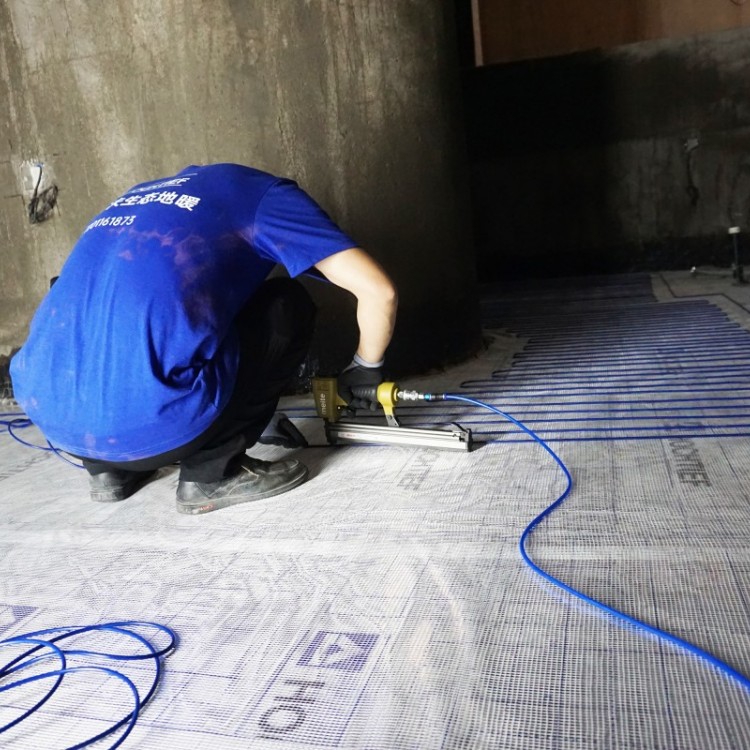
Prior to installing the carbon fiber electric underfloor heating system, the electrical resistance and rated resistance of the underfloor heating products should be tested for insulation. To prevent accidental damage to the insulation layer of the electric underfloor heating products during construction, a retest should be conducted before installing the carbon fiber underfloor heating products to ensure proper operation after concealment. The concealed sections should be documented with an on-site concealed work drawing to facilitate user understanding of the carbon fiber underfloor heating product layout, and to avoid damaging the structural layers of the system during house repairs.
The electric floor heating market has entered a mature development phase, with heating companies growing increasingly sophisticated and robust. The market is gradually shaping into a situation of perfection and scale. The rise of this heating method has added comfort, warmth, environmental friendliness, and fashion to residential homes, gaining social recognition.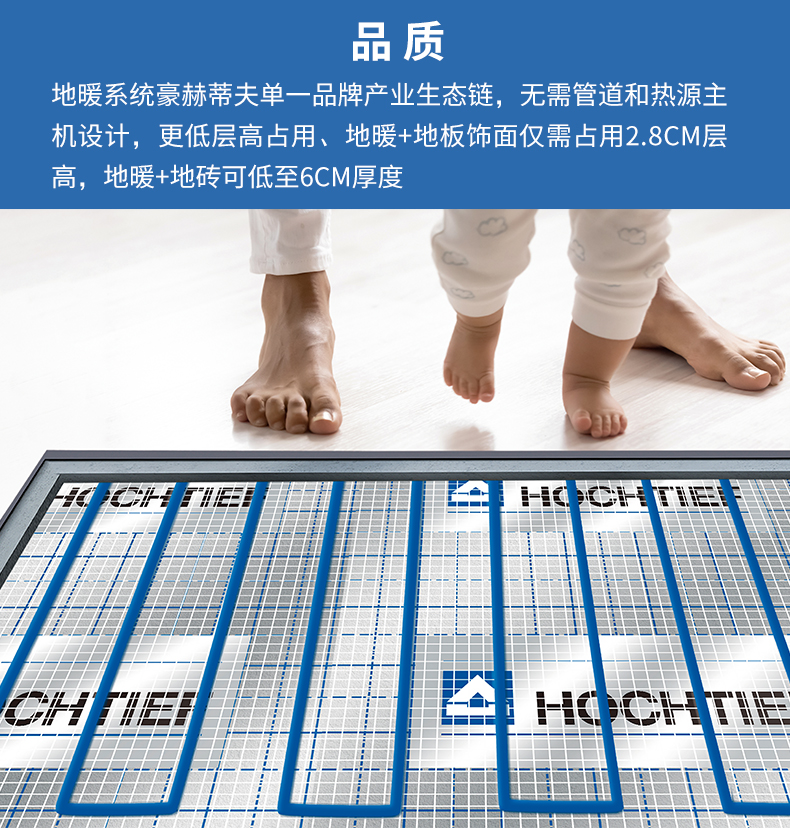
Installation Standards for Electric Underfloor Heating
The installation process for electric underfloor heating is similar to that of low-temperature water underfloor heating. Once the ground part of the electric underfloor heating is installed, just install a thermostat on the indoor wall. For the ground part of the low-temperature water underfloor heating, a boiler and a circulator are also required.
Electric underfloor heating is also safe to use. It has been tested under 4000 volts of high voltage, while domestic voltage is only around 220 volts. The heating element has double-layer protection, and it also features electromagnetic wave shielding grounding protection. In case of any leakage, the main power supply in your home will be immediately disconnected. The product's lifespan exceeds 50 years. Electric underfloor heating has large-scale engineering cases in major buildings across China and around the world.
The decorative layer above the electric underfloor heating can be chosen from: tiles, marble, engineered wood flooring, and solid wood flooring (self-regulating heating cables can be used for solid wood flooring).
Less is More
Comfort to life
Underfloor heating, never so simple
Haughton, let the temperature adapt to you
As a pioneer manufacturer and supplier of standalone electric ground heating systems, Haohetif emphasizes environmental protection, craftsmanship quality, user-friendly design, and a simple, comfortable lifestyle.
Haugheitif adheres to the company's values of technology, safety, responsibility, and sustainability, seeking to offer innovative electric heating system solutions and services that purely enhance living quality, creating a simple, beautiful, and worry-free comfortable living space for consumers.
In the past century, HOCHTIEF has established the gold standard for comfortable heating systems in residential and commercial spaces, adapting temperature to you—not the other way around.




















